🔥 World Briefing Hot Take
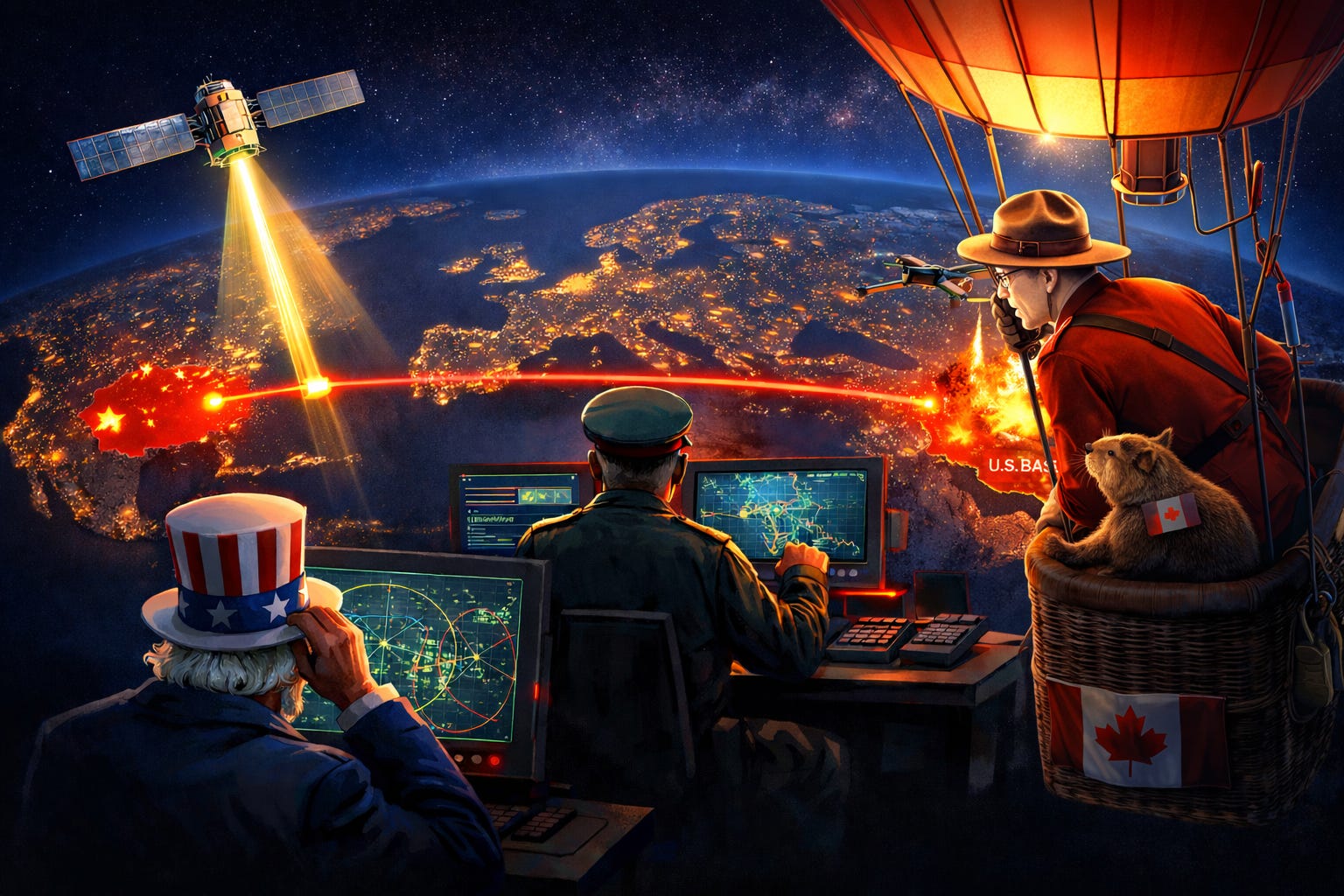
This is no longer a loose alignment of convenience - it’s starting to look and operate like a coordinated war-fighting ecosystem.
What makes this moment so dangerous is not just that Iran is striking U.S. and allied targets - it’s how it’s doing so. Chinese satellite capability providing the eyes. Reported Russian intelligence supplying the coordinates. Iranian drones and missiles delivering the punch. Different flags, same battlefield effect.
For years, Washington and its allies treated these relationships as parallel challenges. But the lines are now blurring in real time. If U.S. intelligence is correct, Moscow is not just backing Tehran politically - it may be actively helping it target American ships and installations. And Beijing, whether directly complicit or not, is enabling a leap in Iran’s surveillance and strike capability that would have been unthinkable just a few years ago.
And yet - here’s where it gets even more uncomfortable.
According to reporting cited by The New York Times, U.S. intelligence believes China may be edging closer to supplying weapons and military support to Iran, even as Washington appears reluctant to escalate directly with Beijing. Donald Trump has publicly emphasized his “good relationship” with Xi Jinping and is pressing ahead with a high-stakes summit in China next month - signaling a clear preference for a diplomatic and political win over confrontation, despite mounting concerns about Beijing’s role.
In other words, at the very moment a shadow alliance may be sharpening its battlefield coordination, the West’s response risks being constrained by optics, timing - and the pursuit of headline diplomacy.
Now layer in Tehran’s threat to effectively shut down vast swathes of the Persian Gulf, the Sea of Oman and the Red Sea - arteries that power a significant share of the global economy - and you begin to see the contours of something much bigger: not just a regional war, but a coordinated pressure campaign on the global system itself.
And here’s the kicker: this “axis” doesn’t need a formal treaty or a NATO-style Article 5 to be effective. It’s already functioning through deniability, plausible distance, and asymmetric cooperation - just enough coordination to shift the balance, not enough to trigger a unified Western response.
The result? The rules-based international order isn’t just under strain - it’s being outmaneuvered by a network that has figured out how to fight below the threshold of accountability.
And if this is the model going forward, the question isn’t whether the West can respond - it’s whether it even knows who, exactly, it’s responding to anymore.
News Briefs:
Iran secretly acquired a Chinese spy satellite that gave the Islamic republic a powerful new capability to target US military bases across the Middle East during the ongoing war, the Financial Times reported. Leaked Iranian military documents show the satellite, known as TEE-01B, was acquired by the Islamic Revolutionary Guard Corps’ Aerospace Force in late 2024 after it was launched into space from China. Time-stamped coordinates lists, satellite imagery and orbital analysis show that Iranian military commanders later tasks the satellite to monitor key US military sites. The images were taken in March before and after drone and missile strikes on those locations. Evidence that Russia has also provided the Iranian military with specific satellite intelligence to help the IRGC target American ships, along with military and diplomatic installations throughout the Middle East, has also reportedly been obtained by US intelligence agencies. Earlier reports from CNN and The New York Times that say US intelligence agencies have information about possible shipments from China of shoulder-fired missiles to Iran. The New York Times, citing US officials, said the shipment has already been sent, while CNN’s reporting said China was preparing to send a shipment in the coming weeks - FT/RFE/RL
Ali Abdollahi - the commander for Iran’s Khatam al-Anbiya Central Headquarters, the country’s highest operational command co-ordinating the armed forces - says that if the US continues its blockade and creates “insecurity for Iran’s commercial vessels and oil tankers”, it will “constitute a prelude to a violation of the ceasefire”. Abdollahi adds that Iran’s armed forces would consequently not allow “any exports or imports to continue in the Persian Gulf, the Sea of Oman, and the Red Sea”. He did not specify which countries’ exports and imports could be affected, although the bodies of water he mentions cover a vast area - BBC
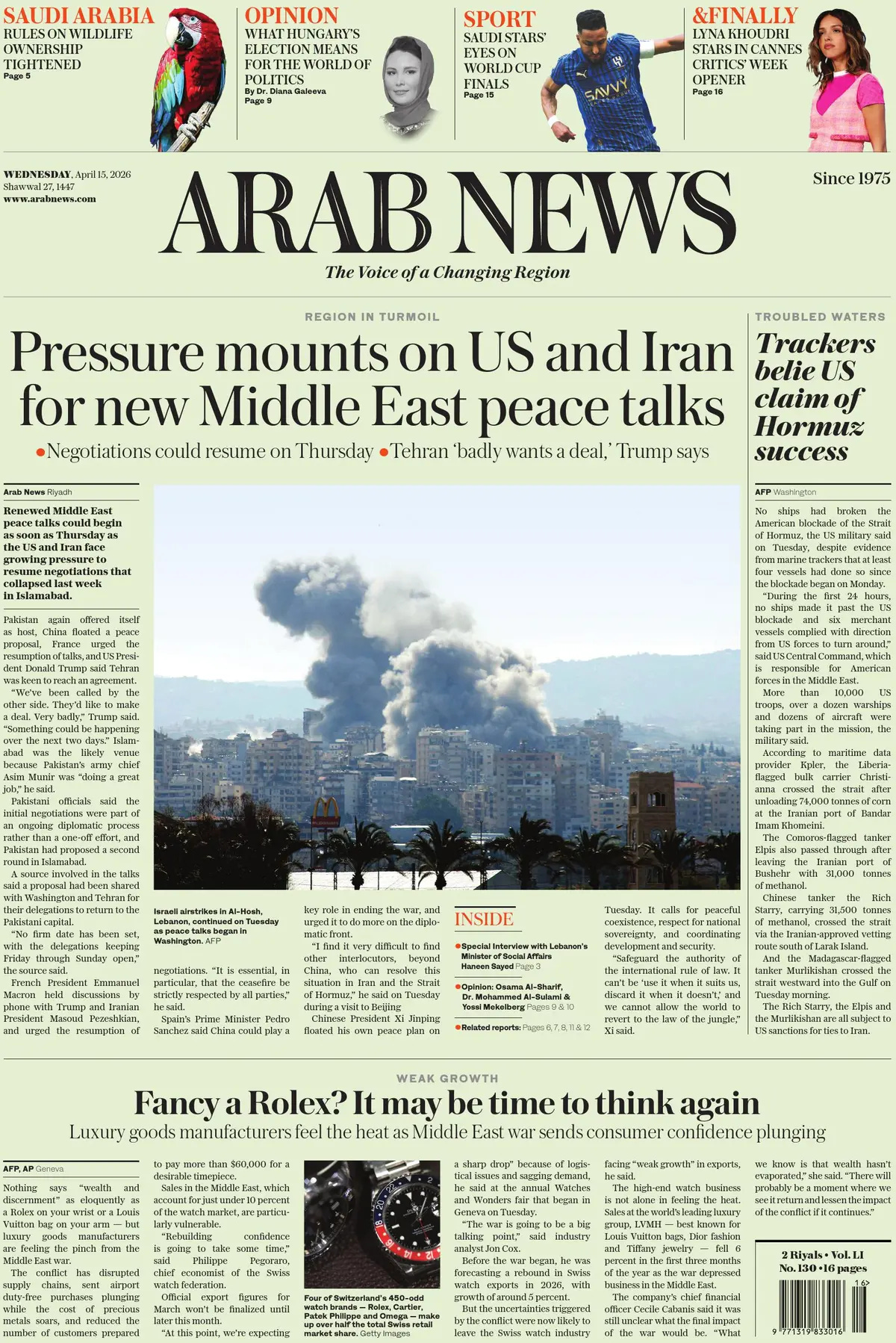
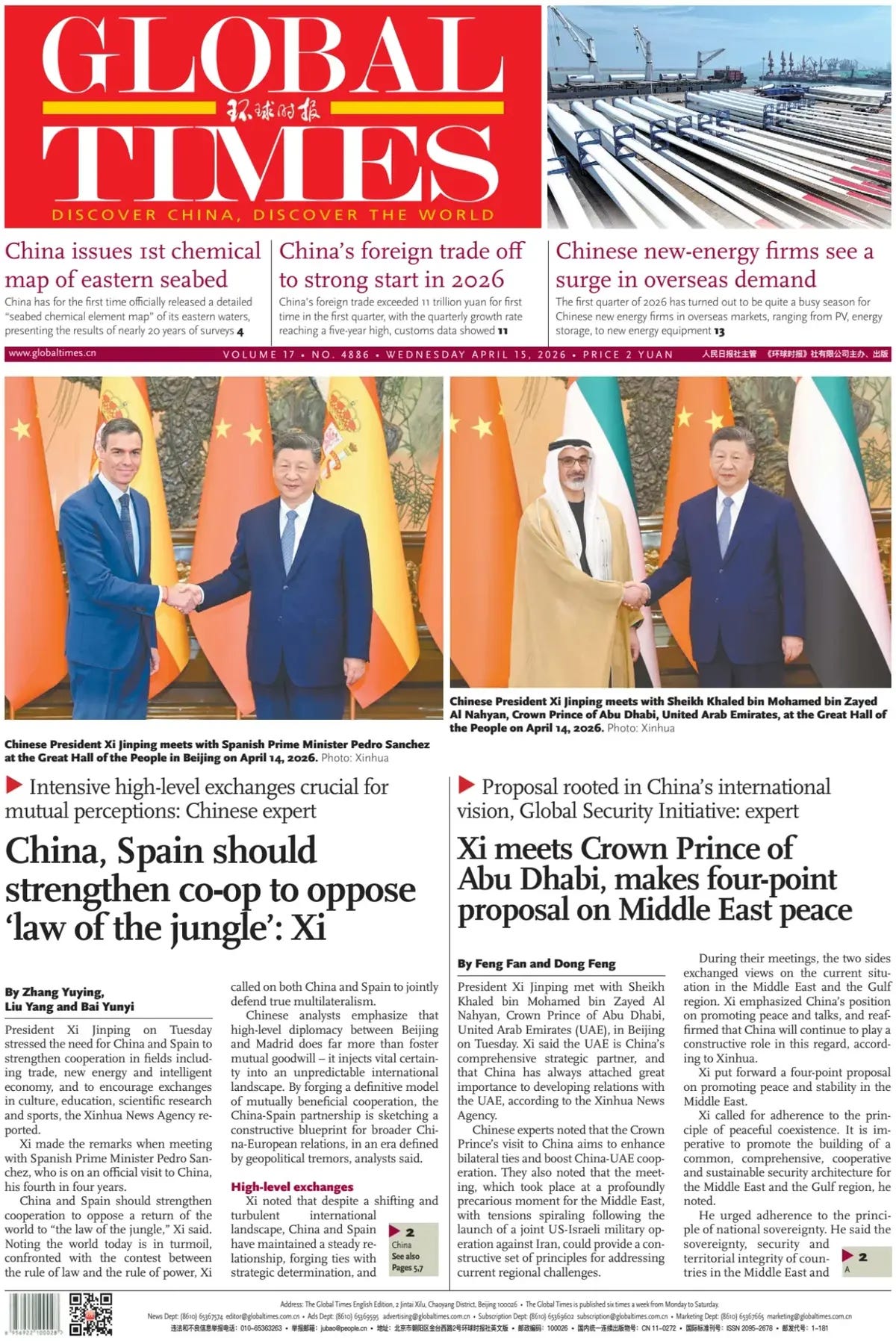
Russian Foreign Minister Sergei Lavrov arrived in Beijing as China steps up diplomatic efforts around the war in Iran amid a US blockade on vessels calling at Iranian ports that the Chinese Foreign Ministry has called “dangerous and irresponsible.” Lavrov held talks with Chinese Foreign Minister Wang Yi on April 15, which covered the wars in Iran and Ukraine, as well as Beijing and Moscow’s deepening ties, according to Russia’s Foreign Ministry. Chinese leader Xi Jinping also met with Lavrov in the Great Hall of the People in Beijing, where he urged Russia and China to “firmly defend their legitimate interests and safeguard the unity of Global South countries.” The Chinese readout of Xi’s remarks did not mention the war in Iran, but his comments appeared to reference growing fears that a long-term blockade of the Strait of Hormuz -- a strategic chokepoint for the world's fertilizer and energy supplies -- could trigger a economic and food crisis that hits countries in the Global South particularly hard. Xi has hosted the leaders of Spain, Vietnam and Abu Dhabi in recent days, but the arrival of the top Russian diplomat was the main focus this week, as Russia is a top energy supplier for China - RFE/RL / Moscow Times
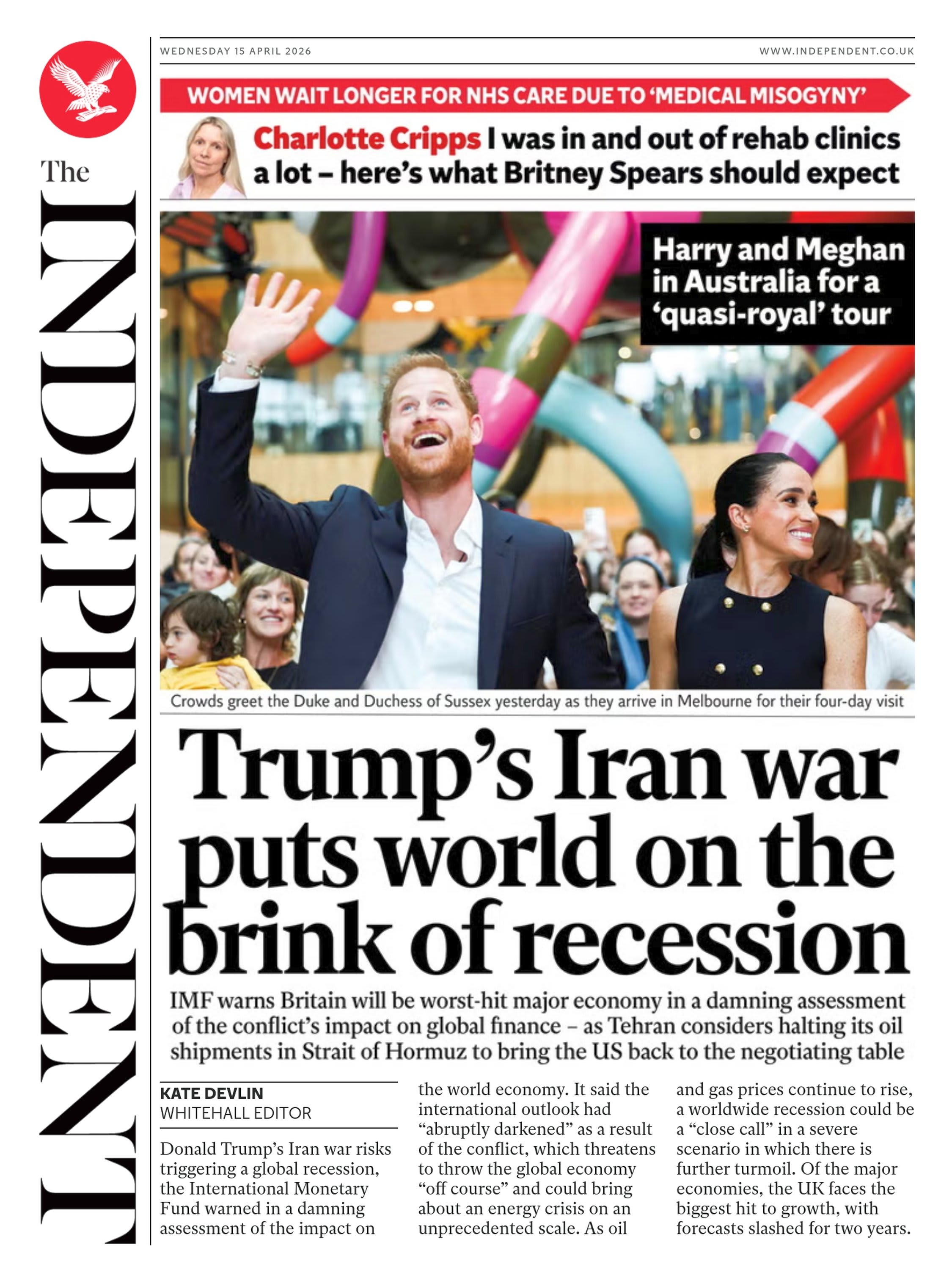
Israel and Lebanon held their first direct diplomatic talks since 1993, though the meeting didn’t result in a major breakthrough to end a brutal war between Israel and Hezbollah. The Iran-backed group wasn’t represented at the Washington meeting and said it wouldn’t abide by any deal the two sides reached, complicating the path to peace even as the countries agreed to further negotiations. US President Donald Trump, meanwhile, said Washington and Tehran could hold additional talks in the coming days after marathon weekend negotiations stalled. The US hopes to pressure Iran to make concessions with its blockade that came into effect Monday: More than a dozen American warships have confronted six vessels departing an Iranian port, forcing them to turn back - Semafor
World Briefing | News Brief
A sweeping investigation by Bellingcat is raising serious questions about the credibility of official narratives emerging from the United Arab Emirates, particularly as the country comes under sustained Iranian drone attacks.
Drawing on verified open-source evidence - including satellite imagery, geolocated videos, and expert analysis - the report finds that Emirati authorities have, in multiple high-profile cases, downplayed damage, characterized interceptions, or failed to acknowledge direct strikes altogether. The findings come at a sensitive moment for a a country that has carefully cultivated its image as one of the world’s safest hubs for business, aviation and tourism.
The discrepancies are stark. At the strategic oil hub of Fujairah, authorities attributed a major fire to debris from a “successful interception.” Yet video evidence appears to show a drone striking intact, while satellite imagery later confirmed the destruction of multiple storage tanks. Similar contradictions emerged at Dubai’s Jebel Ali Port - one of the busiest in the Middle East - where fires at separate locations were officially linked to debris, despite independent reporting pointing to direct Iranian strikes.
In Dubai itself, damage to the iconic Burj Al Arab was described by officials as “limited” and caused by shrapnel. But footage reviewed by investigators shows flames engulfing multiple floors - suggesting a far more serious impact. Other incidents, including a strike on the Fairmont Palm hotel and a drone hit on a residential tower, were either downplayed or omitted entirely from official accounts. A strike near Dubai International Airport was never publicly acknowledged, despite verified footage showing an explosion close to a terminal.
At the same time, authorities have moved aggressively to control the narrative. The UAE’s attorney general has ordered arrests and fast-track trials for dozens accused of sharing “misleading” footage online, while police have detained more than 100 individuals suspected of filming or posting strike-related content. Strict cybercrime laws - including prison sentences and heavy fines - have created a chilling effect, with fewer videos emerging as awareness of enforcement grows.
Overlaying this is a parallel information campaign. A number of near-identical videos posted by influencers - including Anastasiya Makshayeva, a UAE transplant from Kazakhstan with almost 400,000 followers on TikTok and 2.3 million on Instagram - promoting the UAE’s safety and leadership appeared, often using the format: “You live in Dubai, aren’t you scared?” followed by images of UAE leaders and the response: “No, because I know who protects us.”
Investigators and media analysts, including reporting cited by the BBC, identified these coordinated pro-government messaging by influencers - some posting near-identical videos within seconds - reinforcing narratives of safety and control. Critics argue that licensed influencers in the UAE increasingly function as extensions of state messaging.
The broader implication is unsettling: a widening gap between observable reality and official communication at a time of active conflict. With at least a dozen people reported killed and nearly 200 injured since the strikes began, analysts warn that restrictions on reporting - under the banner of national security - risk undermining public trust and limiting access to critical information.
For a country built on perceptions of stability, the findings raise a deeper question: if the facts on the ground are contested, what - and whom - can audiences rely on?

Serbia is emerging as ground zero in a sprawling and dangerous trucking scheme uncovered by CBS 60 Minutes - one that could be putting millions of motorists at risk on US roads. At the center of the investigation is Super Ego Holding, a Serbia- and U.S.-linked network of trucking and leasing companies now under federal scrutiny, accused of operating so-called “chameleon carriers”: fleets that repeatedly shut down and relaunch under new identities to wipe away safety violations. These shadow networks exploit gaps in U.S. regulation, allowing operators - often based overseas - to set up a trucking company online in a matter of weeks, sometimes for as little as $1,000. By simply changing names and Department of Transportation identifiers, companies can erase records of crashes, violations, and unsafe practices, re-entering the system as “clean” carriers. Industry estimates suggest that as many as 10–20% of the roughly 700,000 U.S. trucking companies may be operating in this grey zone. The consequences are severe. Chameleon carriers are linked to thousands of safety violations - from excessive driving hours to poor maintenance and substance abuse - and are reportedly four times more likely to be involved in crashes. In one case tied to the Super Ego network, a speeding truck slammed into a school bus, critically injuring two children. Overall, more than 5,300 people died in U.S. truck-related accidents in 2024, underscoring the scale of the risk. Despite mounting evidence, enforcement remains thin. The Federal Motor Carrier Safety Administration has just 350 investigators overseeing the entire industry, though officials say reforms and new systems are in the works. Meanwhile, whistleblowers and drivers describe a profit-driven model that prioritizes revenue over safety—raising urgent questions about oversight, accountability, and how a Serbia-linked operation became a key node in a globalized loophole with deadly consequences on American roads.
A public backlash over tightening internet restrictions in Russia, particularly against the popular Telegram service, is forcing a Kremlin rethink amid worries the crackdown is hurting President Vladimir Putin’s support. The push by Russia’s FSB security service for tougher controls has prompted some top officials to warn of political and economic risks from barring access to the internet, according to people familiar with the discussions. That’s likely to slow the crackdown, allowing Telegram to continue functioning in Russia, the people said, asking not to be identified discussing internal issues. “It’s clear that internet restrictions are causing inconvenience for many citizens, but that’s how it is now,” Kremlin spokesman Dmitry Peskov told reporters on Tuesday, insisting the measures were necessary on security grounds and were supported by most Russians. “Once the need for these measures disappears, service will be fully restored and normalized.” Russian authorities have waged a relentless campaign against social media platforms including YouTube, Facebook, WhatsApp and Instagram as part of efforts to suppress dissent since Putin ordered the 2022 full-scale invasion of Ukraine. More recently, they have pushed Russians to adopt a state-run “super-app” called Max, modeled after China’s WeChat, including by severely limiting access to Telegram. Widespread mobile internet outages for weeks in Moscow, a city of more than 13 million people, also prompted an outcry in March as the authorities appeared to test further controls on the nation’s online infrastructure. The Kremlin justified the disruption as a security measure. There’s also been a push to restrict Russians’ usage of virtual private networks, or VPNs, that help them to evade bans on blocked content. It’s unclear how far officials ultimately intend to go to limit online access in Russia. But discontent over the daily inconveniences for people who’ve grown reliant on digital services may be feeding into Putin’s declining public rating as Russians grow tired of disruption linked to the war. Trust in Putin has fallen by more than eight percentage points since January to 67.8%, according to the state-run pollster VTsIOM. By early March, it had reached its lowest level since the war began. That’s a problem for the Kremlin as it seeks to manage the public mood ahead of parliamentary elections in Russia scheduled for September. And it undermines official narratives that the public remains united behind Putin in the conflict with Ukraine that’s now in its fifth year. “The blocking is most noticeable among the relatively active, affluent populations of large cities, who were already dissatisfied with the government,” said Denis Volkov, head of another Moscow-based pollster, Levada, whose own polling hasn’t shown a sharp decline in Putin’s rating so far. “It has a lesser impact on the mood of Putin’s loyal electorate that watches television.” - Bloomberg
Approximately 250 Rohingya refugees and Bangladeshi nationals are missing after a boat capsized in the Andaman Sea, the United Nations refugee agency and the International Organization for Migration (IOM) said. Loaded with men, women and children, the trawler reportedly sank due to strong winds, “rough seas and overcrowding”, the UN High Commissioner for Refugees (UNHCR) and the IOM said in a joint statement issued on Tuesday. The trawler had departed Teknaf in southern Bangladesh and was attempting to reach Malaysia, according to reports. “This tragedy highlights the devastating human cost of protracted displacement and the continued absence of durable solutions for the Rohingya,” the UNHCR and the IOM said in their statement. Long persecuted in Myanmar, more than 730,000 Rohingya were forced to flee their homes in 2017 amid a campaign of ethnic cleansing by Myanmar’s military, and sought safety in refugee camps in neighbouring Bangladesh. Thousands of Rohingya risk their lives every year to flee both repression and civil war in Myanmar and the overcrowded camps in Bangladesh, often going to sea on makeshift boats to reach neighbouring countries and the possibility of a better life.
The Philippines says it has discovered cyanide on Chinese boats near a disputed South China Sea atoll, warning the substance could be used for “sabotage” against local fish populations. Security officials from the Philippines said on Monday that laboratory tests confirmed the presence of the toxic substance in bottles seized by the Philippine navy last year at Second Thomas Shoal, a submerged reef in the Spratly Islands of the South China Sea. The officials warned that the cyanide could have had serious consequences for marine life and weakened the reef supporting a warship that Manila grounded on the atoll to reinforce its maritime claim. “We wish to underscore that the use of cyanide in Ayungin Shoal is a form of sabotage that seeks to kill local fish populations, depriving navy personnel of a vital food source,” Cornelio Valencia, National Security Council spokesperson, told a news conference, using the Philippines’ name for the atoll. Valencia added that cyanide could damage the reef and “ultimately compromise” the warship’s stability. The Foreign Ministry of China rejected the Philippines’ assertions, calling them a “stunt.” China claims nearly all the South China Sea, including areas claimed by Brunei, Malaysia, the Philippines and Vietnam. A 2016 ruling by an international arbitral tribunal found Beijing’s sweeping claims had no basis under international law, a decision China rejects. More than $3 trillion in annual ship-borne commerce travels through the key waterway - Al Jazeera
Kanye West just buckled under pressure from France, shelving his upcoming concert in the Europeon country over his past antisemitic remarks. Here’s the deal ... the rapper was supposed to perform in the southern port city of Marseille in June, but the French interior minister was “highly determined” to block Kanye’s concert because of his previous support of Nazis and Adolf Hitler, according to The Guardian. In January, Kanye apologized for making those hurtful remarks, taking out a full-page ad in the Wall Street Journal to address the issue. But Kanye is still feeling the negative effects of his ugly rhetoric, writing on X Tuesday night that he's postponing his Marseille gig after "much thought and consideration." - TMZ
The journals….