🔥 World Briefing Hot Take
When deterrence becomes a part-time job, rivals don’t wait - they build, expand and entrench. That’s exactly what’s happening now in the South China Sea.
News Briefs
China is accelerating land reclamation at Antelope Reef in the disputed South China Sea - and the timing is raising eyebrows across the Indo-Pacific. New satellite imagery, first reported by The Wall Street Journal, shows large-scale dredging operations underway since October 2025, expanding an existing outpost into what could soon rival Beijing’s largest artificial island bases, Asia Times reported. Located in the Paracel Islands - a critical maritime corridor carrying roughly one-third of global trade - Antelope Reef sits just 281 km from China’s key naval hub at Sanya on Hainan Island. According to the Asia Maritime Transparency Initiative (AMTI), reclaimed land at the reef has already reached approximately 6.1 square kilometers - nearly matching the size of major Chinese-built strongholds like Mischief Reef. The scale and layout suggest the site could support a runway of up to 2,700 meters, alongside expanded port and surveillance infrastructure. This is not just about territory - it’s about control of information and denial of access. Beijing’s strategy appears focused on strengthening anti-access/area denial (A2/AD) capabilities across a dispersed network of fortified outposts. These installations enhance surveillance, electronic warfare, and rapid-response capacity — complicating any potential US or allied operations in a Taiwan-linked contingency. And crucially, China may be acting while the window is open. As the US-Israel-Iran conflict draws significant American military assets into the Middle East, Washington’s posture in the Indo-Pacific is thinning. The redeployment of major carrier strike groups - including the USS Abraham Lincoln and USS George Washington - alongside Marine expeditionary units, risks leaving the USS Theodore Roosevelt as the only US carrier presence in the Pacific. The shift goes beyond naval power. According to The Guardian, the US is also redeploying elements of the Terminal High Altitude Area Defense (THAAD) system from South Korea to the Middle East - a move that could create new vulnerabilities in Northeast Asia. First deployed in Seongju in 2017 to counter North Korean missile threats, THAAD has long been both a cornerstone of regional defense and a flashpoint with Beijing. Together, these moves are creating what analysts increasingly describe as a “carrier gap” - limiting Washington’s ability to manage simultaneous crises from the Taiwan Strait to the Korean Peninsula and the South China Sea. At the same time, surveillance coverage appears to be slipping. Chinese data cited by regional analysts suggests US reconnaissance flights over the South China Sea dropped by roughly 30% between late 2025 and February 2026 - a decline that coincides with Washington’s Middle East focus. Regional actors are taking note - and reacting. Vietnam, for instance, has dramatically expanded its own island-building efforts across the Spratly Islands, dredging more than 13 square kilometers of reef since 2022. Analysts warn this tit-for-tat expansion risks opening a “Pandora’s box” of competitive militarization across the region. The result? A rapidly hardening battle space. If current trends continue, Asia Times says, China’s expansion at Antelope Reef - enabled in part by reduced US presence - could cement a more militarized South China Sea, raise the cost of future US intervention, and further tilt the strategic balance in Beijing’s favor. In short: while Washington is consumed by crises in the Middle East, Beijing is quietly reshaping the map - and the rules - of the Indo-Pacific.
There’s a hidden vulnerability at the heart of the global tech economy: Taiwan’s dependence on naphtha, a little-known petrochemical feedstock essential for semiconductor production. The risk has long gone unnoticed because “the dependency is real but indirect,” but the sudden closure of the Strait of Hormuz has exposed just how fragile the system is. As Camba puts it, “without naphtha, there is no fab process.”
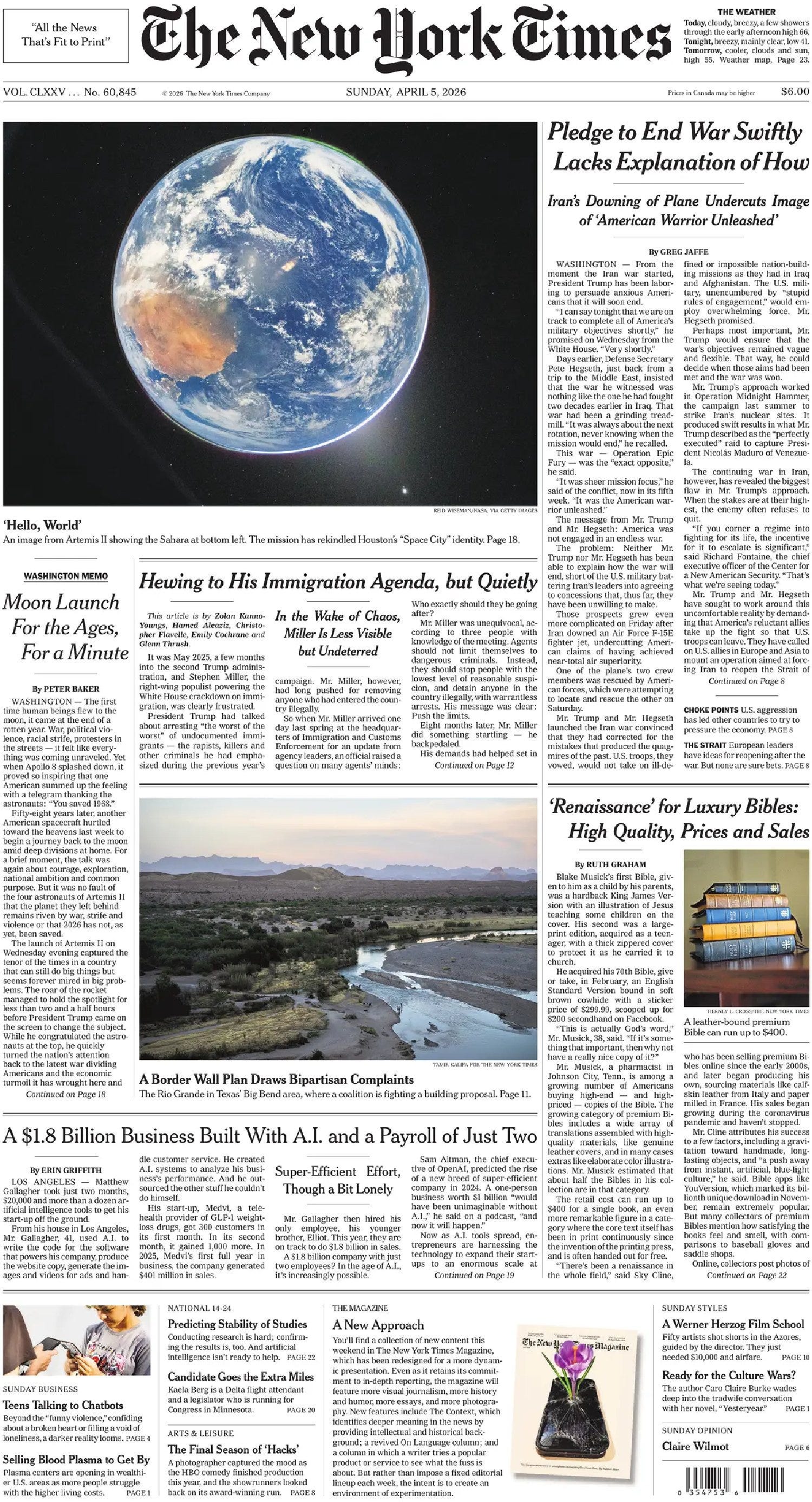
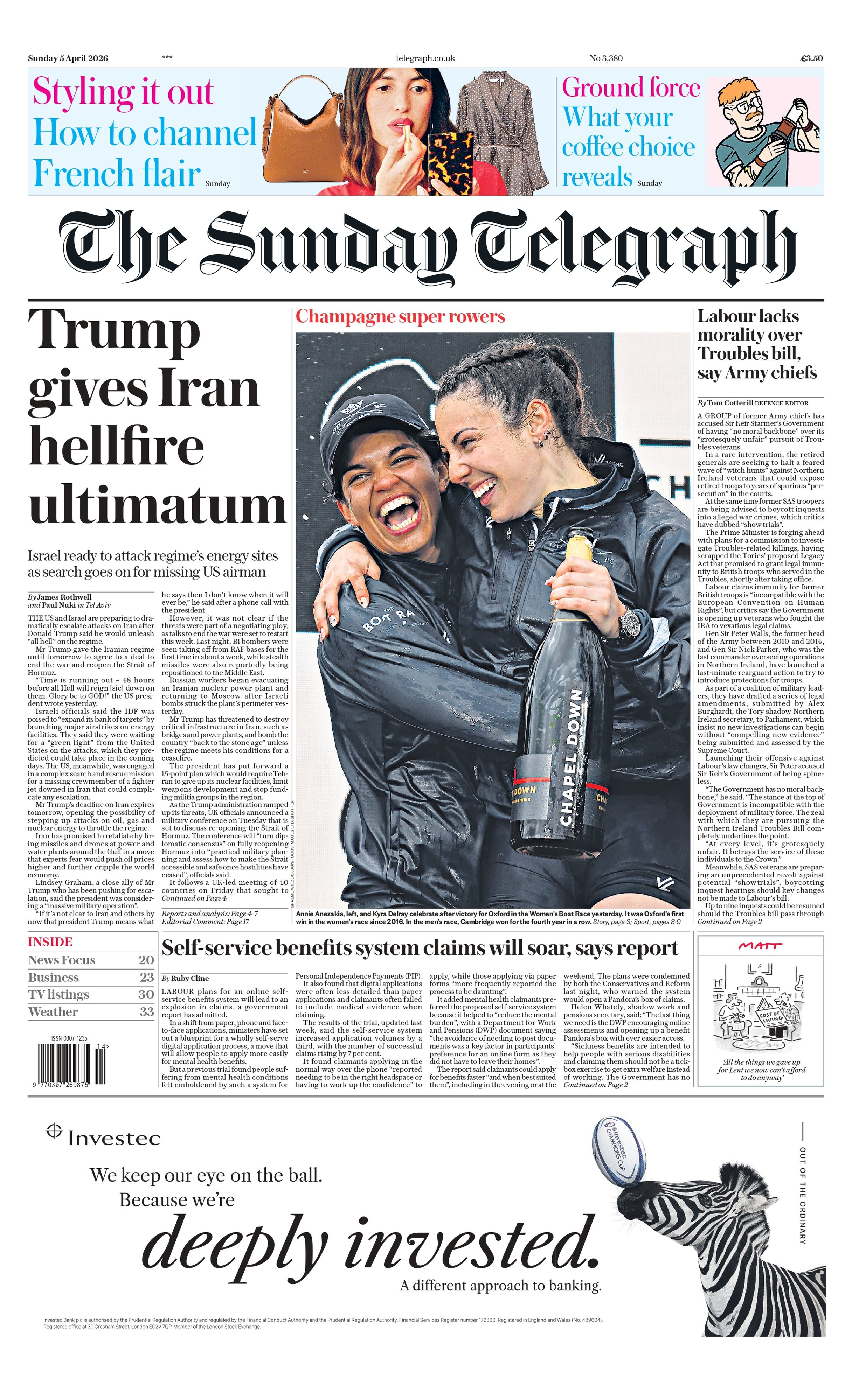
A U.S. Airforce officer whose plane was shot down in Iran was rescued by U.S. forces early Sunday after evading capture for more than a day in enemy territory, President Trump announced on social media. “The U.S. Military sent dozens of aircraft, armed with the most lethal weapons in the World, to retrieve him. He sustained injuries, but he will be just fine,” Trump said on Truth Social. The officer’s F-15 fighter jet was shot down on Friday over western Iran, and Trump said “one of the most daring Search and Rescue Operations in U.S. History” was undertaken to rescue him. Trump said the airman was a colonel and “was behind enemy lines in the treacherous mountains of Iran.” He was one of two crew members who ejected when their jet was hit. The pilot was rescued shortly after the shoot down, but the colonel, a weapons officer, could not immediately be reached. The U.S. military scrambled to launch a massive rescue operation. President Trump said in his Truth Social post that it involved dozens of aircraft. Three of those rescue aircraft, which were flying at low altitudes, were also hit by Iranian fire, according to a U.S. official who was not authorized to speak publicly. One was an A-10 Warthog. The pilot managed to keep flying until he reached nearby Kuwaiti airspace, where he ejected and was rescued. Two helicopters were hit by Iranian fire, but were able to make it safely back to their base, the U.S. official said. Since the war with Iran started six weeks ago, 13 U.S. service members have died in airstrikes and also an aircraft refueling crash in Iraq. An attack on a Saudi airbase left more than a dozen U.S. troops wounded, several of them serious - NPR
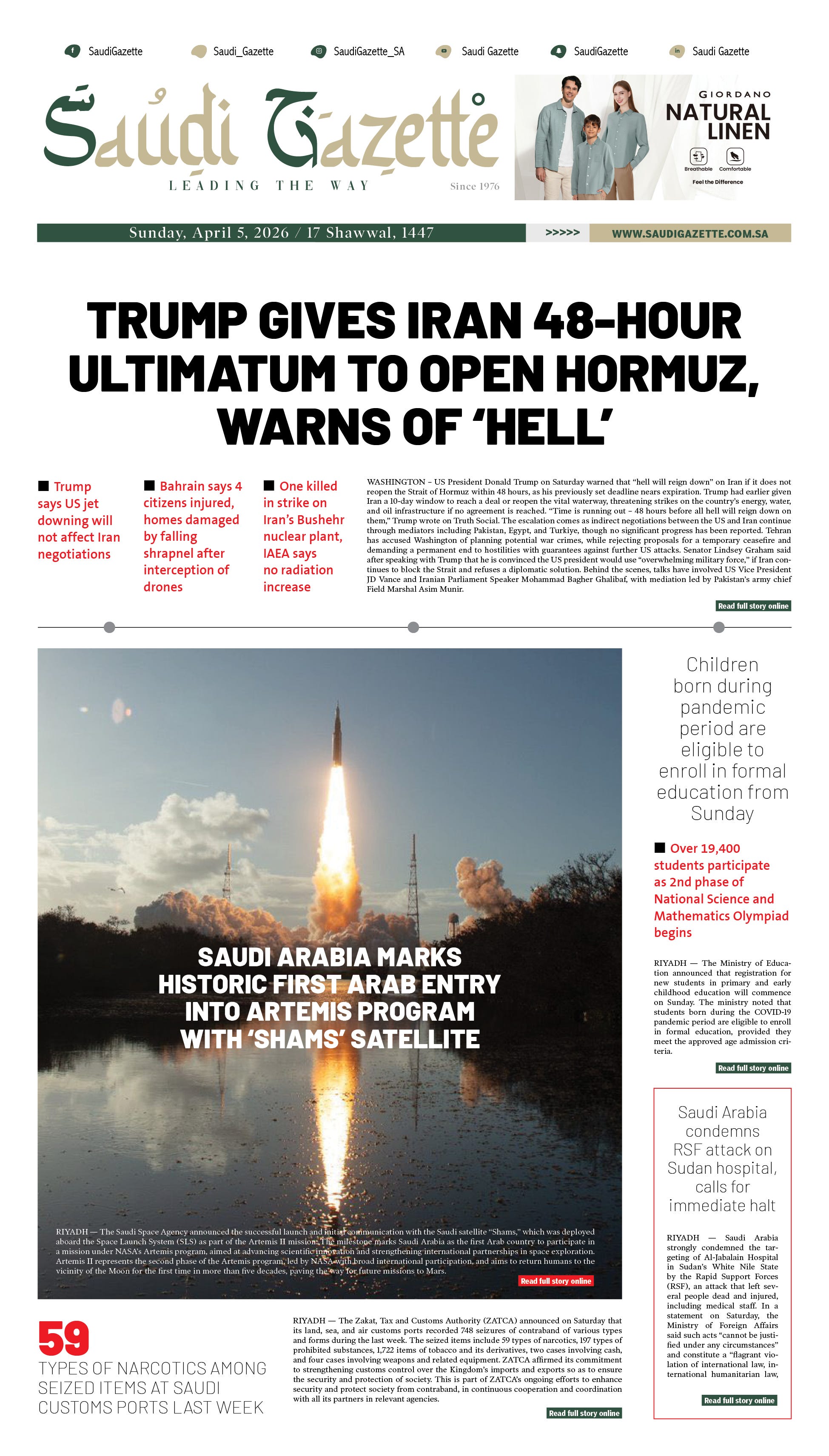
US President Donald Trump has published an expletive-laden post on his Truth Social platform, in which he threatens Iran to reopen the Strait of Hormuz.
He references targeting civilian infrastructure and tells Iran they will be “living in Hell” if the vital shipping lane is not opened. The post comes ahead of Trump’s self-imposed deadline to Tehran to reopen the strait by Monday, which has been effectively closed since war broke out at the end of February. Trump says: “Tuesday will be Power Plant Day, and Bridge Day, all wrapped up in one, in Iran. There will be nothing like it!!! Open the Fuckin’ Strait, you crazy bastards, or you’ll be living in Hell - JUST WATCH! Praise be to Allah. President DONALD J. TRUMP” - BBC
Fuel leaked at Russia’s Baltic Sea port of Primorsk, while NORSI oil refinery caught fire following a drone attack, Russian authorities said on Sunday. Ukraine has stepped up its attacks on Russian energy infrastructure in the past month in an effort to inflict damage on Russia’s key source of revenue and undercut its military might. The governor of north-western Leningrad region Alexander Drozdenko initially said a pipeline was damaged at Primorsk, one of Russia’s main oil exporting outlets. He later said in a post on the Telegram messaging app that the pipeline was not damaged but a fuel reservoir in the port area leaked when it was hit by shrapnel. Primorsk, one of the country’s largest export gateways, which can handle 1 million barrels per day, lost at least 40 percent of its storage facilities in Ukrainian drone attacks last month, US commercial satellite images seen by Reuters showed on Thursday. At some point last month, around 40 percent of Russia’s oil exporting capabilities were shut due to the attacks, the closure of the Druzhba pipeline in Ukraine and the seizure of Russia-linked tankers - Al Arabiya
The flow of volunteer humanitarian aid from the United States to Ukraine -- a critical lifeline for frontline communities -- is coming under mounting strain, as disruptions linked to the Iran conflict ripple through global shipping networks. US-based charities and volunteer groups tell RFE/RL that deliveries of essential supplies are now delayed by weeks, while transportation costs are rising sharply -- forcing difficult choices between funding freight and purchasing life-saving equipment. For some organizations, the system is approaching a breaking point. The ongoing Iran conflict has severely disrupted international shipping, especially through the Strait of Hormuz, a key waterway used to transport about 20 percent of the world’s oil and gas. Security risks in the Red Sea have forced ships to take longer routes, causing major delays and higher freight costs. Hope For Ukraine, a New Jersey-based nonprofit delivering medical and humanitarian supplies to civilians and frontline areas, says its shipments are now taking significantly longer to reach Ukraine. Containers carrying medical supplies and energy-resilience equipment are delayed by an additional three weeks, extending transit times by nearly a month. “These kits are essential,” the group’s CEO, Yuriy Boyechko, told RFE/RL on April 2. “They keep clinics and shelters powered. When they are delayed like this, it creates a real, life-threatening gap.” The organization typically ships one to two containers per month from the United States, each carrying up to 20 tons of aid. Unlike government assistance, these deliveries rely on private donations and volunteer networks. But those shipments are now facing growing uncertainty. “The routes have been completely redirected,” Boyechko said. “Ships have to take a much longer path. That means much longer delivery times for people who cannot afford to wait.” Among the most critical supplies are solar-powered generators -- now indispensable in a country where energy infrastructure has been repeatedly targeted. Hope For Ukraine distributes the generators to frontline communities and areas enduring prolonged blackouts, where access to reliable power remains limited. “We don’t ship food -- we buy that locally,” Boyechko said. “What we send are things people cannot access in Ukraine, especially energy equipment.”Each delay, he added, has direct humanitarian consequences. “Every extra week means people stay without power,” he said. “After the winter we had, with so much infrastructure destroyed, this becomes an energy crisis for those communities.” Without electricity, clinics struggle to function, medicines cannot be stored safely, and even basic care becomes harder to deliver. The delays are also affecting shipments of electric mobility scooters -- a key resource for Ukraine’s growing population of war amputees. According to Boyechko, Ukraine now has more than 120,000 amputees as a result of the war. “For them, every delay means more time without independence,” he said. “It’s more waiting for something that is essential to their daily lives.” At the same time, the cost of shipping aid is climbing. After more than two years of relatively stable rates, Hope For Ukraine was notified that prices would increase beginning April 1. “We are seeing a 10 to 25 percent increase,” Boyechko said. For nonprofits operating on limited budgets, the impact is immediate. “That means we have to redirect funds,” he said. “Money that would go toward generators or medical supplies now has to cover shipping.” - RFE/RL
The White House was forced to step in after the rumor mill went into overdrive on Saturday with wild speculation about the health of President Donald Trump. The administration went on the defensive after social media lit up with unfounded stories that the 79-year-old president was hospitalized at the Walter Reed Medical Center in Bethesda, Maryland. The rumors followed several days when Trump had, unusually, been out of the public eye. Deranged liberals cook up insane conspiracy theories when @POTUS goes 12 hours without speaking to press,” the White House’s rapid response account said. X. “(They said nothing when Biden routinely went 12 days without speaking to press) Fear not! President Trump literally never stops working.” The account reposted CBS reporting showing that a Marine sentry was spotted outside the West Wing on Saturday afternoon. The presence of sentries signals that the president is in the West Wing or the Oval Office, as they are tasked with rotating shifts to guard the entrance. Trump was last seen by the public on Wednesday night when he gave a rambling national address asserting the dominance of the U.S. amid the war with Iran—while distancing himself from the oil price spikes and backlash from allies that it has produced - TMZ
The journals…..