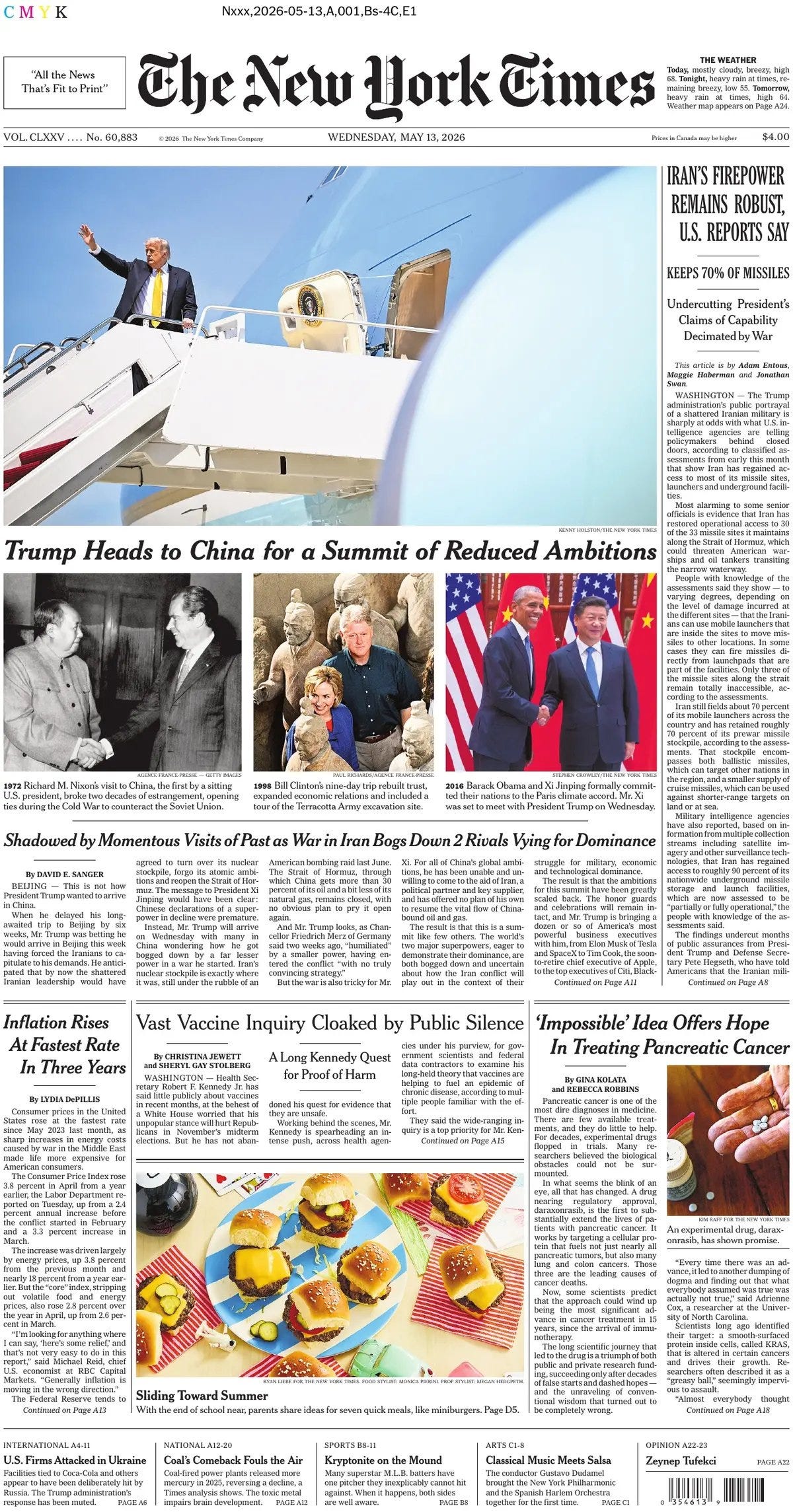
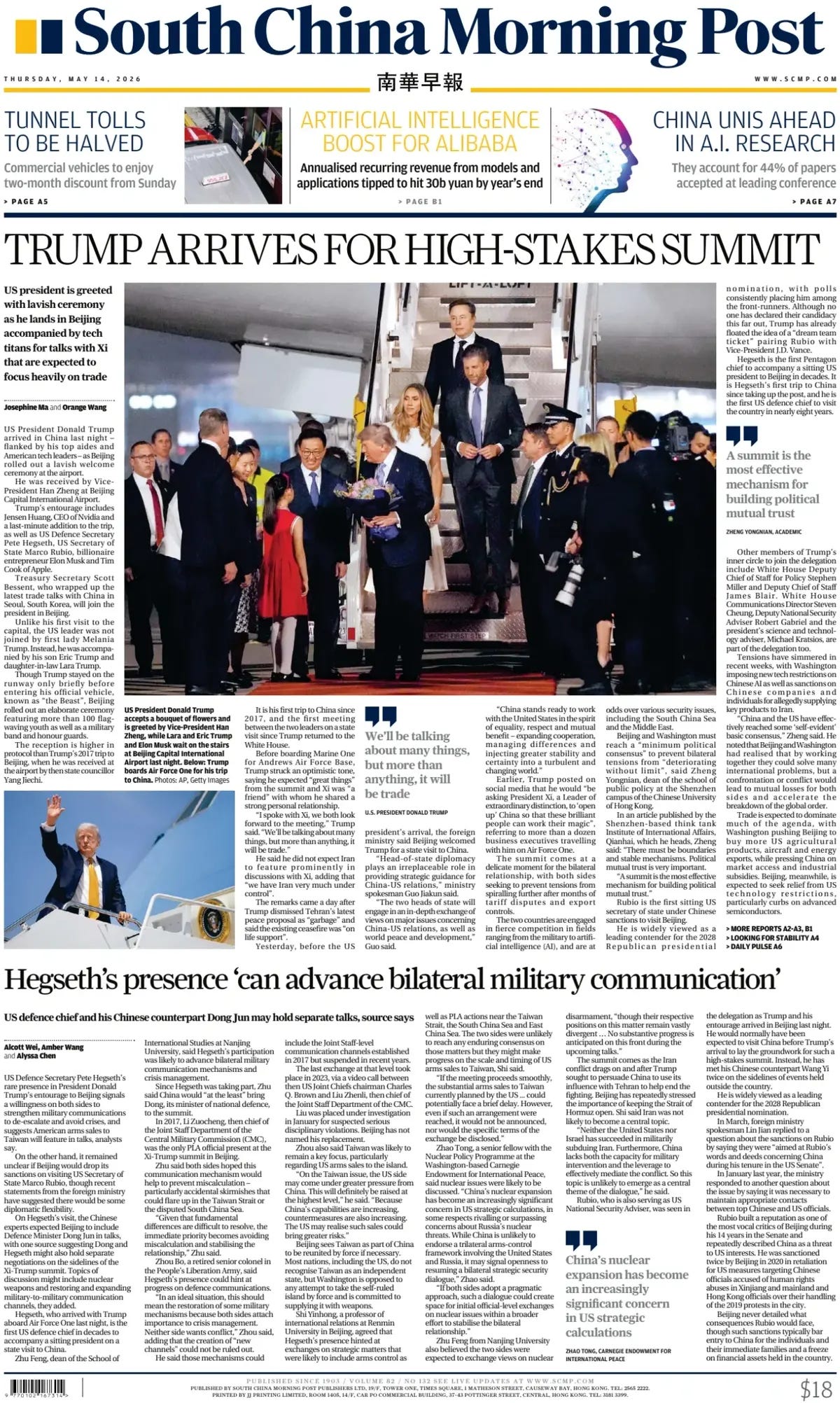
President Trump and China’s leader, Xi Jinping, are expected to discuss trade, Iran, Taiwan and other points of contention when they meet at a high-stakes summit meeting in Beijing on Thursday. The summit, the first U.S. presidential visit to China in nearly a decade, could determine whether a détente that has prevailed between the superpowers will continue — and what concessions, if any, either side is willing to make. The two leaders last met in October in South Korea, where they agreed to pause a bruising trade war in which Beijing had threatened to impose sweeping new restrictions on exports of rare earths in response to triple-digit U.S. tariffs on Chinese goods. Mr. Xi decided at the time to postpone those measures for a year. A question looming over the summit is whether China will agree to an extension. Mr. Trump has said that his trip to Beijing, which will include meetings with Mr. Xi at historic landmarks and conclude on Friday, will focus on trade and investment. The president is also expected to call on Beijing to help persuade Tehran, its closest partner in the Middle East, to end the deadlocked war in Iran that the United States and Israel started in late February. Mr. Trump has demanded that Tehran reopen the Strait of Hormuz, a crucial supply route for the world’s oil and natural gas, and on Tuesday again threatened to decimate Iran unless its leaders agree to limits on their nuclear program. Mr. Xi will have other priorities. Analysts say he may push for the loosening of U.S. export controls on advanced technology, and for pledges from Mr. Trump not to raise tariffs on Chinese goods, among other things. But his main priority is Taiwan, the issue that could most likely set off a war between the two superpowers. Mr. Xi may try to persuade Mr. Trump to break with longstanding U.S. policy by saying he opposes independence for Taiwan, a self-governing island that Beijing claims as its territory. A related Chinese priority is persuading the United States to significantly curtail its arms sales to Taiwan. Forcing major shifts in U.S. policies toward Taiwan would be a long shot. But then again, Mr. Xi has a powerful card to play: China’s economic leverage over Tehran, and the prospect that it could potentially help to reopen the strait and ease the widening economic fallout of the war - NYT
As Trump returns to Beijing, the mood around the visit appears more cautious than during his first trip in 2017. Trump’s first visit was marked by lavish “state visit-plus” treatment, including a private tea with Xi Jinping in the Forbidden City. At the time, both sides emphasised personal diplomacy, with optimism that leader-level ties could drive broader cooperation. This time, Trump is still expected to receive a formal welcome - including a state banquet and a cultural tour - but analysts said the pomp will fall short of the lavish reception seen in 2017. The shift reflects lessons learned over the past decade. Trump’s first term ultimately gave way to tariffs, tech restrictions and a deepening strategic rivalry, tempering earlier hopes that leader-level chemistry could reshape ties. As one analyst put it, the relationship is now “less romantic” - with fewer expectations that personal rapport alone can deliver breakthroughs. Beyond Iran, the talks are also expected to touch on long-standing flashpoints such as Taiwan and nuclear arms, although these issues are unlikely to dominate the agenda, said Philip Luck, an economist at the Center for Strategic and International Studies. “I think the best outcome here is they have a dialogue … There’s decisions around sort of purchases on both sides and sort of commitments to continue conversation, commitments on continuing dialogue,” Luck said. “I think that’s with no giant concessions on important issues on either side,” he said - CNA
As (Chinese President) Xi has noted, dialogue is better than confrontation. The two sides should think big and recognize the long-term benefit of cooperation. Meanwhile, the world today is confronted with many complex challenges. China and the United States can jointly shoulder their responsibilities as major countries - Xinhua
Global oil inventories are declining at an alarming rate, the International Energy Agency warned Wednesday, as the Strait of Hormuz shutdown continues to strain the energy sector. “Oil is in a race against time,” one analyst said. Even if the mounting pressure on oil stockpiles forces the reopening of the strait in June — as JPMorgan analysts recently predicted — the market will be “severely undersupplied” until October, the IEA warned. Import-dependent countries are turning to the US, which has become the world’s “supplier of last resort,” with exports hitting a record high, a Bloomberg energy columnist wrote. But it can only play that part for so long; the US’ crude oil and gas inventories are consistently falling - Semafor
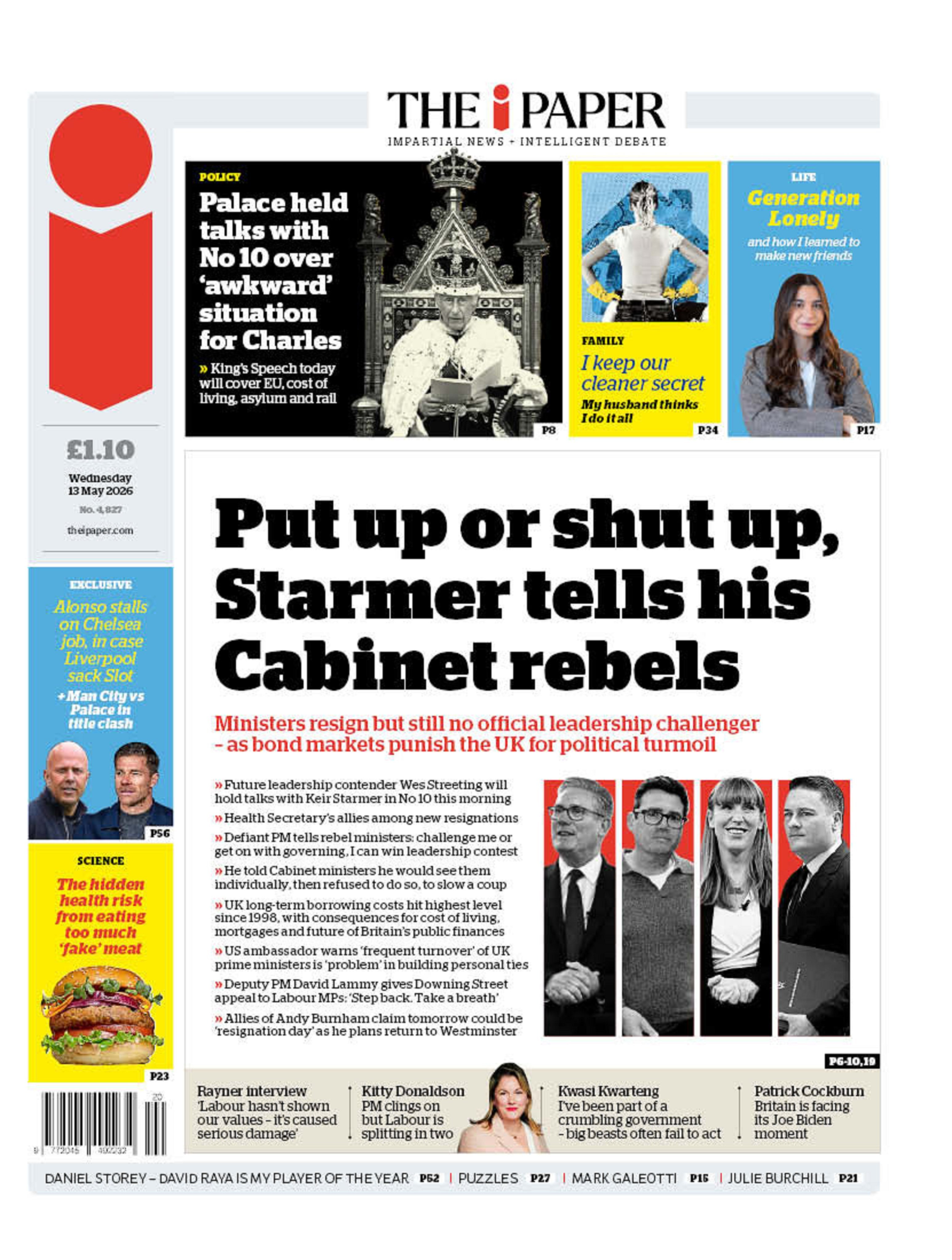
UK Prime Minister Keir Starmer moved quickly to shore up his position Wednesday, meeting with MPs and ministers in Parliament after allies of Health Secretary Wes Streeting signaled he could launch a leadership challenge as soon as Thursday. BBC reported that Starmer was blunt in the room, warning that a contest would “100% plunge Labour into chaos” - a sign of just how seriously Downing Street is taking the threat. Streeting would need backing from at least 81 Labour MPs to trigger a challenge, a high but not impossible bar. Defence minister Al Carns is also expected to put his name forward if a contest materializes, though he would enter as a heavy underdog. The drama unfolded on an otherwise ceremonial day in Westminster - King Charles had earlier delivered the government’s agenda at the State Opening of Parliament. But the pageantry was quickly overshadowed by the internal turbulence. As BBC political editor Chris Mason noted, the government had braced for a post-election reboot - not a battle for Starmer’s own survival.
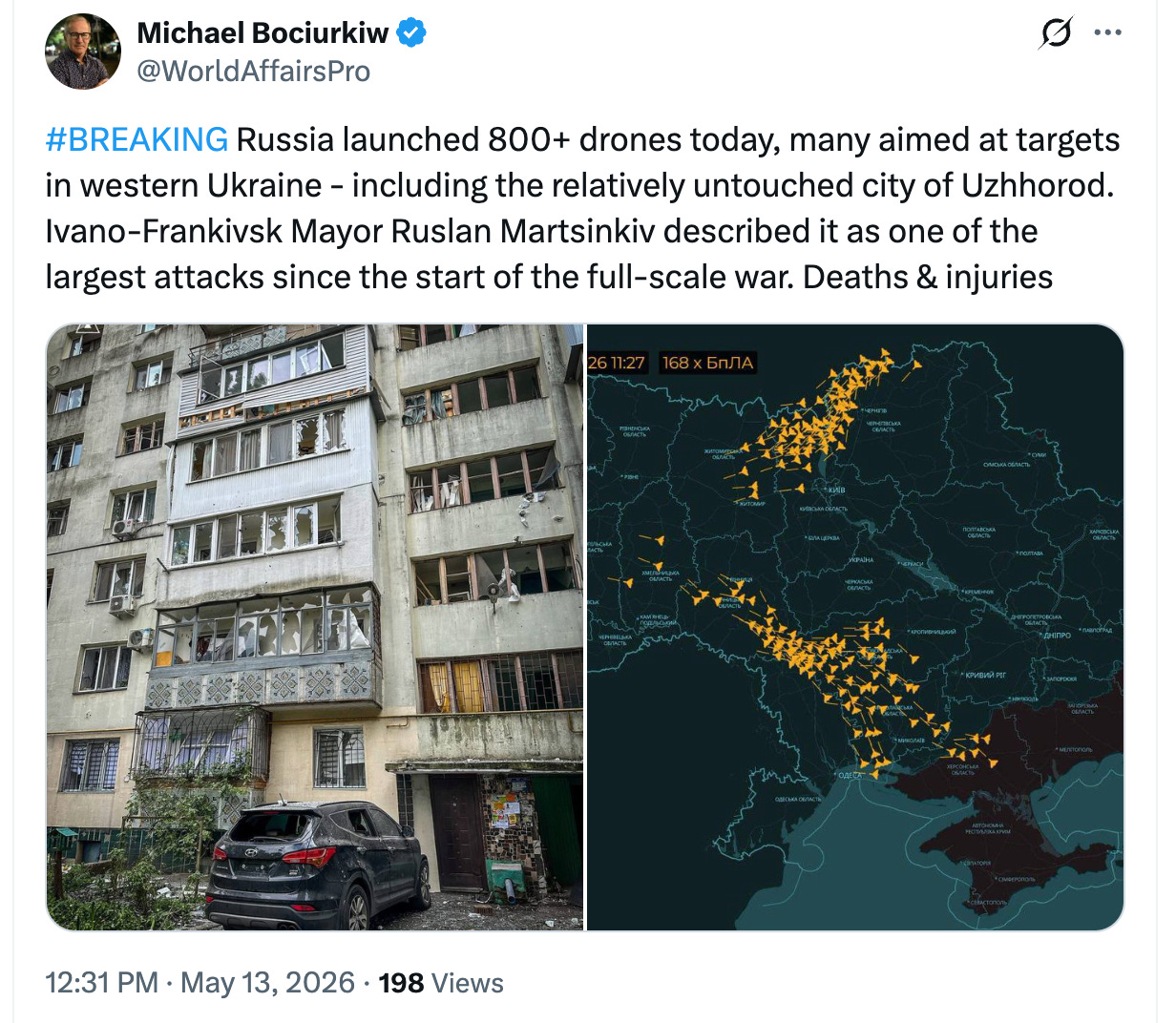
Missiles and drones rocked Kyiv overnight on May 14 as Russia launched a large-scale missile attack across Ukraine, extending a mass daytime assault into the late evening and early morning hours. In the early hours of Thursday local time, news outlets reported at least 14 dead and more than 80 injured nationwide. Shortly before 1 a.m., Ukraine’s Air Force issued a nationwide aerial alert, warning that Russia had launched MiG-31 bombers and that every region in the country was now at risk of ballistic missile strikes. Explosions were heard in Ukraine’s capital, a Kyiv Independent journalist on the ground reported at 3:08 a.m. local time, as many air defense systems worked to knock down Russian drones. Fallen drone debris sparked a fire on the roof of a five-story residential building in the Dniprovskyi district, and debris fell onto a road in the Holosiivskyi district, Kyiv Mayor Vitali Klitschko reported.
President Vladimir Putin replaced the governors of the Bryansk and Belgorod regions, two regions bordering Ukraine that have been regularly hit by Kyiv’s retaliatory attacks, the Kremlin said Wednesday. The two governors — Alexander Bogomaz and Vyacheslav Gladkov — led the regions throughout Moscow’s Ukraine war. The Russian leader replaced them with an army general who has fought in Ukraine and an official who previously worked for Russia’s occupational authorities in east Ukraine. Gladkov — who had led the Belgorod region, the worst hit by Ukrainian counterstrikes, since 2021 — had documented the attacks daily, with Russian media reporting on his popularity in the region. Putin appointed Alexander Shuvayev, a Russian army general who has fought in Ukraine since 2022, as interim head of Belgorod. He also appointed Yegor Kovalchuk — who briefly led Russian occupation authorities in Lugansk — as interim leader of Bryansk. Both Bryansk and Belgorod have been hit by cross-border attacks by Ukraine during Moscow’s offensive, even suffering incursions earlier in the four-year war - Moscow Times
CBS News anchor Tony Dokoupil will broadcast from Taipei this week after failing to obtain a visa to China in time, a stumble in the network’s efforts to play a leading role in this week’s dominant global story. American broadcasters are planning extensive coverage from the Chinese capital this week. Semafor first reported Sunday that NBC News’s Tom Llamas would be anchoring from Beijing, as will ABC News’s David Muir. CBS appears to have planned similar coverage, and was forced to change course at the last minute: On the CBS morning planning call Wednesday, they discussed plans for Dokoupil to broadcast from the Taiwanese capital, according to a person on the call. Two people who had been briefed on the issue said Dokoupil had not been able to get a Chinese visa, though it’s unclear whether the block came from a late application or another issue. The setback comes as CBS Evening News, already in third place, has continued to see its ratings slide. Wednesday evening’s broadcast was prematurely ended when a CBS cameraman on set in Taipei reportedly fainted.
British Airways has introduced strict new rules forbidding its cabin crew from taking selfies, making TikToks, or posting any photos while staying in hotels during layovers. Staff have been warned that violating this policy could result in termination. The airline is even asking crew members to delete past posts — including private ones — if they feature hotel interiors, exteriors, or even nearby parking lots. According to the airline, photos taken in or around hotels could unintentionally reveal the crew’s location to malicious actors through background details like pool tiles, signage, or recognizable views. As a result, British Airways has banned all types of content creation during layovers, including popular “get ready with me” videos, uniform selfies, and even shots taken from hotel windows. This builds on a 2023 rule that already prohibited crew from posting anything while “professionally engaged,” such as in-flight or cockpit selfies. Critics argue the policy may be extreme and potentially counterproductive. View From the Wing noted that hotel locations are often already known, since airline staff arrive in uniform and may share their whereabouts with others. With many flight attendants turning to social media content as a side hustle, the crackdown could alienate a growing wave of influencers who also serve as unofficial brand ambassadors for the airline.
The journals….