Analysis by Nichola Castillo, with on-the-ground reporting from World Briefing
The state of play
Armenia holds national elections on June 7, and the race has crystallised a years-long drift between Yerevan and Moscow into a sharp confrontation. Prime Minister Nikol Pashinyan’s Civil Contract party has progressively moved Armenia out of Russia’s orbit since Moscow failed to defend Armenia in Nagorno-Karabakh - and Russia is now openly alarmed.
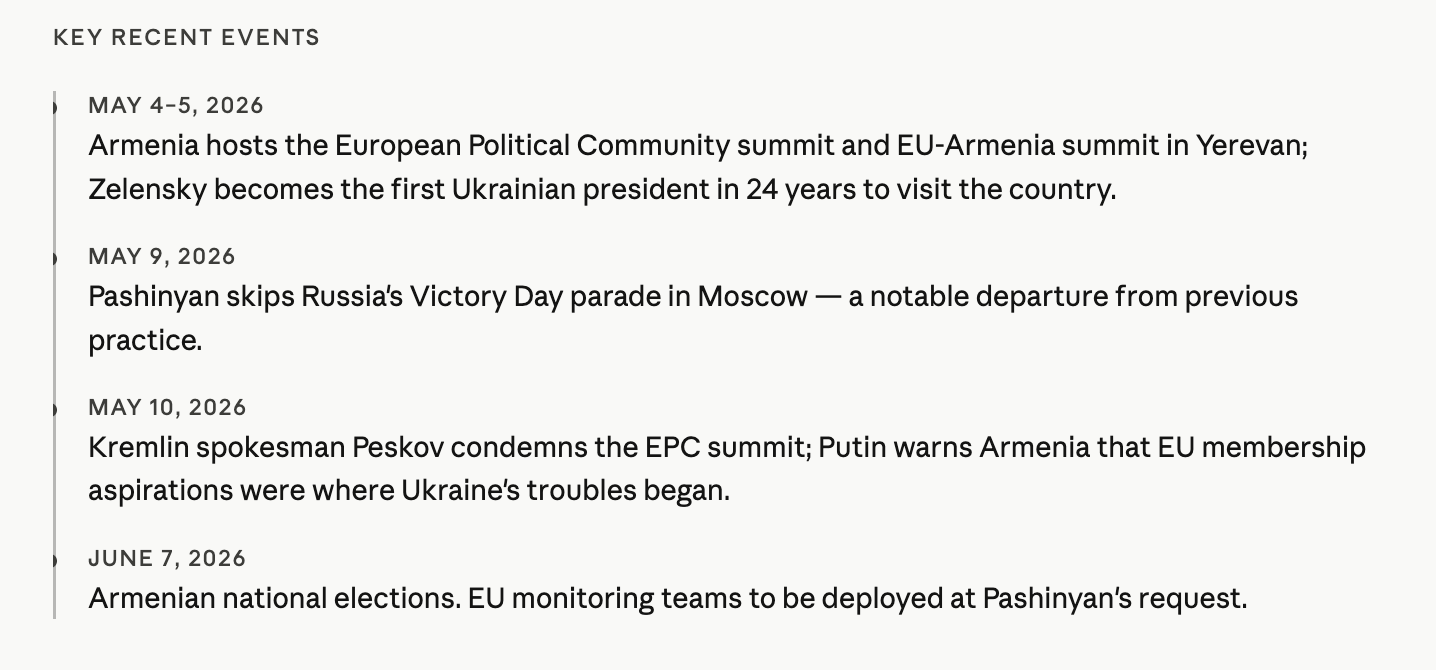
The flashpoints have piled up quickly. Armenia hosted the 8th European Political Community summit and the first-ever bilateral EU-Armenia Summit in May, bringing dozens of European leaders - and Ukrainian President Volodymyr Zelensky - to Yerevan in an event of outsized symbolic weight for a small post-Soviet state. Zelensky enraged Moscow by making statements mocking its security concerns (Russian Foreign Ministry spokeswoman Maria Zakharova called Armenia's actions "incomprehensible," criticizing Yerevan for serving as a platform for Zelensky to voice supposed anti-Russian and terrorist threats).
Days later, Pashinyan skipped Russia’s May 9 Victory Day parade in Moscow for the first time, a break from a ritual he had maintained even as relations soured. The Kremlin’s response was immediate: spokesman Dmitry Peskov condemned the EPC summit as a platform for “anti-Russian statements” and Putin ominously noted that EU membership ambitions were where Ukraine’s troubles began.
The candidates
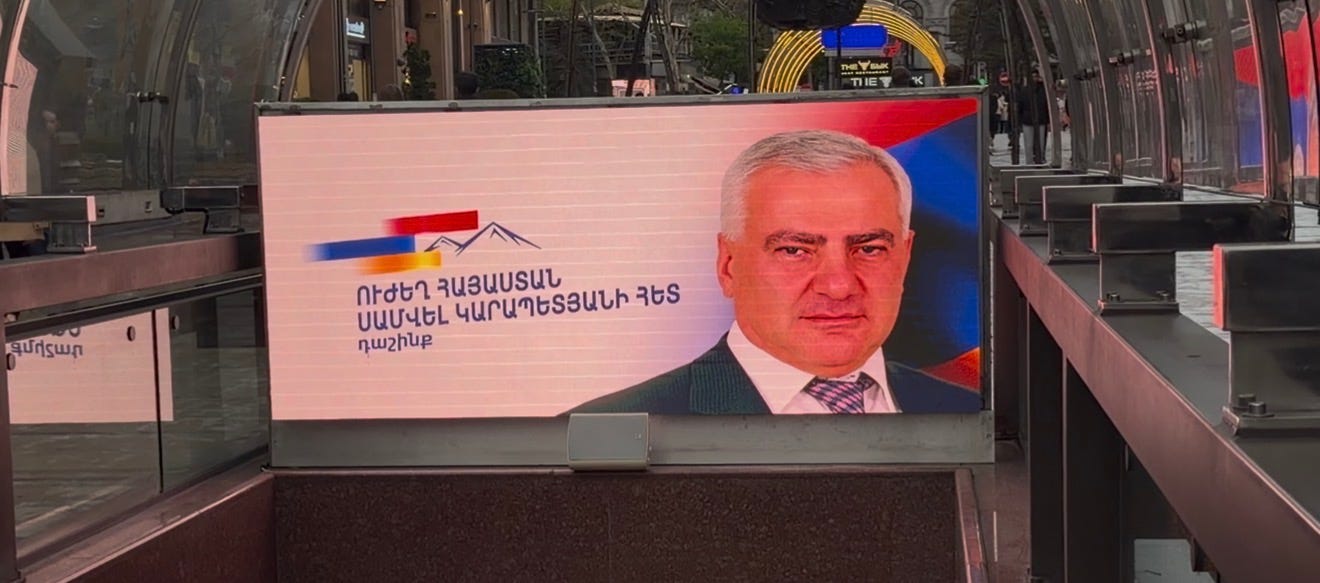
Pashinyan faces a fragmented field. The two main challengers are Russian-Armenian billionaire Samvel Karapetyan (net worth $4.1Bn) - who built his fortune largely in Russia, holds dual citizenship, and is currently under house arrest following anti-government statements - and former President Robert Kocharyan, who has openly called for restoring Armenia’s “strategic partnership with Russia.” Both men argue the real threat to Armenia is not Russia but Azerbaijan and Turkey, and have accused Pashinyan of caving into Baku and Ankara (a complaint against the ruling leader is removing Mount Ararat from Armenian passport stamps at the behest of Turkey).

Russia’s levers
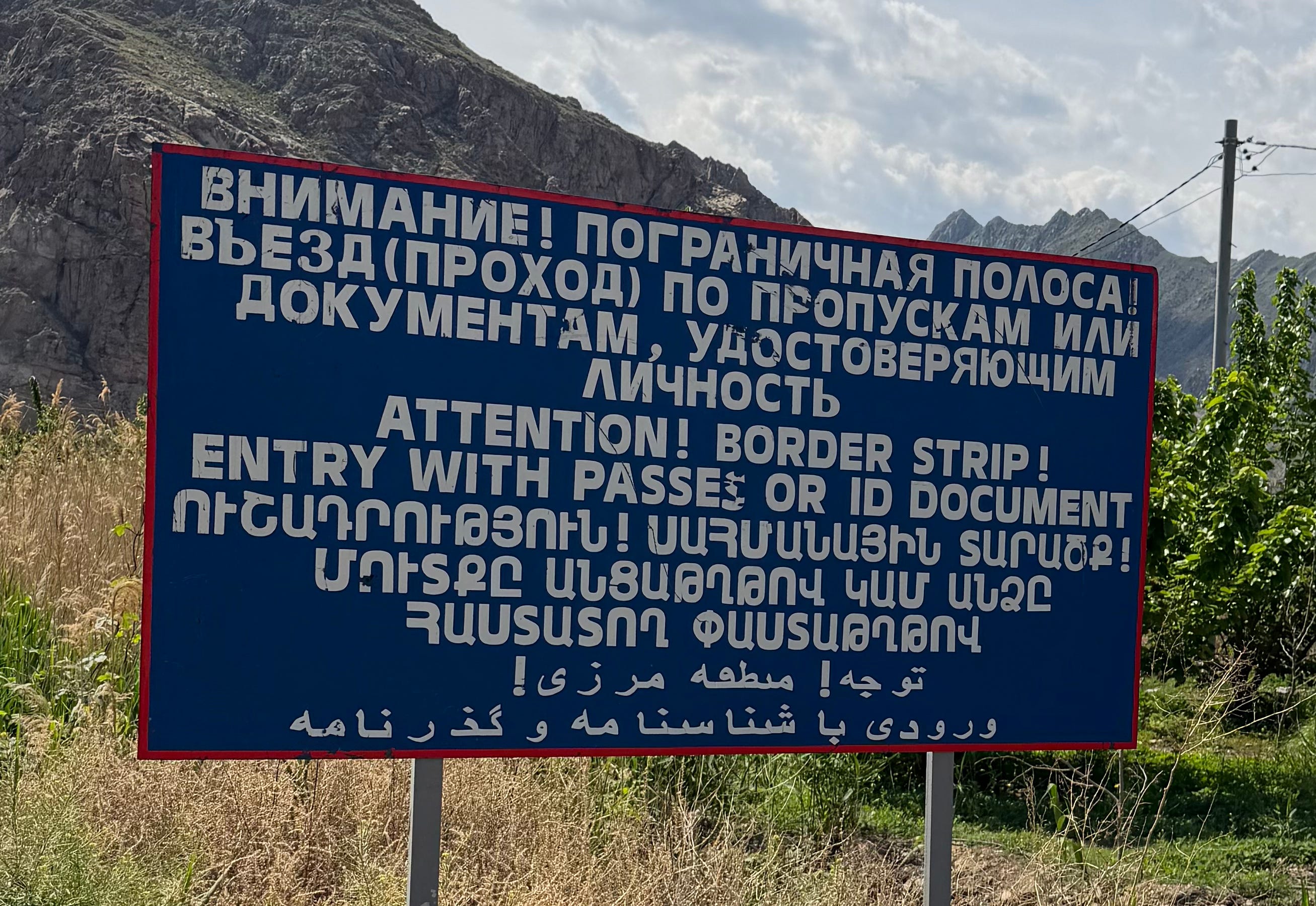
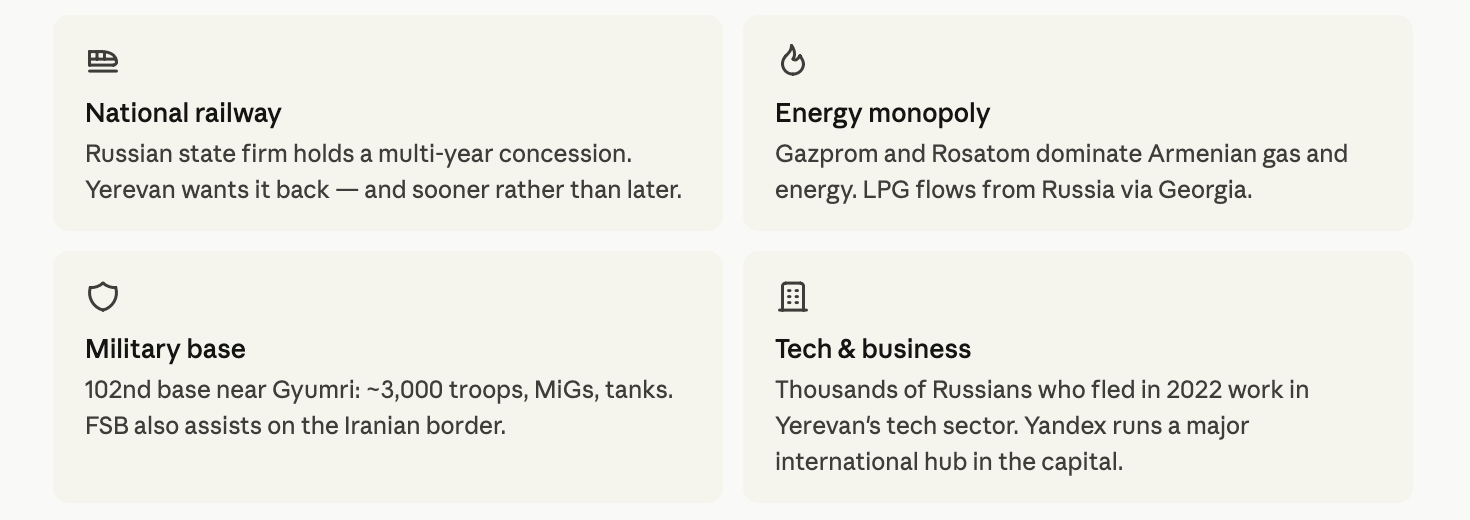
Despite the political estrangement, Russia retains deep structural influence over Armenia that is difficult to unwind quickly. Militarily, the 102nd Russian Military Base outside the city of Gyumri - some 3,000 soldiers, MiG fighter jets, tanks and supporting equipment - remains a pillar of Armenia’s defence posture. FSB personnel also support Armenia in patrolling its border with Iran. For a country that still faces an unresolved security environment with both Azerbaijan and Turkey, Russia’s military presence is not easily dismissed.
Russia’s playbook — and its limits
Leaked documents and investigative reporting point to a coordinated Kremlin operation, reportedly overseen by senior official Sergei Kiriyenko - the same figure who handles policy toward Russia’s occupied Ukrainian and Georgian territories. The campaign involves FSB and SVR operatives, hostile media operations traced to Moscow, paid influencers, Telegram channels, and reported pressure on the Armenian diaspora to back Kremlin-aligned factions. Anticipating interference, Pashinyan has requested - and received - EU election monitoring teams.
Yet those efforts face a fundamentally changed public. Yerevan has absorbed thousands of Russians who fled following the February 2022 full-scale invasion of Ukraine - many of them tech workers and remote employees, a community (of up to several hundred thousand people) that has paradoxically deepened Armenia’s ties to the Russian-speaking world while being largely hostile to the Kremlin. The city’s demographics, and its politics, are shifting.
“Moscow is attempting to retake Armenia - not with tanks, but with Telegram channels, paid influencers, and geriatric loyalists. This will not be easy. Russian sources themselves admit there is now ‘no one to speak for Russia’ in Armenia.”
— Commentary, The Moscow Times, June 2025
“It is hard to win hearts with empty promises, especially from the country that abandoned you in war. The Armenian public, especially the youth, is more interested in visas to Paris and tech jobs in Silicon Valley than Soviet fairy tales.”
— Commentary, The Moscow Times, June 2025
Some observers cited by the Moscow Times in July 2025 went further, arguing that growing acrimony between Moscow and Yerevan is itself evidence of Russia's diminished ability to sway its neighbours and prevent a geopolitical reordering in the South Caucasus.
Outlook
The broader regional picture works against Moscow. Russia’s political centrality across the former Soviet space has declined sharply since 2022: Azerbaijan’s Aliyev skipped May 9 for the second year running; the EU has poured hundreds of millions of euros into Armenia since 2020; and Armenia’s membership of the International Criminal Court makes a Putin visit effectively impossible. The Kremlin’s recent track record in electoral interference - near-success in Moldova’s 2024 referendum, failure in Moldova’s 2025 parliamentary vote, failure to prevent Péter Magyar’s landslide in Hungary - is mixed at best.
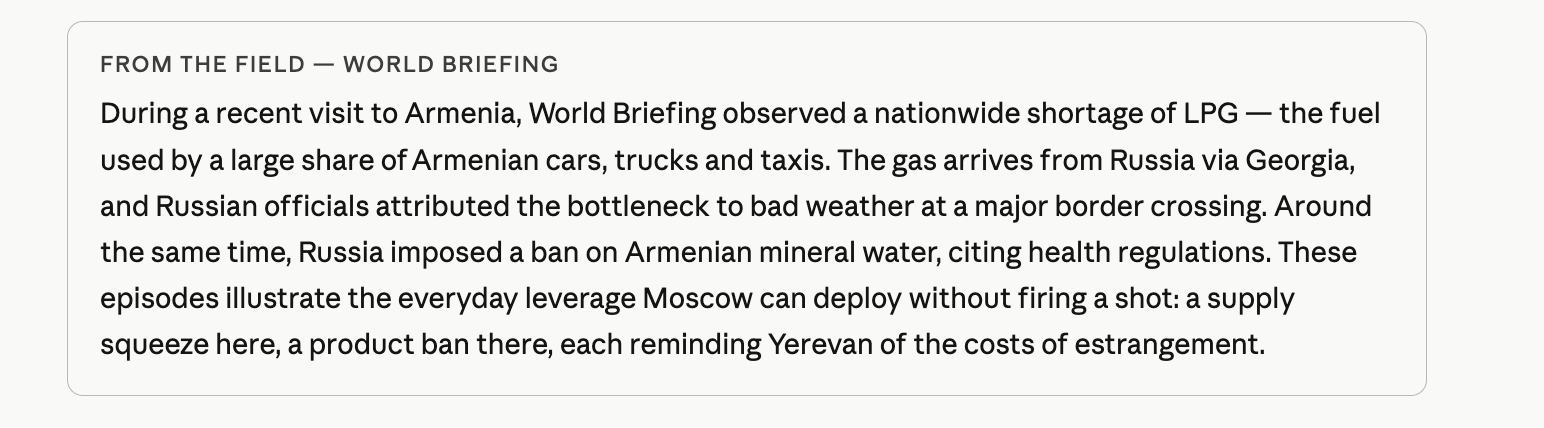
Pashinyan’s lead in the polls is commanding, and the opposition is divided, with several key figures facing legal proceedings his critics view as politically motivated. Russia still has tools short of elections - supply squeezes, product bans, infrastructure pressure - but deploying them too visibly risks accelerating the very estrangement Moscow is trying to reverse. If the Kremlin resorts to direct vote mobilisation, low turnout would be its best ally. But with Pashinyan holding the levers of government and EU and OSCE monitors on the ground, the conditions for a Russian-engineered upset look difficult to achieve.
Source analysis: Nichola Castillo, researcher and freelance writer. Additional reporting and field observations: World Briefing. Background sources include the Moscow Times, Carnegie Endowment, OC Media, DFRLab, and the International Republican Institute.
Russia on Wednesday voted with other major energy exporters and greenhouse gas emitters against a UN General Assembly resolution that requires governments to take stronger action on climate change. The vote was 141-8 with 28 abstentions. Russia, Iran, the United States, Belarus, Saudi Arabia, Israel, Yemen and Liberia voted against the non-binding resolution. The vote backs a July 2025 International Court of Justice (ICJ) advisory opinion stating that it is “unlawful” for countries to neglect their climate commitments and that they may be required to pay “full reparation to injured states.” The biggest contributors to greenhouse gas emissions routinely oppose any mechanism that could force them to pay reparations to victims of climate disruption. Russia is one of the top global emitters, with its share in both historic and current emissions at around 5% - Moscow Times
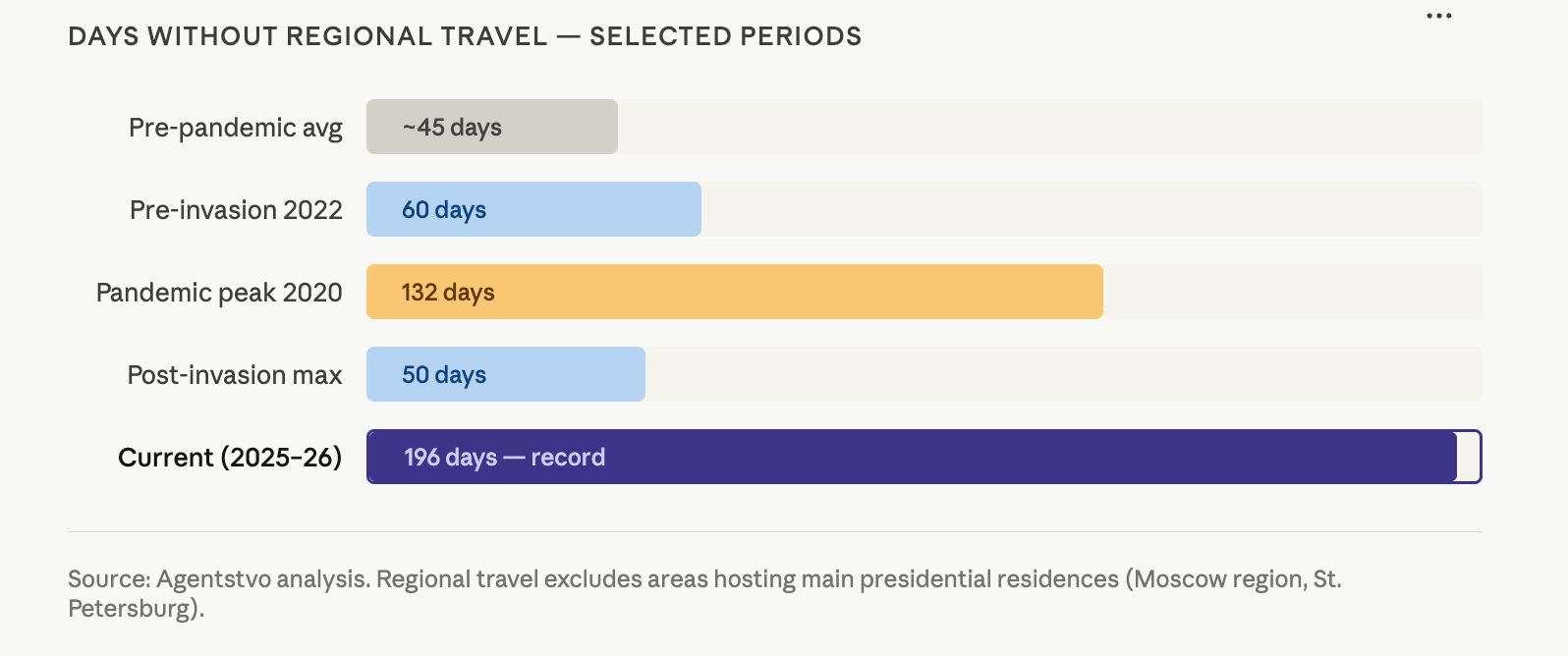
Vladimir Putin has gone a record 196 days without visiting a Russian region outside his main residential areas — surpassing even the longest stretches of the Covid pandemic, according to Russian investigative outlet Agentstvo. His last regional visit was a one-day trip to Samara on November 6, 2025. Since then, nearly all public appearances have been confined to the Moscow region or St. Petersburg. The gap in foreign travel was also notable: before his recent China trip, his last international visit had been to Turkmenistan in December 2025 - a 158-day pause. For comparison, the longest pandemic-era gap was 132 days; in normal pre-war years, breaks rarely exceeded 45 days. Western intelligence sources leaked to media in early May that Putin has stopped visiting his Valdai residence entirely, is working from hardened bunkers, and that his security detail has significantly stepped up protection - pointing to genuine fears for his personal safety as the likely explanation.
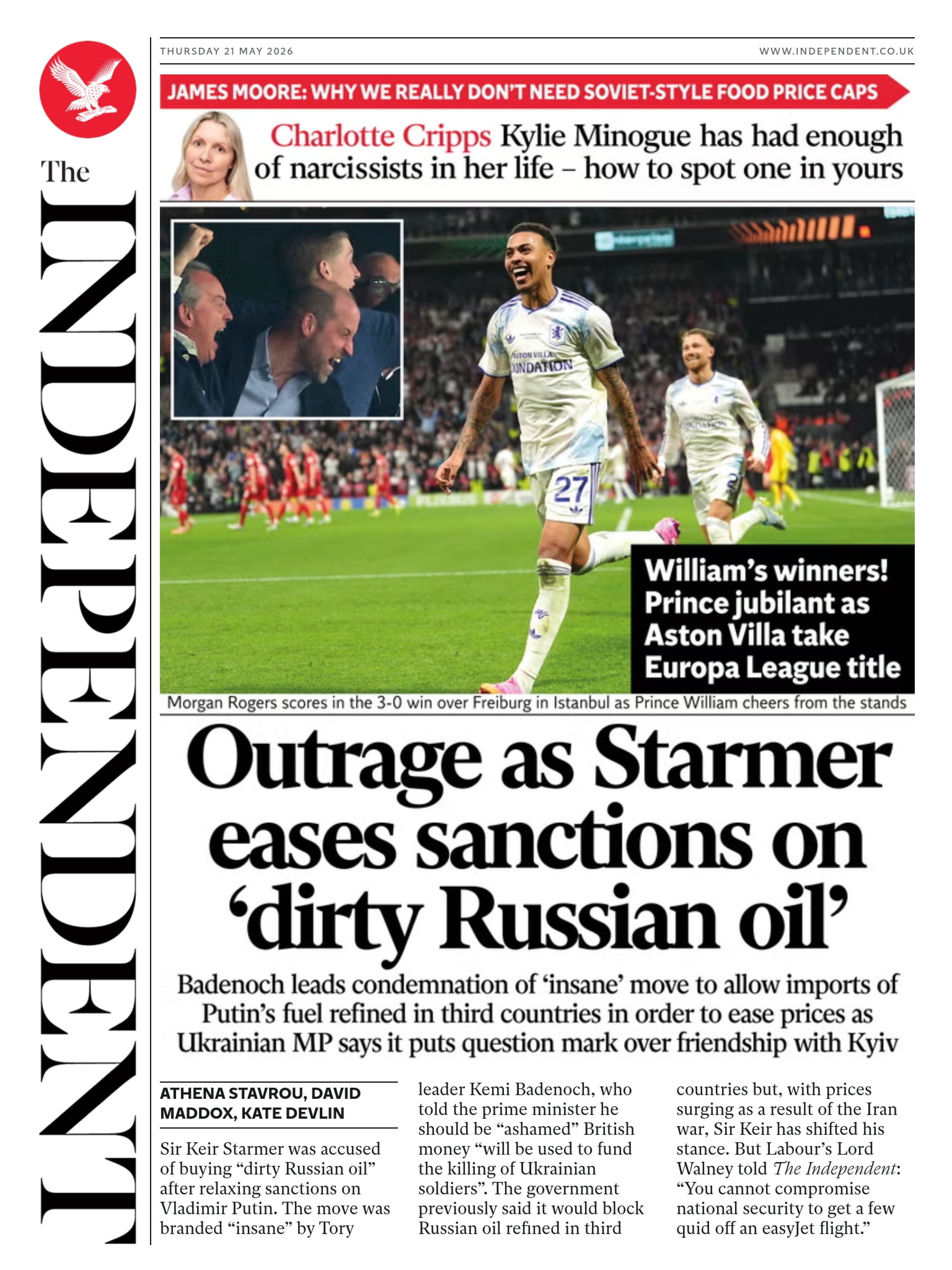
Sir Keir Starmer has been accused of buying “dirty Russian oil” after the UK quietly relaxed sanctions on Moscow in a move which critics fear will be a major boost to Vladimir Putin. The move has been condemned by senior Labour figures and branded “insane” by Tory leader Kemi Badenoch, who told the prime minister he should be “ashamed” that British money “will be used to fund the killing of Ukrainian soldiers”. The government previously said it would block Russian oil refined in third countries in a bid to “further restrict the flow of funds to the Kremlin”. But, with prices surging as a result of the Iran war, Sir Keir has shifted his stance and will now allow imports of jet fuel and diesel made from Russian oil and refined in other countries. The prime minister insisted he is not lifting sanctions on Russian oil “in any way whatsoever” during a fiery Prime Minister’s Questions (PMQs), but Ms Badenoch said: “Labour are giving money to Russia, Reform are taking money from Russia - The Independent
The Iran war is undermining Saudi Arabia’s efforts to diversify away from oil, while boosting the kingdom’s oil revenues. Riyadh ordered government entities to freeze payments to strategy advisers, management consultants, and law firms, which were central to the kingdom’s efforts to reinvent its economy and become a global business and entertainment hub, Semafor reported. The Esports World Cup was moved from Saudi Arabia to Paris because of the war, and the country’s sovereign wealth fund recently pulled out of LIV Golf. But the conflict is delivering a fresh oil windfall for the kingdom. Thanks to its ability to export via the Red Sea and rising oil prices, Saudi oil export revenues jumped to a more than three-year high in March - Semafor
The journals….