🔥 World Briefing Hot Take
Qatar’s has been warning for years that attacking Iran would spark regional escalation has proven prescient - and costly. As missiles and drones hit Gulf states hosting U.S. forces, Trump’s claim of surprise clashes with intelligence assessments that flagged retaliation as a real risk. The result is more than a military crisis; it’s a strategic rupture. Allies that have anchored U.S. power in the Gulf for decades are now confronting an uncomfortable reality: they may be bearing the consequences of decisions they neither made nor fully signed up for.
Qatar warned: attack Iran, and the region escalates. It did. Yet Trump now says he wasn’t told Iran could hit U.S. allies in the Gulf. Watch the above video where Qatari Foreign Ministry Spokesperson Majid al-Ansari makes a rare tongue-lashing directed at the United States, and Israel
President Donald Trump was warned that attacking Iran could trigger retaliation against U.S. Gulf allies despite his claims on Monday that Tehran’s reaction came as a surprise, said a U.S. official and two sources familiar with U.S. intelligence reports. Pre-war intelligence assessments did not say that Iran’s response was “a guarantee, but it certainly was on the list of potential outcomes,” said one source, who like the other two requested anonymity to discuss the issue. The president twice on Monday said that Iran’s retaliatory strikes against Qatar, Saudi Arabia, the United Arab Emirates, Bahrain and Kuwait were a surprise, the first time at a Kennedy Center board meeting in the White House. “They (Iran) weren’t supposed to go after all these other countries in the Middle East,” he said. “Nobody expected that. We were shocked.” Trump was also briefed ahead of the operation that Tehran would likely seek to close the economically vital Strait of Hormuz, according to two other sources familiar with the matter. Over the past two weeks, Iranian drones and missiles have struck targets in the Gulf states that have included U.S. military bases and an Emirates base hosting French troops, civilian structures, including hotels, airports, and energy facilities. Iran has also halted almost all shipping through the Strait of Hormuz, through which 20% of oil supplies move, causing global energy prices to spike - Reuters
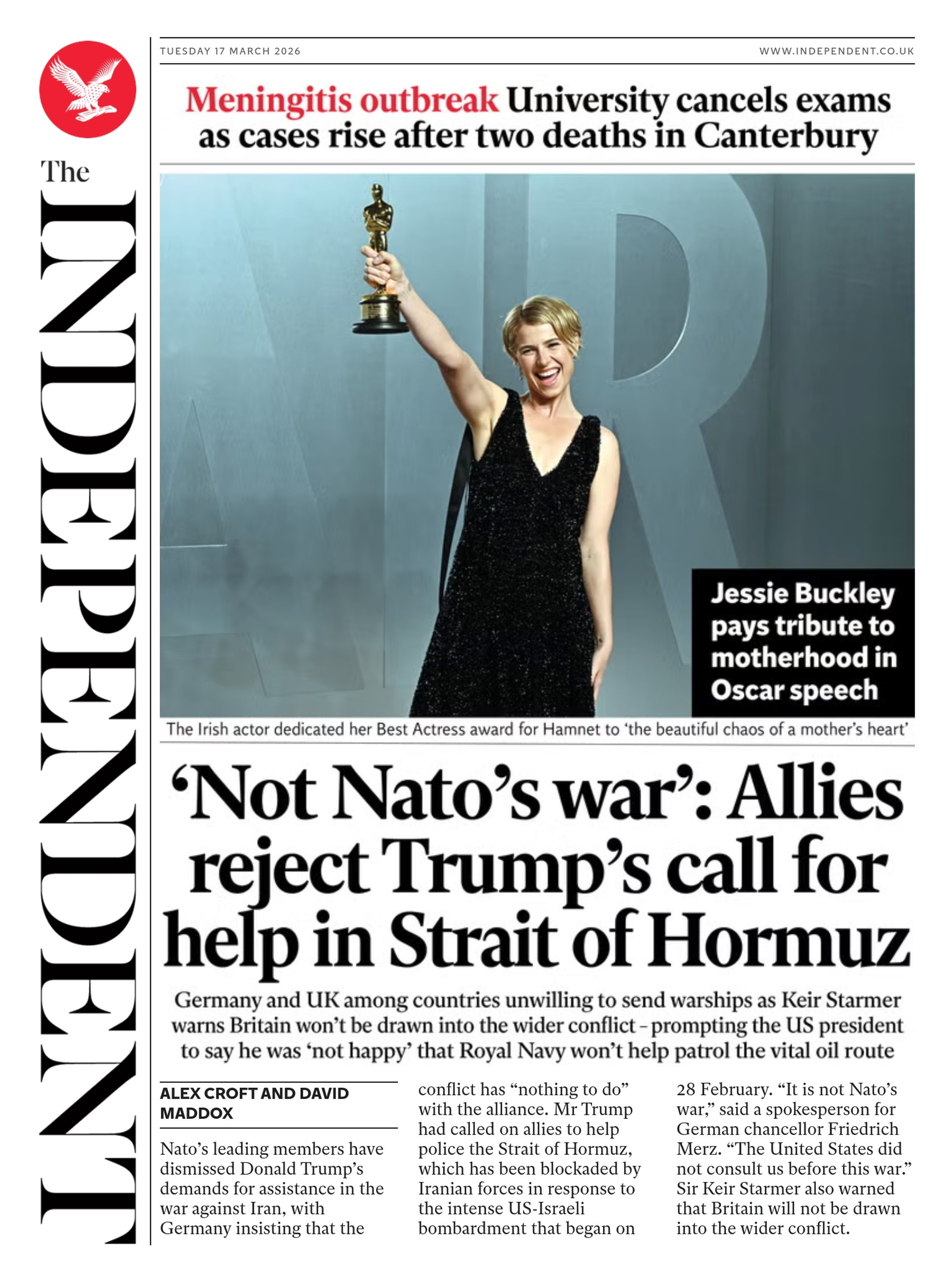
President Donald Trump on Monday lashed out at US allies for rebuffing his calls to help reopen the Strait of Hormuz, reflecting Washington’s strained relations with its closest partners. Europe has largely resisted Trump’s efforts to build an international coalition against Iran, with Germany’s defense minister saying Monday, “This is not our war.” Japan, Italy, and Australia declined to send ships to the strait, while South Korea remained noncommittal. Trump responded to the rejections with his trademark bravado and belligerence, saying, “We don’t need anybody,” while framing his requests as a “loyalty test of America’s allies,” The New York Times wrote. A Politico poll showed that key US allies in the West now see Beijing as more dependable than Washington - Semafor
Iranian officials have reached out to Trump’s Middle East envoy, trying to reopen a diplomatic channel, but Trump said he didn’t want to negotiate now, two senior White House officials told CNN. Part of the reason is because Trump’s administration is not confident that Iran’s new supreme leader, Mojtaba Khamenei, “is actually in charge,” one of the officials said. Iran’s foreign minister denied having any contact with the president’s envoy in recent days, as the White House officials claim. Some American, European and Asian diplomats are growing increasingly frustrated with the Trump administration’s refusal to use traditional diplomatic channels. “If there was more diplomatic engagement on the US side, they might be able to get a more positive outcome,” said one European diplomat.
Twice on Monday, President Donald Trump said he’d wrangled a confession of sorts from an Oval Office predecessor who he said had expressed regret in a private conversation about not attacking Iran the way Trump has been doing for more than two weeks. But there’s just a little problem: Representatives for the four living former presidents — three Democrats and one Republican — said none have been in touch with Trump recently. Trump declined to name the former president when reporters asked who it was, saying he didn’t want to “embarrass him.” The Republican president first told the story during extended remarks about the Iran war as he opened a meeting of the board of trustees of the Kennedy Center. Trump is chairman of the board and held the meeting at the White House. He repeated that Iran had been a threat to the United States for decades but said he is the only president who had the courage to do something about it - AP
Yesterday, World Briefing mapped the global fallout from the Middle East war. Today, I follow up with essential tips to help you travel savvy in a world where the rules have suddenly changed.
At least 400 people were killed and 250 injured in a Pakistani air strike on a hospital in Kabul, the Afghan Taliban said, while Pakistan rejected the claims. The 2,000-bed Omid Hospital, a substance-abuse rehabilitation center in the Afghan capital, was reportedly hit in a Pakistani air strike late on March 16. Efforts were under way to rescue the injured and recover the bodies, according to Hamdullah Fitrat, deputy spokesman for the Taliban government in Afghanistan. “The Pakistani military regime carried out an air strike at approximately 9 p.m. [local time, on March 16] on the Omid Addiction Treatment Hospital, a 2,000-bed facility dedicated to the treatment of drug addiction,” he said in a post on X, adding that “large sections of the hospital have been destroyed.” Pakistan’s Information Ministry claimed the strike had targeted military installations and terrorist support infrastructure in Kabul and Nangarhar Province and did not deliberately hit civilians. “Technical support infrastructure and ammunition storage facilities at two locations in Kabul were effectively destroyed,” Pakistani Information Minister Attaullah Tarar said in a post on X. “The visible secondary detonations after the strikes clearly indicate the presence of large ammunition depots,” he added. The claims from either side could not be independently verified - RFE/RL
From the Gulf to Ukraine, the geopolitical dots are multiplying by the day.
Upgrade to World Briefing Plus and stay ahead of the headlines — or support independent global reporting through Patreon or PayPal.
South Korea’s customs authorities are intensifying efforts to curb a surge in illegal vehicle shipments bound for Russia, channelled through intermediary nations including China, Kazakhstan, and Kyrgyzstan. The move follows a significant increase in such exports. The Korea Customs Service reported a more than five-fold jump in illegal vehicle exports last year, reaching 149.2 billion won ($100.78 million). This marks a substantial rise since Seoul imposed stringent export restrictions following Russia’s full-scale invasion of Ukraine. Investigations revealed that some traders falsely declared the vehicles’ final destination, listing neighbouring countries like Kazakhstan and Kyrgyzstan while their true destination was Russia. Further tactics involved purchasing new vehicles, then “disguising” them as used cars for onward shipment to Russia via these same intermediary nations. A customs official confirmed that many of these illicitly exported vehicles were German premium brands initially imported into South Korea. Authorities have pledged to ramp up their crackdown on these circumvention schemes. Since 2024, Seoul has required vehicles with an engine of more than 2.0-litres to have a permit for export to Russia. Those who break the law face a prison term of up to seven years or a fine of up to five times the value of the goods - The Independent
Millions in Cuba have been left without power after the national electric grid collapsed on Monday, the country’s power operator says. This is the latest in a series of widespread power outages to hit the country, whose chronic fuel shortages have been exacerbated by a recent US blockade on oil shipments to the island. UNE, Cuba’s grid operator, said it was gradually restoring electricity in provinces and cities around the country. Cuba, an island of around 10 million people, has battled widespread blackouts in recent years - a persistent source of public discontent that has triggered rare protests. Cuba relies heavily on imported fuel, and Venezuela was believed to have sent around 35,000 barrels of oil a day to Cuba - accounting for about half of the island’s oil needs. But these shipments have been halted since the US captured Venezuelan president Nicolas Maduro in January - BBC
When Nigerian President Bola Tinubu arrives in the UK this week, the visit will carry more than ceremonial significance: it will be the first state visit by a Nigerian leader to Britain in 37 years. King Charles III and Queen Camilla are to host Tinubu and first lady Oluremi Tinubu at Windsor Castle from Wednesday to Thursday. The last Nigerian state visit, considered one of Britain’s most important diplomatic tools, took place in 1989 when then-military ruler Ibrahim Babangida met Queen Elizabeth II. “It’s the first time since Nigeria returned to democracy [in 1999] that a democratically elected Nigerian head of state is being afforded this honour by the British monarchy,” said Ikenna Okonkwo, data integrity lead at the Nigerian intelligence consultancy SBM Intelligence. The visit comes at a time when both countries are trying to deepen economic cooperation. Nigeria is one of Britain’s most important partners in Africa. Trade between the pair was worth more than 8 billion pounds ($10.6bn) in the year to October. In 2024, they signed a trade and investment partnership aimed at expanding business opportunities. Kabir Adamu, managing director of Beacon Security and Intelligence Ltd in Abuja, said some may see the visit as a chance to reset relations after Britain’s departure from the European Union. Discussions are likely to focus on expanding the trade and investment partnership and cooperating on security, migration policy and climate financing, he told Al Jazeera. “The UK secures deeper commercial access to Africa’s largest market,” he said. “At the same time, Nigeria gains essential foreign direct investment and security backing to stabilise its domestic economy.” - Al Jazeera
The guest list for Vanity Fair’s Oscars after-party on Sunday was more exclusive than it has been in years: most agents, managers, brand representatives and news outlets were turned away from the celebration, which took place at the Los Angeles County Museum of Art. The directive to scale back the party came from the top: Mark Guiducci, Vanity Fair’s new editor, wrote this month that the magazine was “encouraging a renewed sense of privacy at this year’s Oscar party, going so far as to sticker guests’ cameras.” For years, the vibe-killing intrusion of corporate sponsorship had been making the party feel more like a networking event for brand executives than a louche hang where the rich and actually famous could let their hair down. Mr. Guiducci’s goal for the party was “to make a destination for the winners of the Oscars,” he said last week on “The Town,” a showbiz industry podcast. “There’s a golden rule: You come with an Oscar, you’re coming in.” - NYT
The journals…..