🔥 World Briefing Hot Take
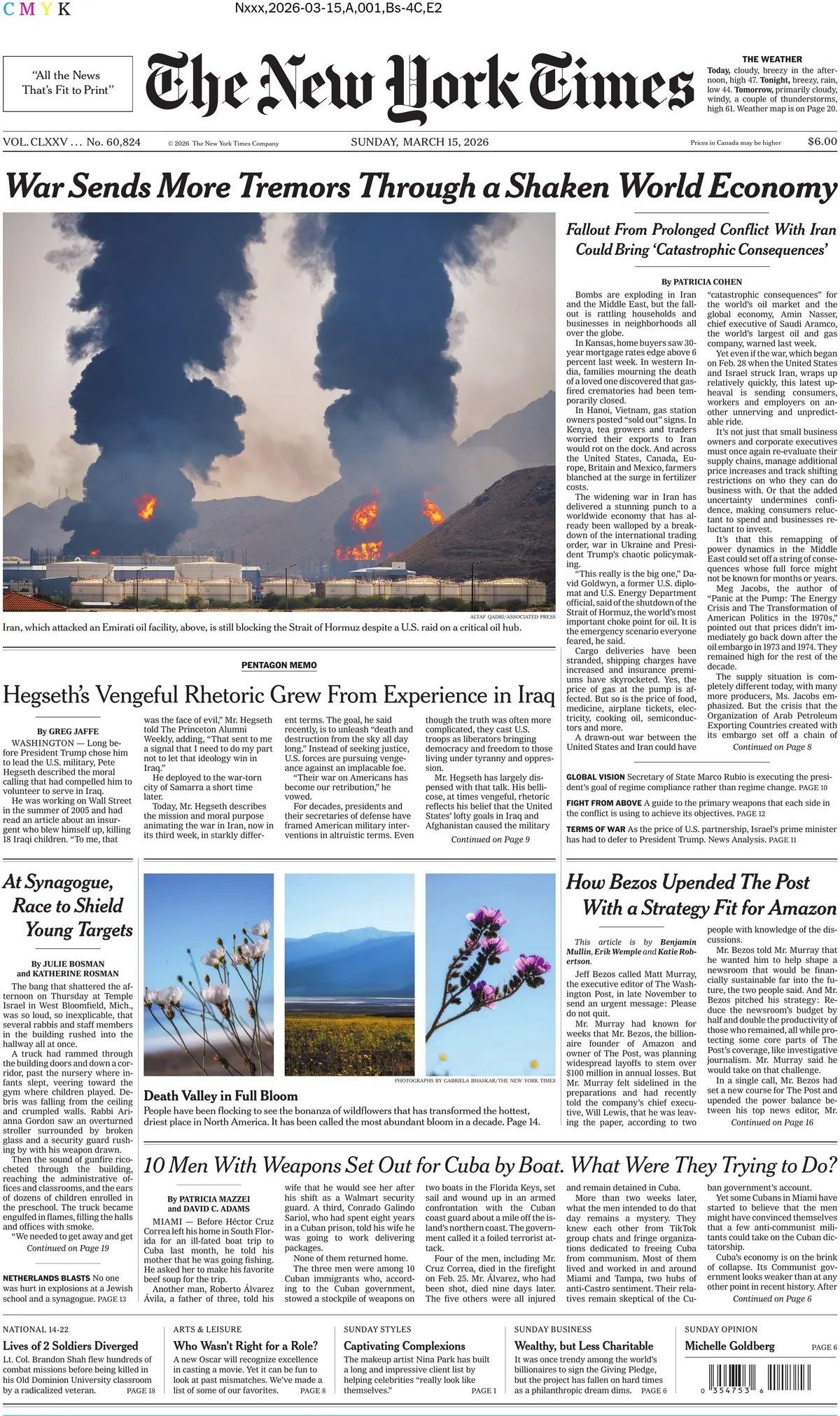
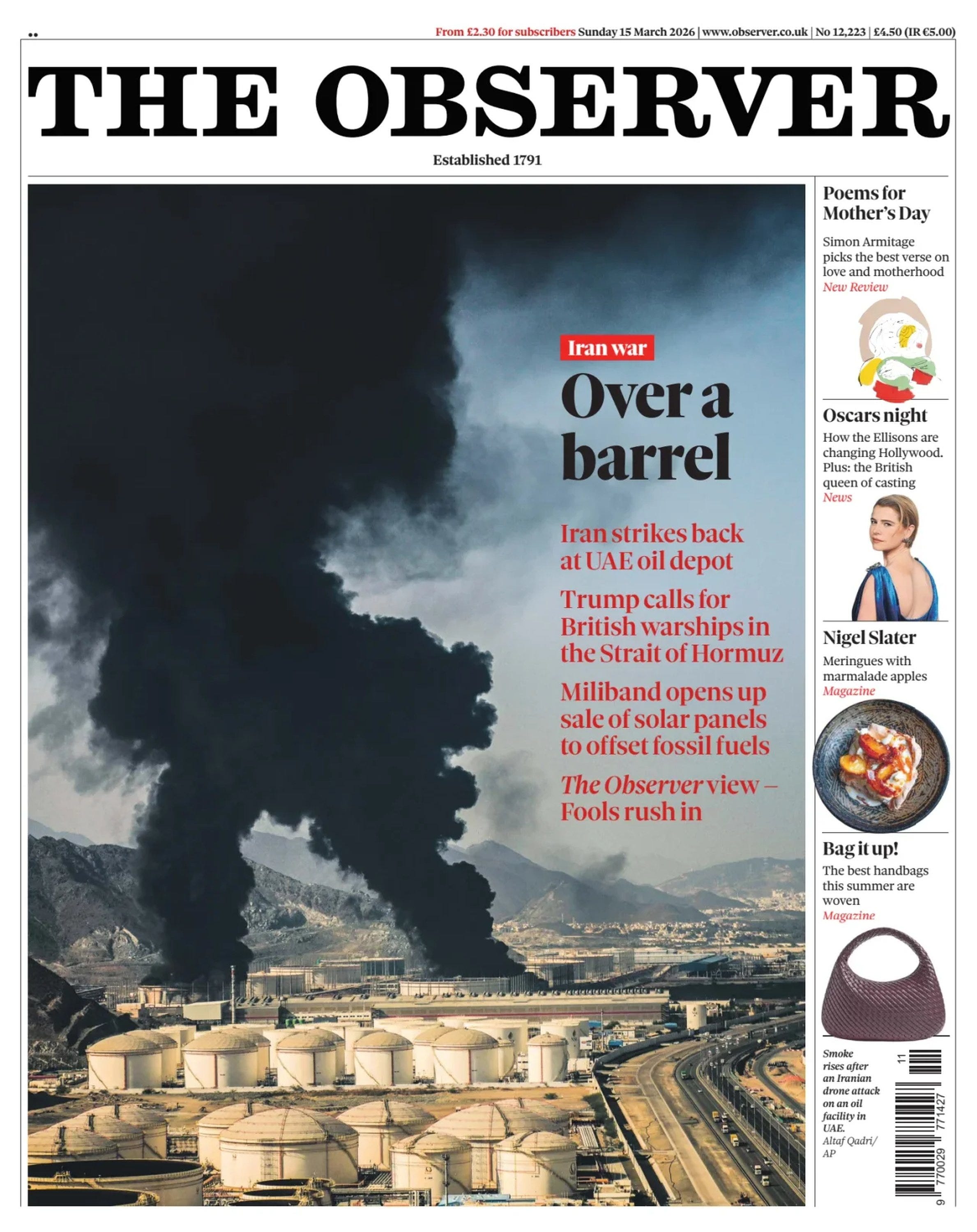
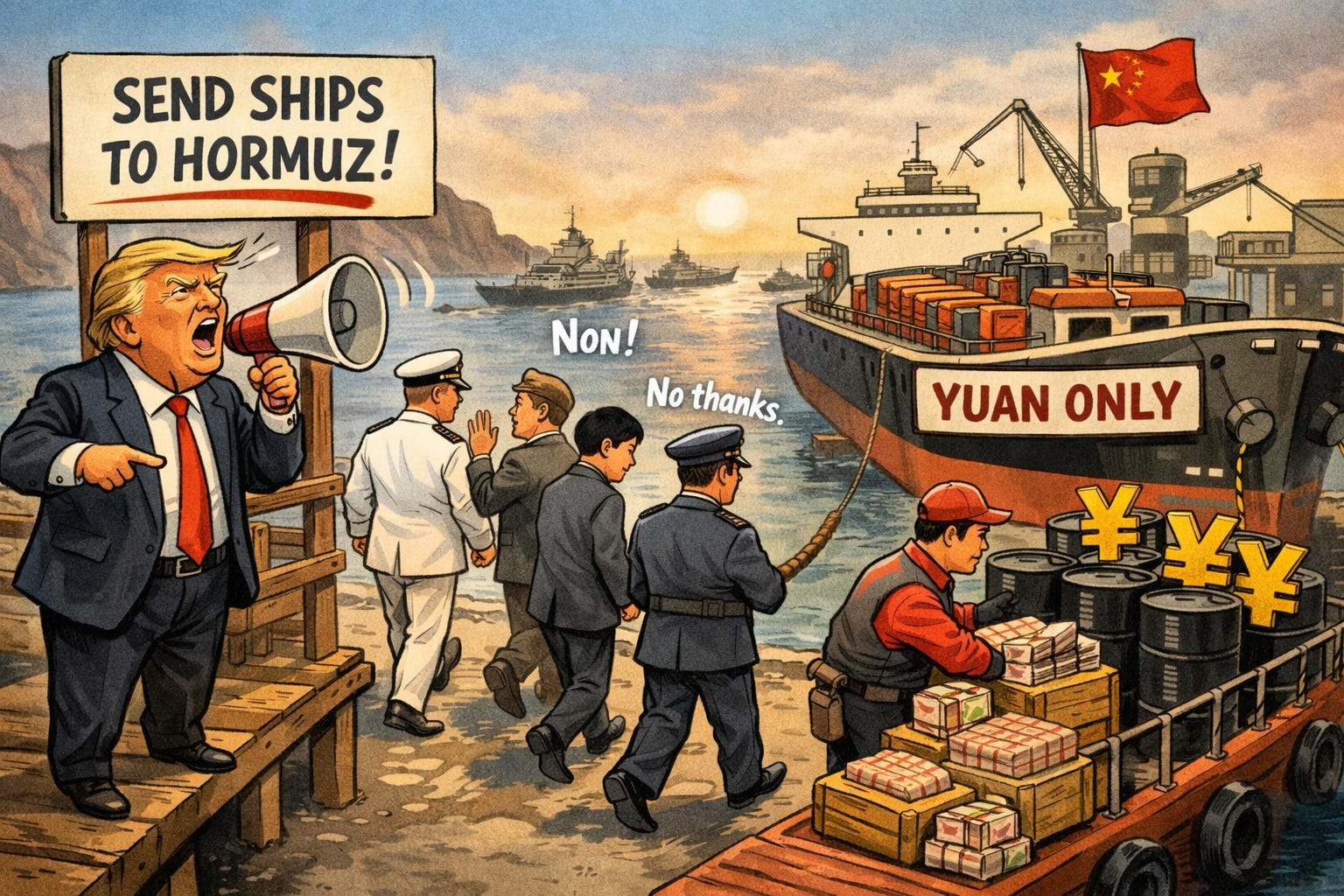
President Donald Trump’s call for allies to dispatch warships to escort oil tankers through the Strait of Hormuz is being met not with a coalition - but with hesitation and outright refusal. France has already said “Non,” Japan says the threshold for sending ships is “extremely high,” and Britain and South Korea are hedging while China is urging restraint. The collective reluctance reflects deep unease among U.S. partners over the widening U.S.–Israeli war with Iran and the unpredictable economic shockwaves now rippling through global energy markets.
Adding a fascinating strategic layer, Iranian officials are reportedly considering allowing a limited number of tankers through the Strait - but only if the oil is traded in Chinese yuan rather than U.S. dollars. If Tehran moves forward with such a plan, it would effectively weaponize the world’s most critical energy chokepoint not only militarily but financially - challenging the dollar’s long-standing dominance in global oil trade.
For Beijing, the crisis could present an unexpected opening. Speaking today with a seasoned observer of Middle East and Africa politics, I was reminded that China has spent years trying to expand the international use of the yuan in commodity trade, including oil purchases from the Gulf. Meanwhile, BRICS nations and many emerging economies - particularly in Africa - have long explored ways to reduce reliance on the U.S. dollar, whether through alternative currency baskets or bilateral trade arrangements (we even heard this at the G20 Leaders’ Summit in South Africa). Those efforts have frequently drawn sharp warnings from Washington, including from Trump himself. But with U.S. alliances fraying and global energy flows now entangled in geopolitics, many emerging markets may be quietly asking whether this moment offers a chance to accelerate that shift. If countries already wary of Washington’s economic leverage begin experimenting more aggressively with alternative currencies, the ramifications could extend far beyond the Gulf - potentially reshaping the financial architecture that has underpinned U.S. global influence for decades.
In trying to choke the Strait of Hormuz, Iran may have stumbled onto something even bigger: a real-time test of the dollar’s dominance.
News Briefs
Iran is considering allowing a limited number of oil tankers to pass through the Strait of Hormuz, provided that the oil cargo is traded in Chinese yuan, a senior Iranian official tells CNN. The potential move comes as the Islamic Republic is working on a new plan to manage the flow of oil tankers through the Strait, the source added. International oil is almost entirely traded in dollars, apart from sanctioned Russian oil, which is traded in roubles or yuan. China has attempted to make inroads for the past several years to buy oil in yuan, particularly in Saudi Arabia. But the dollar remains the world’s reserve currency, and the yuan is not broadly accepted on the global marketplace. Market anxieties about the strait - a significant artery for the world’s energy - have pushed oil prices to their highest point since July 2022, the summer after Russia’s invasion of Ukraine. The United Nations warned on Friday that restrictions on the flow of ships through the strait will have an “immense impact” on humanitarian efforts as the war continues. “When ships stop moving through that Strait, the consequences travel fast,” Tom Fletcher, the United Nations’ under-secretary-general for humanitarian affairs, said. “Food, medicine, fertilizer and other supplies become harder to move and more expensive to deliver.”
Observers in China have reacted cautiously to reports that Iran may allow oil tankers through the Strait of Hormuz if the trade is conducted in Chinese yuan, citing operational feasibility limits and security risks. While the plan could symbolically advance the use of the Chinese currency, its implementation would face security and feasibility challenges and could strain China-US ties, they warned - SCMP
President Trump called on other countries, including Britain, France, South Korea and China, to send warships to the Strait of Hormuz to try to ensure that oil tankers could pass, as Iran pledged to keep the vital waterway closed. In a social media post on Saturday, Mr. Trump said the “Countries of the World that receive Oil through the Hormuz Strait must take care of that passage, and we will help — A LOT!” It was far from clear, however, if any countries would volunteer to patrol the Persian Gulf strait, through which about a fifth of the world’s oil transits. Oil prices have risen steeply since the United States and Israel launched their air war on Iran two weeks ago. While the Trump administration and other governments have sought to soothe prices — including by easing sanctions on some Russian oil — they have seen little success thus far. Mr. Trump has threatened to attack oil infrastructure on Kharg Island, home to Iran’s main oil export terminal, if Tehran does not allow ships to freely pass through the Strait of Hormuz. Such a move would likely further rattle energy markets. U.S. consumers have already seen the price of a gallon of gasoline rise by 25 percent on average, according to the AAA motor club. But Iran’s Islamic Revolutionary Guards Corps defied Mr. Trump’s threat, asserting in a statement on Saturday that the critical waterway was under its full control and that “any attempt to move or transit will be targeted.” Fighting continued on Sunday across the Middle East. The Israeli military said on Sunday morning that it had launched a new wave of airstrikes in western Iran. Israeli fighter jets have conducted more than 7,000 strikes in Iran since the war began in late February, according to the Israeli military. Iran’s Islamic Revolutionary Guards said on state media that they were continuing to shoot at Israel and at U.S. assets in the region. Iranian missiles repeatedly set off air raid sirens in Israel, without reports of serious casualties. Saudi Arabia said it had intercepted drones near the capital and in an eastern province - NYT
So far, no countries have publicly agreed to Trump’s call to escort oil tankers through the Strait of Hormuz. A spokesperson for the British Ministry of Defence told US media that the UK is “currently discussing with our allies and partners a range of options to ensure the security of shipping in the region”. Also speaking to US media, Chinese embassy officials said Beijing is calling for hostilities to stop, and that “all parties have the responsibility to ensure stable and unimpeded energy supply”. Japanese officials told local media Japan won’t dispatch ships just because Trump asked, saying, “Japan decides its own response, and independent judgement is fundamental.”
France has said it is not sending ships. Posting on X, the Foreign Ministry said, “No, the French aircraft carrier and its group are staying [in] the eastern Mediterranean.” South Korea’s presidential office said on Sunday it would carefully review Trump’s calls and “communicate closely” with the US - Al Jazeera
A senior Japanese policy adviser said Sunday the threshold is “extremely high” for Tokyo to send its warships to help protect the Strait of Hormuz, AFP reported. As the world’s number-four economy, Japan is the fifth-biggest importer of oil -- 95 percent of it from the Middle East and 70 percent passing through the Strait of Hormuz, which is now effectively closed. “I regard the threshold as extremely high” for sending Japanese navy ships to the region under existing Japanese laws, Takayuki Kobayashi, the policy chief of Prime Minister Sanae Takaichi’s ruling Liberal Democratic Party (LDP), said Sunday on the public broadcaster NHK’s political debate program. “Legally speaking, we do not rule out the possibility, but given the current situation in which this conflict is ongoing, I believe this is something that must be considered with great caution,” he said. Sending its Self-Defense Forces abroad is politically sensitive in the officially pacifist Japan, as many voters support the US-imposed, war-renouncing 1947 constitution.
At least 1,348 civilians in Iran have been killed since the start of the war, Iran’s representative to the United Nations told the Security Council on Wednesday, the latest figure the country has provided. In Lebanon, officials said that 826 people had been killed and over 2,000 others injured. And in Israel, at least 12 people have been killed, according to the Israeli authorities.
Several drones targeted Kuwait International Airport hitting the radar system on Saturday evening, Kuwait’s Public Authority for Civil Aviation said according to the state news agency, KUNA. No human injuries have been reported, KUNA added.
The head of Iran’s parliamentary committee on national security and foreign policy said that by providing drone support to Israel, Ukraine has “effectively become involved in the war.” Ebrahim Azizi wrote in a post on X that the entire country has become a target for Iran. Iran has been one of Russia’s closest allies since the beginning of Moscow’s invasion of Ukraine in early 2022. Tehran first supplied Russia with Shahed-type drones to attack Ukraine and later shared the technology, allowing Moscow to set up production domestically. Eleven countries have requested Kyiv’s help in countering Shahed-type drones amid the Iran war and Tehran’s ongoing attacks against the Gulf states, Ukrainian President Volodymyr Zelenskyy said last week. Zelenskyy said that Kyiv has reviewed in detail all the requests for “security support from our side in countering “shahed” drones and other similar challenges. As Russia’s full-scale invasion entered its fifth year, Ukraine’s drone interception rate stands at around 80%. Since 2022 Kyiv has developed a complex and multi-layered air defence system against drones, which includes mobile fire groups, often using pickup trucks armed with heavy machine guns, various electronic warfare and Ukraine’s domestically developed interceptors - Euronews
Formula 1 has canceled races in Bahrain and Saudi Arabia scheduled for April, as the ongoing war between Iran and the U.S. and Israel disrupts international sports throughout the Middle East. “Due to the ongoing situation in the Middle East the Grands Prix, alongside F2, F3, and F1 Academy rounds, will not take place as scheduled,” Formula 1 said in a post on X. The grands prix, marquee events at the top of the F1 calendar, were scheduled to be the fourth and fifth races of the season, which kicked off during the first weekend of March in Melbourne. Last year, both were won by Australian driver Oscar Piastri, who rode a strong start in the campaign to a third-place finish in the F1 season standings - Politico
Taiwan saw a surge of Chinese military planes near the island, its defense ministry said Sunday, after a sharp drop in flights over the past two weeks had sparked discussions among observers. The ministry detected 26 Chinese military aircraft around the island on Saturday, with 16 of them entering its northern, central and southwestern Air Defense Identification Zone. Seven naval ships were spotted around the island, it reported. The increased number of aircraft came after the ministry reported a fall that left analysts scratching their heads about what China’s military may be up to. Taiwan didn’t report any Chinese military planes that went beyond the median line and entered the zone for a week from Feb. 27 to March 5. After two were detected on March 6, the next four days had none. Such flights resumed in small numbers between Wednesday and Friday. The drop coincided with the annual meeting of China’s legislature. While such flights have fallen in the past during major events and public holidays, this year’s fall was more prominent than in the past. Analysts said the meeting could not be the sole reason behind the recent drop. Another potential factor could be a desire to calm the waters with Washington weeks before a visit by U.S. President Donald Trump. The White House has said that Trump would travel to China from March 31 to April 2, though Beijing has not officially confirmed that - AP

From the Gulf to Ukraine, the geopolitical dots are multiplying by the day.
Upgrade to World Briefing Plus and stay ahead of the headlines — or support independent global reporting through Patreon or PayPal.
Large parts of Moscow’s city center have been grappling with intermittent or near-total mobile internet disruptions for nearly two weeks due to what the Kremlin says are “security measures.” The shutdowns have significantly disrupted everyday life in a city known for its widespread use of apps and digital services and are costing businesses millions — and authorities have not specified when they might end. Regions across Russia have been living with mobile internet disruptions for months due to the threat of Ukrainian drone attacks. Nor is this the first time that Moscow has had its mobile internet cut off. But given their duration and scale, the latest outages in Moscow have fueled speculation that the authorities may be readying a new clampdown on Russians’ digital freedoms. Some residents said mobile internet access varied from neighborhood to neighborhood, disappearing unpredictably and without any notice. Experts estimate that Moscow’s businesses lost between 3 billion to 5 billion rubles ($38-63 million) during the first five days of the disruption, with courier services, taxi and car-sharing companies and retailers among the hardest hit. The internet outages have even reached Russia’s political elite. Kremlin spokesman Dmitry Peskov said Friday that the presidential administration had switched to using landline phones - Moscow Times
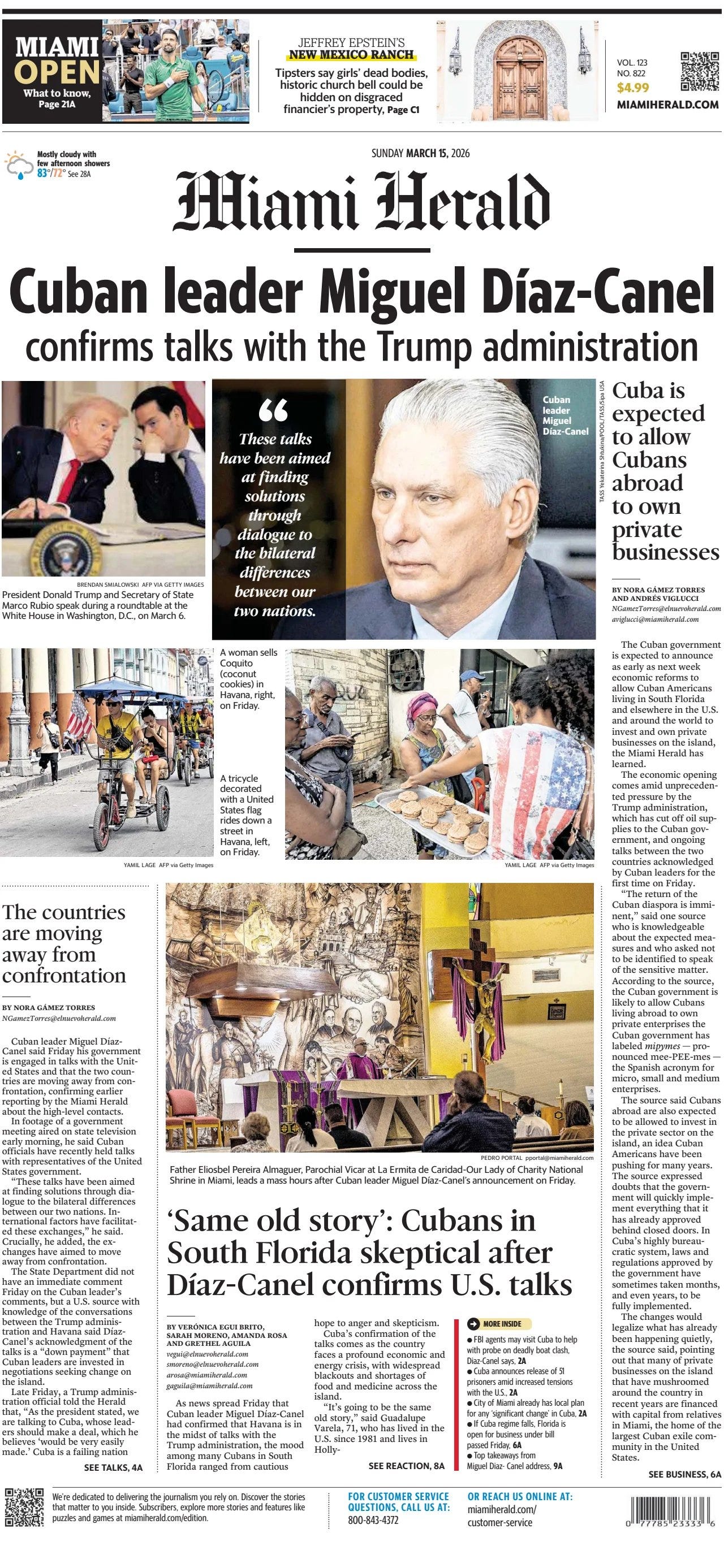
Cuban officials have held talks with the United States, Cuban President Miguel Díaz-Canel confirmed for the first time on Friday, as the island faces an economic crisis and intense pressure from Donald Trump. “There are international factors that have facilitated these talks,” Díaz-Canel said in a video broadcast Friday on national television, describing the purpose of these talks to “identify the bilateral problems that need a solution.” Trump on Friday confirmed Díaz-Canel’s announcement, reposting an article about it on his Truth Social platform. Díaz-Canel said the talks with the US were led by him, along with former President Raúl Castro and some members of his Communist Party, although he did not specify who participated on behalf of the United States. “As the President (Trump) stated, we are talking to Cuba, whose leaders should make a deal, which he believes ‘would be very easily made,’” a White House official said - CNN
A man calling himself “Catman” completed a 4,000-mile walk across Australia while dressed in a full-body cat costume. Viral sensation Kentaro Jin set out from Carnarvon in Western Australia in November 2023 and reached his destination of the Sydney Opera House on the other side of the country on Saturday evening, local time. Jin pushed a yellow wheelbarrow across the coastline of the vast, arid country, raising roughly $50,000 for children’s cancer research along the way. At the finish line, Catman was met by thousands of supporters and well-wishers, many of whom had followed his journey online. Jin has amassed nearly 850,000 followers on Instagram, where he has been sharing his humorous interactions with Australian locals along his journey. The former construction worker is notable for his now-iconic good humour and cheerful demeanor. " I don’t want to be a hero trapped in a screen—I want to be a real presence that brings hope into the real world," Jin wrote on his GoFundMe account. Not content with the walk, he is now planning to cycle back to where he started, eventually completing a full lap of the country - The Daily Beast
The journals….