


Walk pedestrianised Oxford Street this week and you’ll see two kinds of light. Above you, the spectacular twinkling Christmas decorations. Below you, thousands of phone screens, each one lighting up a bowed face. At the junctions where traffic still flows, people drift across the road with their eyes down and their thumbs moving. Within minutes of arriving from Heathrow, a chatty London cabbie told me that pedestrians stepping out without looking up have become one of the hazards of his job.
Welcome to Zombie World. And before you think I’m pointing fingers: I’ve caught myself doing it too.
The zombie is also prey. London has been dubbed Europe’s phone-theft capital: 71,391 phones were stolen last year, about one every seven minutes. So the scroll-walker faces two dangers at once: the bus he didn’t see, and the thief on the e-bike he didn’t hear.
Christmas dinner, interrupted
Before I wrote Digital Pandemic, I spent a sabbatical in southern Portugal working on a book about device addiction. Its working title was Digital Crack. The research took me to places far and wide that I still think about.
One was a family’s story from California, at Christmas. Twin boys are upstairs on their iPads. Their mother calls them down for dinner. They don’t come. She goes upstairs and takes the iPads away, and one of the boys punches a hole through the wall.
Another was a rainy morning in 2018 at reSTART, a treatment centre in the woods near Redmond, Washington, a short drive from Microsoft’s headquarters. Parents from across the United States paid huge sums to send their sons there. The ones we met were all young men, many of them hooked on gaming. Many had been given a blunt choice: go seek treatment, or move out of the house.
What struck my research assistant and me most was how hard it was for them simply to talk to us. Many could barely string a sentence together or look us in the eye. These young men were in a very bad place, though the centre was doing remarkable work with them.
The programme started cold turkey, with every device taken away. The days were filled with games and group talks. Only later was technology slowly brought back, along with help getting back into the workforce.
Scientists still argue over whether “addiction” is the right clinical word. But anyone who has tried to take a tablet out of a child’s hands knows what withdrawal looks like.
The man who built the hook
One of the most fascinating persons I met during my research was Ramsay Brown, in Venice Beach, California. A too-cool-for-school type of guy. His startup, then Dopamine Labs, sold software designed to make apps more addictive. He explained to me, with real passion, how developers deliberately code their apps to mess with people’s brains in a “weaponised way.” Then he’d had enough.
Brown had already been interviewed by Anderson Cooper for 60 Minutes, so he didn’t need another hack knocking on his door. He agreed to meet me anyway because, he told me, he thought I was cool. I’ll take it.
He and his team built an app that does the opposite, called Space. Before it lets you into Instagram, Facebook and other addictive apps, it makes you stop and breathe. The adjustable pause starts at a few seconds, just long enough to ask yourself whether you really need to pick up the phone.
The tech industry has spent years removing every bit of friction between us and our screens. He helped put a little back. Bravo!
Apple’s first response, according to Brown, was to refuse Space a place in its App Store. An app that encourages people to use their iPhones less, it apparently decided, was inappropriate. Remember that the next time a tech giant tells you it’s on your side.
Three screens, one lecture
At California State University, Dominguez Hills, just outside Los Angeles, I sat in on a class taught by the psychologist Larry Rosen. His message: we are far worse at multitasking than we think. His students were proving it as he spoke, with laptops open, Facebook open, and half a dozen things going at once.
“The ones who think they’re better at multitasking are actually worse at multitasking.”
— Larry Rosen
When Rosen later joined me and my then co-host, Melissa Ricci, on our podcast, he wasn’t surprised. What we call multitasking, he explained, is really task-switching, and we bounce between tasks so fast that “there’s no time for you to thoroughly absorb it deep into your brain. So it just literally gets lost.”
It isn’t just his students. Touring campuses with his daughter, he once sat at the back of a Harvard physics lecture: “Every single one had Facebook on, every single one.” Nor is Rosen immune himself. He watches Dodgers games on his phone while the news is on, then can’t tell his wife what the story was about. “I know you can’t do that,” he admitted. “And yet I was trying.”
What we’re missing
In 2018, writing for CNN Opinion, I called smartphones a kind of digital heroin for young people. I asked for a public-health campaign like the one that turned the world against smoking. We got screen-time settings and some school phone bans. Walk down Oxford Street and tell me we’ve won.
Meanwhile, one in three children worldwide is now short-sighted.
But here’s what worries me most at Christmas, the season of parties, mistletoe and, for some, the accelerated search for a match. I’ve long said you could be sitting at an airport gate, eyes on your phone, while the love of your life walks past, and you would never know.
Back in 2009, I complained to the New York Times that my seat-mates on planes hid behind magazines. On one flight from Toronto to Edmonton, though, I sat next to an off-duty Air Canada flight attendant, the airline’s only Afghan crew member at the time. We traded stories, and she read my palm. She told me I had many angels guarding me.
In fairness
The screen isn’t the villain of every story. In Digital Pandemic, I described how Covid-19 gave technology an unexpected image reboot. During the fiercest lockdowns, our phones and laptops kept us connected to loved ones. They kept us learning, working and informed. We ordered takeaway, saw doctors by video and, in my case, raised prosecco-fuelled toasts with friends half a world away. Lonely people found support groups, and the stigma around anxiety and depression began to fade as more people sought help.
But the devices that rescued us in lockdown never loosened their grip. A report in March 2021 found that 32% of young US adults reported symptoms of depression because they were unable to detach themselves from their screens. The problem was never the tool. It’s that we’ve forgotten how to put it down.
Look up
I’ve spent recent months reporting from Odesa. There, looking at your phone can save your life, because that’s how the air-raid alert reaches you. In London, too many of us look down to escape our lives.
So this Christmas, give yourself a gift that costs nothing. Put the phone in your pocket. Look up. Those angels might be closer than you think.
News Briefs
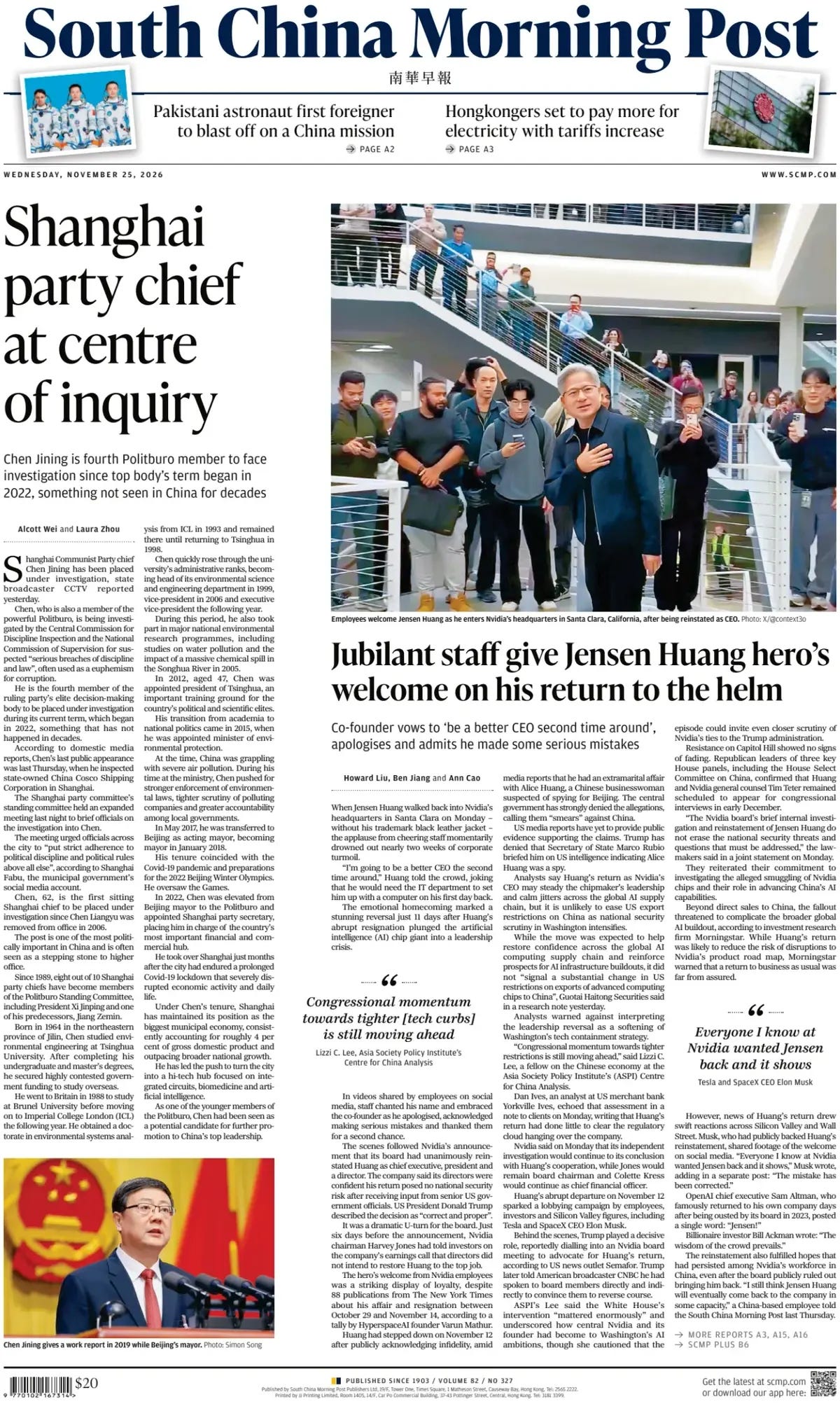
China has put Shanghai’s Communist Party chief, Chen Jining, under investigation, the latest step in the biggest shake-up of Beijing’s political elite in decades. State broadcaster CCTV said on Tuesday that the party’s anti-graft bodies are investigating the 62-year-old over suspected serious breaches of discipline and law, a phrase often used to mean corruption. The South China Morning Post reports that Chen is the fourth Politburo member to be put under investigation since the current leadership term began in 2022, something China hasn’t seen in decades. China watcher Bill Bishop says it hasn’t happened since 1976. Chen is also the first sitting Shanghai party secretary to be investigated since Chen Liangyu was removed in 2006. Chen’s fall is a sharp reversal. He is an environmental engineer who earned his doctorate at Imperial College London and went on to lead Tsinghua University. He then served as environment minister and as mayor of Beijing, where he oversaw the 2022 Winter Olympics, before taking over Shanghai after its punishing Covid lockdown. Until now he was widely seen as a candidate for promotion to the top leadership. No reason has been given. Bishop wrote in his Sinocism newsletter that the cause is still unknown. Other analysts see the case as part of Xi Jinping’s pattern of removing anyone who might rival or succeed him, after a purge that has already reached the top of the military. Beijing’s official press is keeping quiet about it. On Wednesday, the front pages of People’s Daily, China Daily and the Global Times made no mention of Chen, as far as World Briefing can tell. They led instead with Xi’s message marking the International Day of Solidarity with the Palestinian People and with the upcoming Shenzhou-24 launch, which will carry the first foreign astronaut to China’s space station, from Pakistan.
The C4 that wasn't: FT probe into UK explosives for Ukraine
Britain’s Ministry of Defence spent millions of pounds on explosives for Ukraine that were not what the supplier said they were, according to an investigation published today by the Financial Times.
The FT reports that the MoD’s procurement unit for arming Kyiv bought tonnes of a product sold as a new, more powerful form of C4 plastic explosive, called “EDC-4”. The seller was Tripwire South LLC, run by Pennsylvania arms dealer Ryan Morris, who the paper says also worked as a part-time police sergeant. The explosive was meant for Ukrainian attack drones.
According to the FT, the material was actually a cheaper commercial explosive based on PETN, with no detectable RDX, the main ingredient of military C4. The paper says the MoD’s own tests reached the same conclusion. Even so, shipments of several tonnes at a time kept going to Ukraine. They came with safety sheets that left out handling warnings found in the original manufacturer’s documents. An expert quoted by the FT says PETN reacts more readily to heat and friction.
The FT says the deals allowed Britain to buy hundreds of tonnes. One contract alone carried an option worth about £26.3mn.
The FT also describes Morris’s finances. His earlier explosives business collapsed in August 2022 owing nearly $5mn, and he filed for personal bankruptcy in 2024, while Tripwire was already supplying the MoD. He was discharged from bankruptcy in January 2025. About ten weeks after the April 2025 procurement paperwork was signed, the paper reports, he held a Bridgerton-themed wedding at Mount Juliet Estate, a five-star resort in Ireland.
On Tuesday, MPs questioned national armaments director Rupert Pearce. He said the purchase, as described to him, “sounds like fraud,” but added that he had not yet read the report. Tripwire says that remark came from a committee member misstating the facts. The MoD told the FT it considered the explosive fit for purpose and had good feedback from Ukraine.
Tripwire denies wrongdoing, says every batch contained RDX, and has threatened legal action against the FT.
World Briefing has put questions to the Ministry of Defence.
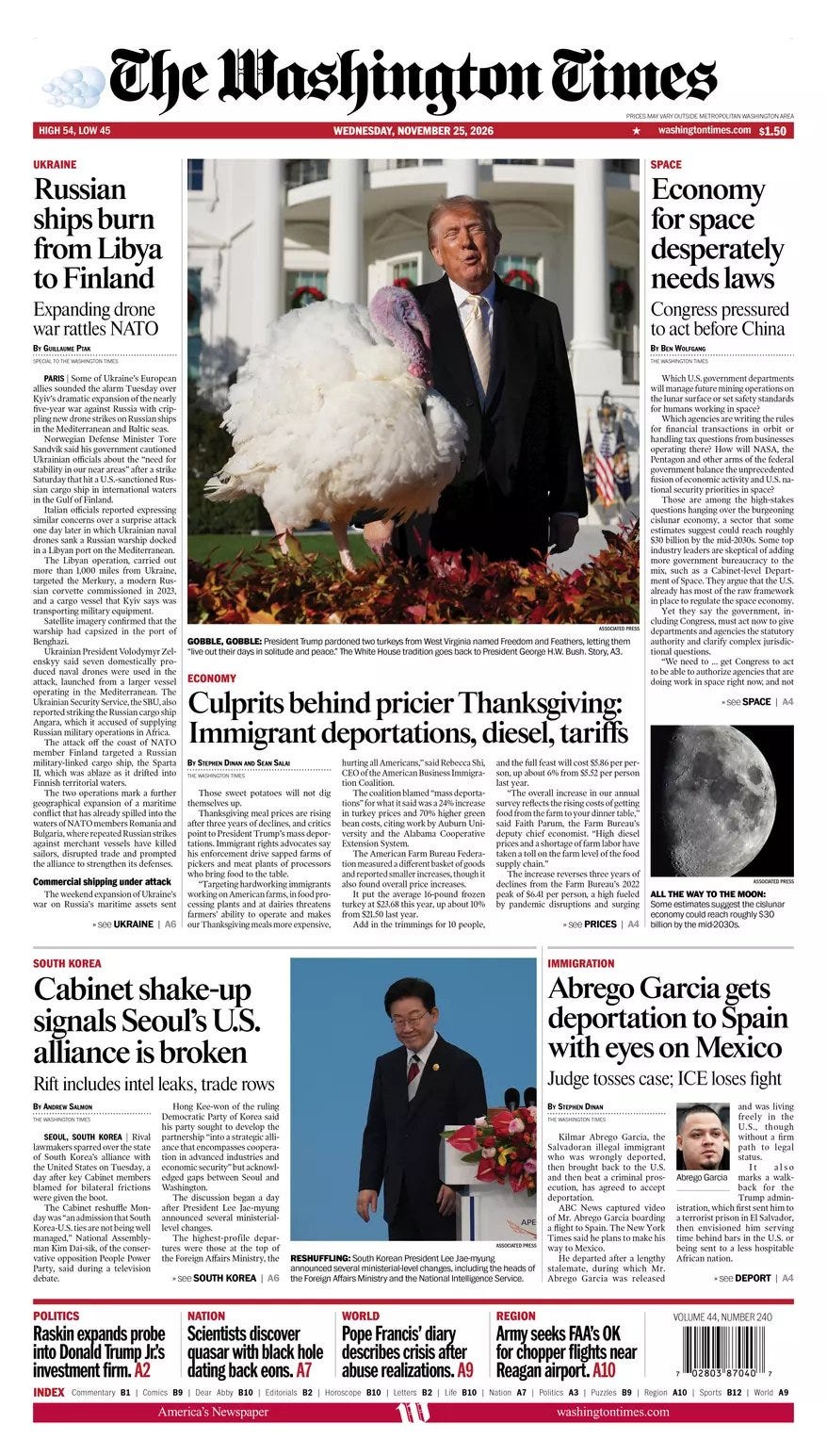
The Trump administration has quietly shelved proposals to use business deals as an incentive for Russia to end the war against Ukraine after Moscow showed little interest in proposed energy and aviation ventures, the Financial Times reported on Wednesday. Trump’s special envoys Steve Witkoff and Jared Kushner told European officials that corporate tie-ups were no longer a core part of the U.S. pitch to Russia, the FT report said, citing five officials briefed on the change in tactic. Top Russian and U.S. officials, including Kushner, held talks about selling ownership of the company that controls the Nord Stream gas pipelines to an American investor, Reuters reported in October. The pipelines delivered natural gas to Germany before being blown up in September 2022. Kushner, who has been trying to broker a truce between Russia and Ukraine and views doing business as central to securing peace, also floated post-war ideas such as U.S. companies investing in Russian oil projects and titanium production ventures, the FT report said. Russian officials initially responded positively to the U.S. suggestions, but Russia has since cooled on the idea, as it insists on Ukraine giving up territory and making other concessions Kyiv considers unacceptable in exchange for peace, the report added. “It was made pretty clear that the Russians were not in the market for this kind of thing,” one of the officials told the FT. In October, the Trump administration temporarily lifted U.S. sanctions on Russian fuel that were designed to deprive Moscow of revenue for its war on Ukraine after Russia agreed to supply diesel to global markets in an effort to lower fuel prices - Reuters via MT
Some British drone makers are moving their testing to Canada. According to the Financial Times, they’re being driven out by slow permits and outdated laws at home. The FT reports that Autonomous UK, a new trade body for the sector, says some firms have already moved trials across the Atlantic. Permits to test aerial drones in Britain can take months to come through, compared with a few weeks in Spain. Makers of uncrewed boats face a bigger obstacle: the Merchant Shipping Act 1995 makes no allowance for a vessel without a master on board, so they can’t legally trial at sea. The group, which launched its manifesto today, also warns that the government’s own defence investment plan shows spending on new uncrewed systems falling by more than half by 2029-30. Meanwhile Russia updates its drones every four to six weeks, the body told the FT. The MoD told the paper it is putting more than £5bn into drones and autonomous systems over the next four years. It called this the biggest investment of its kind in the history of the UK armed forces.
The French navy seized more than 3.3 metric tons of methamphetamine from a tanker sailing without a flag in the Pacific Ocean, the French army said. The vessel was intercepted on Friday, November 20, following several weeks of surveillance, according to AP. The operation was coordinated from Maritime information centers in French Polynesia and New Caledonia along with with other international partners. A boarding team from a French frigate took control of the vessel. Air support came from the frigate’s helicopter, a French military Falcon 50 and a maritime patrol plane from the US Coast Guard.
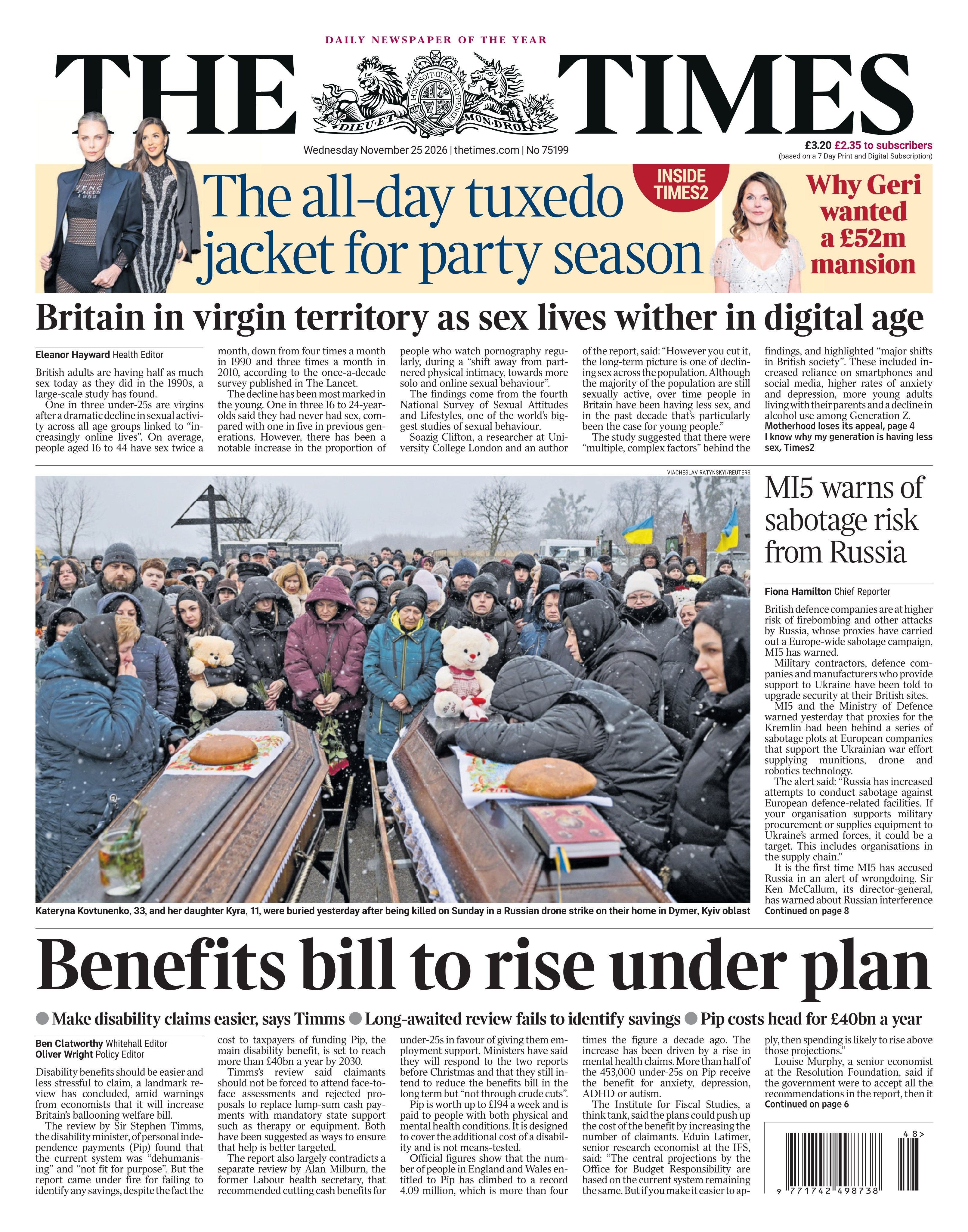
Donald Trump has come up with an explanation for why he still hasn’t found someone to replace Karoline Leavitt as White House press secretary: the 80-year-old president likes doing the job himself. The White House has been without a permanent press secretary since August, when Leavitt, 29, left the role, saying she wanted to spend more time with her two young children. She has since moved into Trump’s political operation and has signed as an on-air contributor at Fox News. Her departure has hardly been followed by a smooth succession. Leavitt's replacement, Katie Zacharia, lasted just five days before her brief tenure imploded after a disastrous first press briefing that ran for only 14 minutes. Since then, the administration has struggled to settle on a successor. Trump even floated the idea of handing the job to UFC president Dana White, after apparently confusing him with a former Pentagon spokesperson with the same name. Yet the president sees little urgency in filling one of the key positions at the White House. Asked by the New York Post why the vacancy remained unfilled, Trump suggested that his own frequent interactions with journalists made a press secretary largely unnecessary - The Daily Beast
The journals…
I’ve seen people out at dinner, on their phones the whole time, hardly speaking to each other.