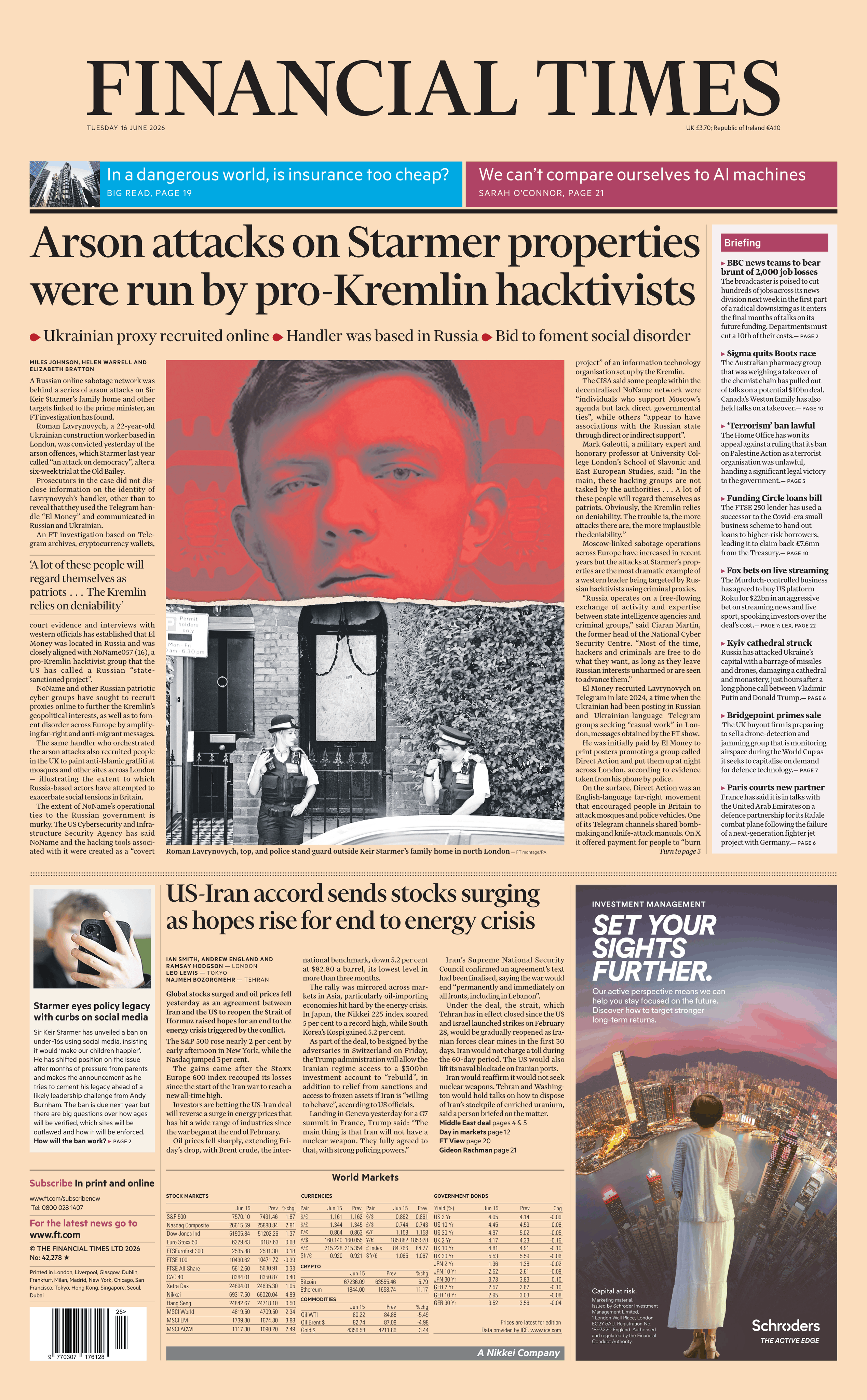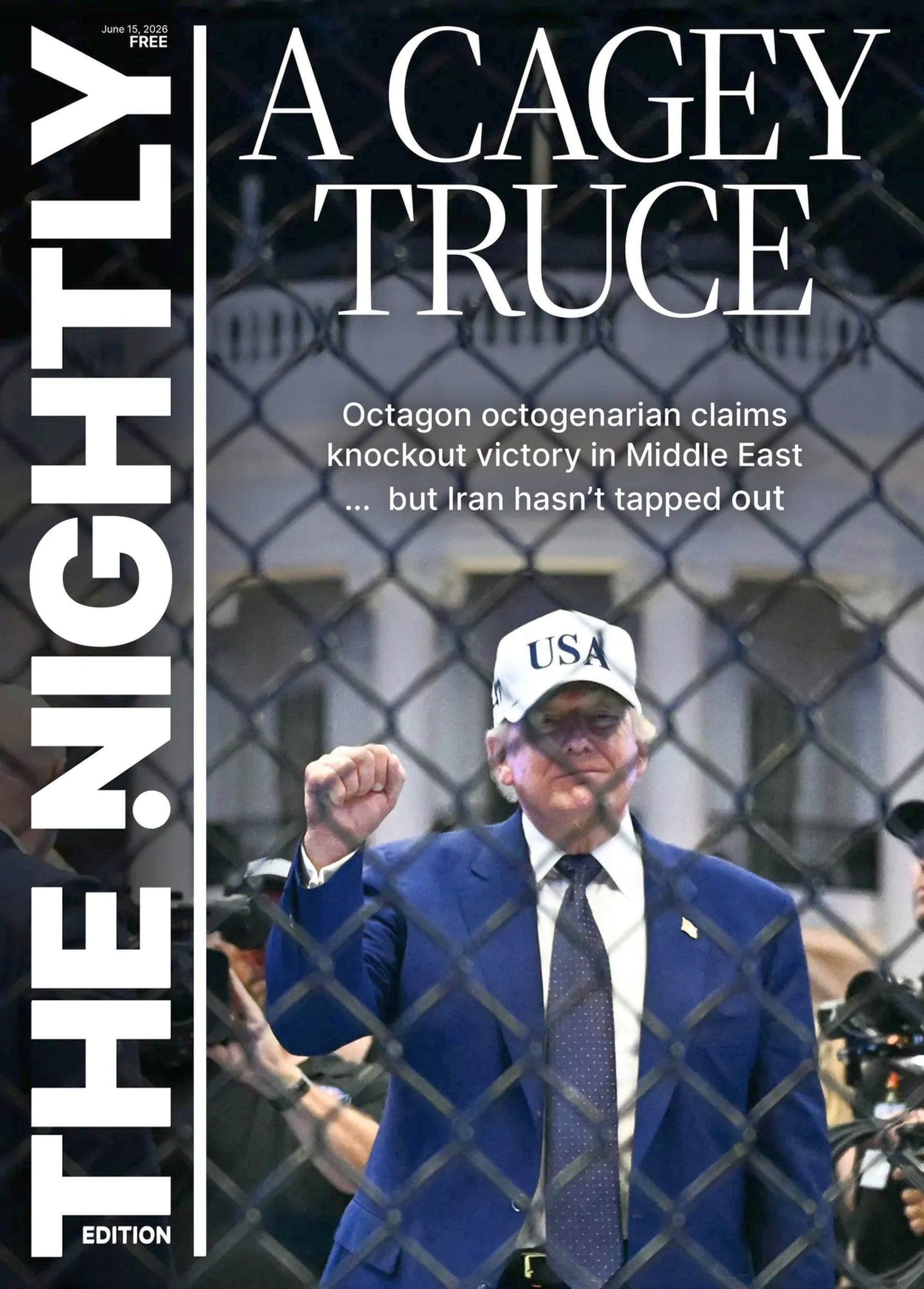
As G7 leaders gather Monday in the French lakeside resort of Évian-les-Bains - with the Ukraine war, trade tensions, and the Iran-US conflict on the agenda - a landmark investigation has landed that couldn’t be more timely, with both the BBC and the Financial Times claiming it as their own: a detailed, damning exposé of a sophisticated Kremlin-linked sabotage campaign that went all the way to the doorstep of the British prime minister. The rare sight of two outlets of this stature publishing what appear to be parallel investigations - on the same day, with overlapping but distinct findings - suggests either a coordinated drop or a remarkable convergence of sourcing. Either way, the combined weight is considerable.
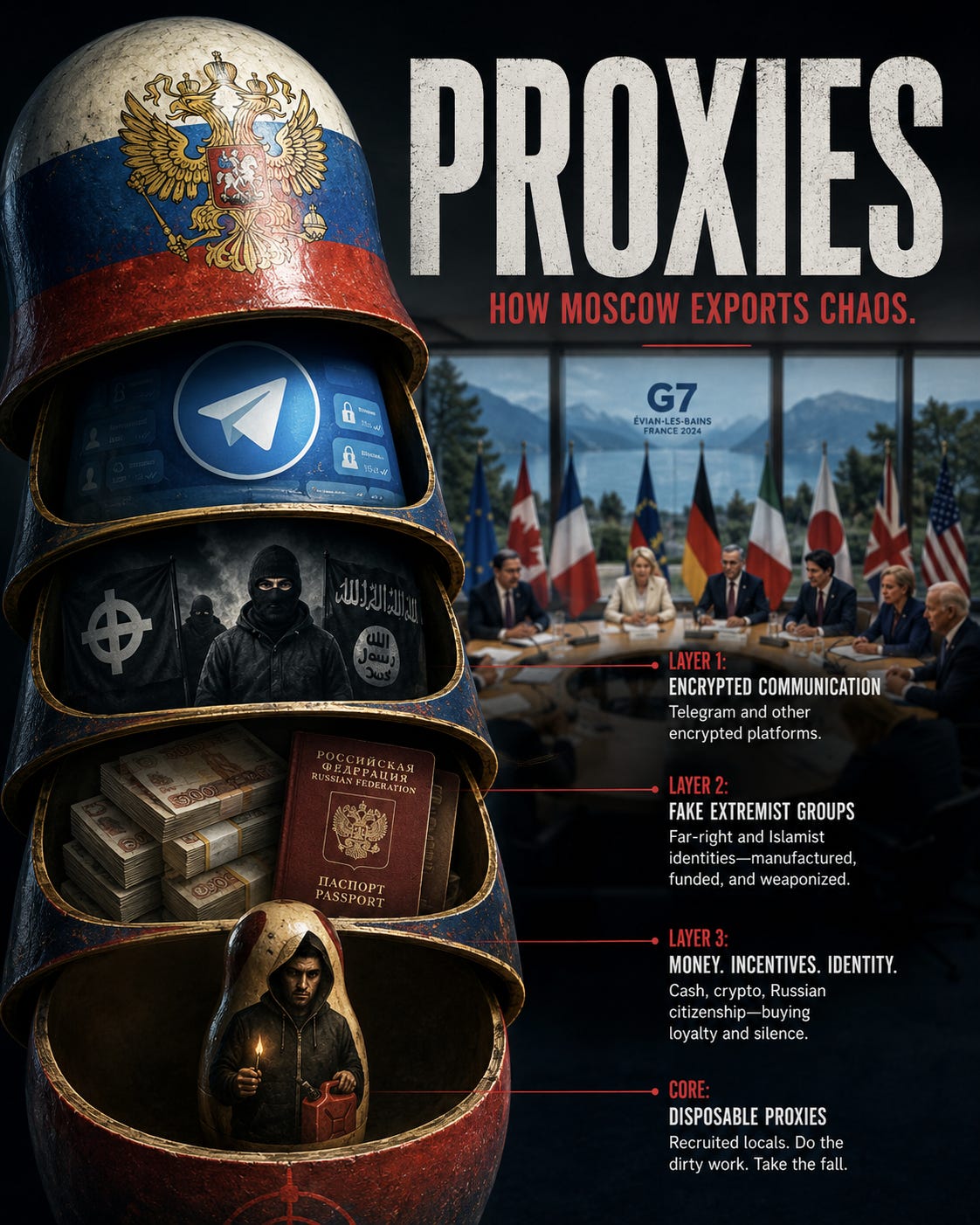
A Ukrainian builder named Roman Lavrynovych was convicted Monday of conspiring to commit arson attacks on property connected to Sir Keir Starmer - including setting fire to the home rented to his sister-in-law. But the real story, both outlets find, was never told in court: Lavrynovych was a recruited proxy, directed through Telegram by a handler known only as “EL,” who offered money, Russian citizenship, and ideological cover in the form of fake far-right and fake Islamist groups manufactured in Moscow. The FT adds that US cybersecurity authorities have linked the broader network to a Kremlin-established IT organisation called NoName057(16) — described as a “state-sanctioned project.”
The BBC has identified EL as Evgeny Lyukshin - a 23-year-old Russian diplomat’s son trained in information warfare at the Moscow State Institute of International Relations, schooled using Rybar’s manuals, and photographed standing behind a senior Russian deputy foreign minister. His fingerprints are all over a network of fake online groups - including one called “Direct Action UK” - that paid people to vandalize mosques, spray Islamophobic graffiti, and stir ethnic and religious division across Britain. A parallel fake Islamic group, the “Takbir Foundation,” was designed to inflame the far right. When the BBC contacted Lyukshin, the Radio Southport Telegram channel - and four other Rybar-created UK hate channels - vanished within hours.
The trial, by design, stayed narrow. The identity of “EL” was deliberately avoided. UK counter-terrorism police say they cannot yet prove state involvement. But British and Ukrainian authorities have privately concluded Russia was behind the attacks — and former Defence Secretary Ben Wallace says the assault on the prime minister’s home would not have come from a low-level actor: it would have come “from the very top.”
Expert voices add crucial texture. Cited in the FT, Mark Galeotti, honorary professor at UCL’s School of Slavonic and East European Studies, captures the Kremlin’s calculated ambiguity: “In the main, these hacking groups are not tasked by the authorities... A lot of these people will regard themselves as patriots. Obviously, the Kremlin relies on deniability — the trouble is, the more attacks there are, the more implausible the deniability.” Ciaran Martin, former head of the National Cyber Security Centre, is more blunt: “Most of the time, hackers and criminals are free to do what they want, as long as they leave Russian interests unharmed or are seen to advance them.”
The timing could cut either way for European leaders trying to keep Ukraine - now 4.5 years into a full-scale Russian invasion - on the G7 agenda. Ukraine was not even listed as one of the US goals for the summit, and European diplomats see the gathering as an opportunity to convince Trump that US proposals for a deal have been too favourable to Moscow. This twin investigation hands them a timely piece of evidence: proof that Russia isn't just fighting on the battlefield, it's waging information warfare, recruiting proxies, and setting fires on the doorstep of a G7 head of government. Whether that's enough to refocus Trump's attention - currently consumed by Iran, trade, and AI - on the Kremlin's broader threat is the open question heading into Tuesday's Ukraine session with Zelensky.
The attack on the prime minister's property would not have come from a low-level individual; it would have come from the very top - Ben Wallace, former UK Defence Secretary
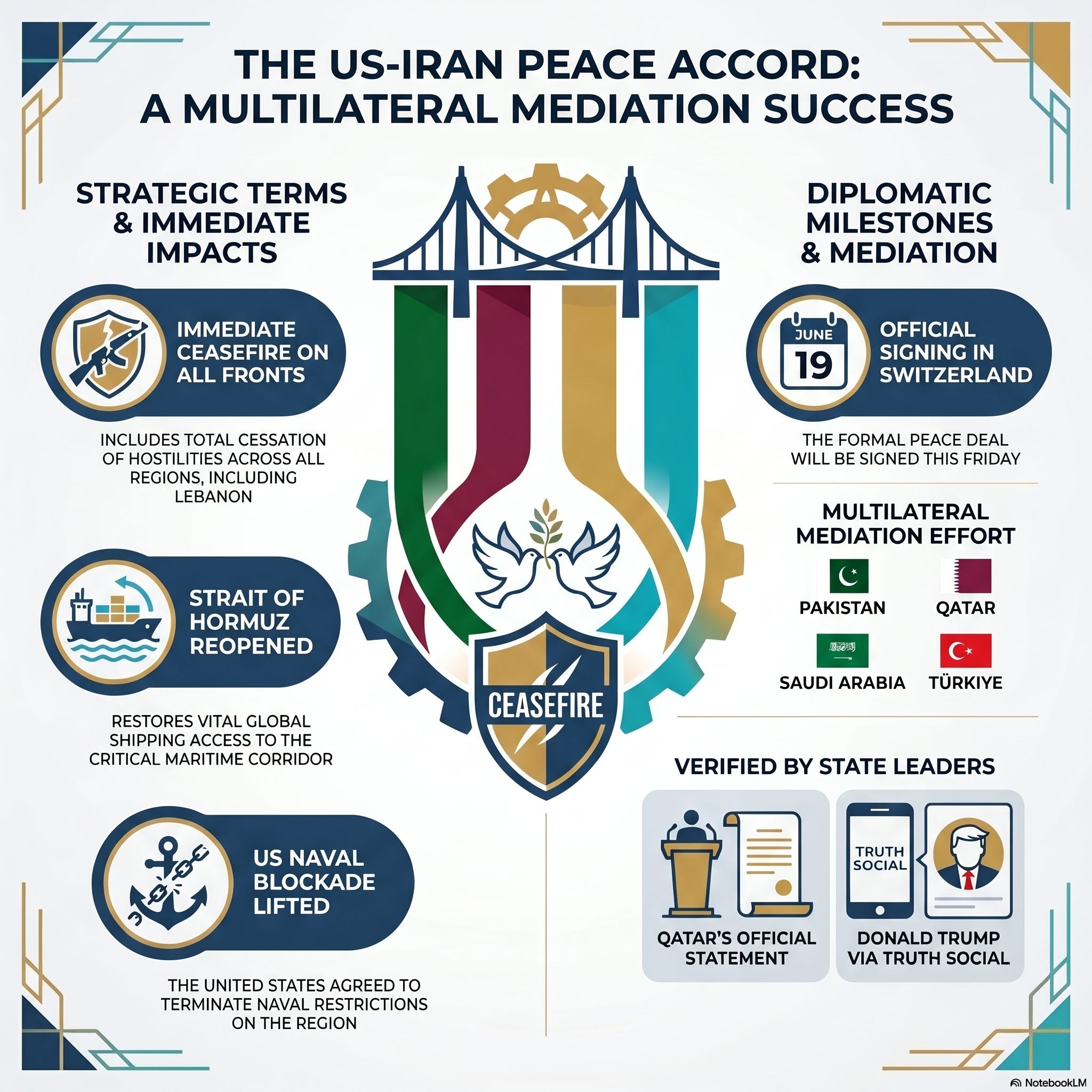
The United States and Iran have signed a memorandum of understanding to end a near four-month war, senior U.S. officials said on Monday, adding that a formal signing ceremony would take place on Friday and shipping traffic in the Strait of Hormuz would significantly but gradually ramp up. The memorandum of understanding has been signed by President Donald Trump and Vice President JD Vance and Iranian parliament speaker Mohammad Bagher Qalibaf, one U.S. official said. After weeks of negotiations, the news that Washington and Tehran had agreed to end the war brought relief to markets, although risks remain given the pact defers potentially complicated talks on containing Tehran’s nuclear program. While still a framework, the deal marked the biggest breakthrough toward resolving the conflict that has killed thousands and upended energy markets since it began with joint U.S.-Israeli strikes on Iran in February. The MOU will provide a structure for how the U.S.-Iran relationship will operate in the future, said the official, speaking on the condition of anonymity in a briefing with reporters, emphasizing that any benefits to Iran such as sanctions relief and release of Tehran’s frozen funds would only come based on their willingness to work with Washington on their nuclear program and not fund what the U.S. official described as “radicalism” in the region. n the short term, the MOU will allow the immediate reopening of the Strait of Hormuz, a major shipping route for global oil and gas supplies that Iran has effectively shut for months, but one U.S. official cautioned that it would take a while for traffic to return to normal. Israel’s withdrawal from Lebanon is not a condition of a pact between the United States and Iran, said a senior U.S. official on Monday, adding Israel will have the right to defend itself against any attacks by Hezbollah - Reuters
Turkey and Saudi Arabia aim to build a railway to link the two countries with Jordan and Syria in the next three or four years, Turkish Transport Minister Abdulkadir Uraloglu said on Sunday, adding other Gulf countries would also join the project. Speaking to Al Jazeera, Uraloglu said the railway would help alleviate in future the problems that have arisen from the disruption of the Strait of Hormuz caused by the war in Iran. The project is described in a memorandum of understanding signed between Ankara and Riyadh last week on logistics cooperation and the railway sector. In the initial phase, a rail link would allow for the transport of goods, oil, natural gas and people between Saudi Arabia, Turkey, Jordan, Syria and Europe, Uraloglu said, adding that the United Arab Emirates, Kuwait, Qatar, Oman, and possibly Yemen would be included later too. “A train leaving from Saudi Arabia, from Riyadh already reaches several regions of Saudi Arabia. So this is a project for it to reach Turkey via Jordan and Syria. We are talking about a route that will carry every type of freight via this route to Europe,” Uraloglu was cited as saying. He said the route from Saudi Arabia to Jordan’s border had been finished and on the Turkish side, the link was completed from Islahiye to Kilis and Gaziantep in southeastern Turkey, near the border with Syria.
That leaves a gap of some 400 km (248.55 miles) between Syria and Jordan, he said.
In addition to commercial trade, Uraloglu said the railway could also be used by people on the annual Muslim hajj pilgrimage - Reuters
Vietnamese police have busted a group suspected of trying to establish a large-scale online scam centre in the country, authorities said, as criminal networks spread their operations across South-east Asia. Police in Phu Tho province uncovered and disrupted a transnational group linked to online fraud syndicates operating in Cambodia, preventing it from setting up what they described as a major scam hub in Vietnam, the Ministry of Public Security said in a statement. Four people were arrested, including a Chinese national and three Vietnamese, according to the statement. Investigators said that the group had rented multiple resorts, farmstays and villas in Hanoi, Lao Cai and Phu Tho to house dozens of people as part of their preparations, adding that many of them had previously worked at scam centres in Cambodia. Police also seized dozens of computers, hundreds of mobile phones and Internet devices allegedly used for online fraud, saying the site was close to becoming operational. The raid “prevented the formation of a large-scale transnational high-tech fraud centre within Vietnam”, and also helped safeguard national security and protect people’s assets, the ministry said. In a separate case, police in business hub Ho Chi Minh City earlier this week detected 83 Chinese nationals staying at a hotel in the city, also allegedly preparing to set up on online scam centre there, state media reported on Friday. They had illegally entered Vietnam from Cambodia, Tuoi Tre newspaper cited the police as saying, adding that they were planning to target Chinese victims. Speaking at a virtual press briefing on Wednesday, FBI co-deputy director Andrew Bailey described scam compounds as among “the most significant threats facing the world today”, warning that their impact across South-east Asia was “growing at an exponential rate”. - Business Times
Medical charity Doctors Without Borders (MSF) admits its staff were accused of sexually abusing at least 59 Sudanese refugees who had fled the civil war in search of safety. Young girls were exploited in some cases, and often food or jobs were offered in exchange for sex. The offences were committed in eastern Chad and date back to 2024 - about a year into Sudan’s still-raging civil war. MSF says it has sacked 18 culprits but tells the AP news agency it was unable to identify some of the other alleged perpetrators. The aid organisation also found patterns of exploitation that might amount to “sexual trafficking”, its own internal report suggested in July. Some of the victims reportedly chose not to speak out about the abuse because they feared access to vital aid would be withheld in retaliation. Those who did report the abuse sometimes received no reply or support, MSF has admitted in its own report, while official complaints procedures were mostly ineffective. “This misconduct represents a serious breach of MSF’s values and responsibilities, and we deeply regret the harm caused,” MSF said in response to reporters at AP who first investigated the misconduct -BBC
An Australian video official appeared to flash a hand signal associated with white supremacists during Sunday’s broadcast of Germany’s 7-1 rout of Curaçao. Shaun Evans, 38, was serving as a support video assistant referee when cameras cut to the review booth before kickoff, briefly showing him forming an inverted “OK” gesture. Once a sign of approval, it has been co-opted by the far right—three raised fingers read as a W, and the loop as a P, for white power. Christchurch mosque gunman Brenton Tarrant made the same sign at his 2019 court hearing. Evans, a former bricklayer, worked as a VAR at the 2022 World Cup in Qatar. The anti-racism Fare network demanded his removal, insisting the official “should have no further role to play in this World Cup.” FIFA acknowledged the matter but declined to comment. The Anti-Defamation League characterizes the gesture as a hate symbol but warns “caution” should be exercised in interpreting it because it’s also occasionally used as a harmless playground prank—with the gesture made toward the ground before punching a second person in the arm if they happen to look down - Daily Beast
The journals…..