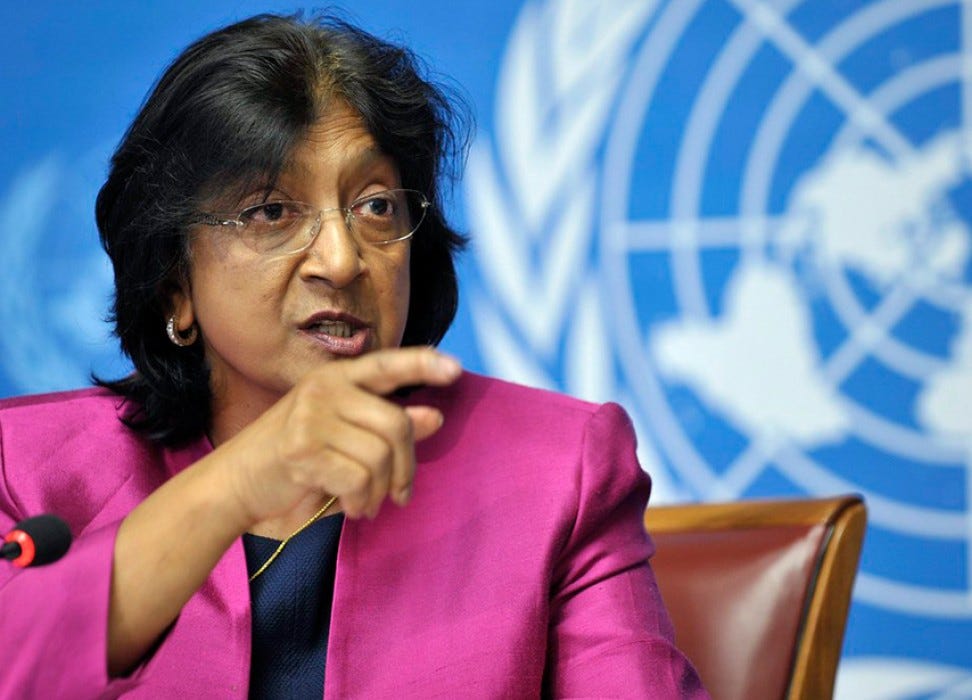
Navi Pillay celebrated her Nobel Peace Prize the way only an 85-year-old jurist who has seen everything could: with a joke at Donald Trump’s expense. Applauded after the announcement, she quipped: “If you clap a little bit more, I may share this prize with Trump.”
Washington’s answer came within hours. The Trump administration sanctioned the International Criminal Court itself, not just individual judges and prosecutors this time, but the institution. That threatens to cut it off from the banks, insurers and software providers it needs to function. Secretary of State Marco Rubio left no doubt about the intent: “Either the ICC will end its threats, or we will end the ICC.” Trump, who has openly coveted the prize, posted on Truth Social that the Nobel committee had “demeaned” it by choosing Pillay. The court called the sanctions an assault on the international legal order and urged its 125 member states to defend it.
The timing could hardly be more pointed. The committee’s chairman warned that the system of international law is under tremendous pressure and its institutions under attack. Pillay, a defence lawyer for Nelson Mandela and the first woman of colour on South Africa’s High Court, went on to serve on the Rwanda tribunal, the ICC and as UN human rights chief.
Former ICC judge Geoffrey Robertson, speaking to the BBC Friday evening, described the Trump team in terms best summed up as “fairly putrid.”
The daughter of a bus driver born under white minority rule, Pillay has spent her life advocating or advising women who’ve faced discrimination, The Times Africa correspondent, Jane Flanagan, told Times Radio today. “I cannot think that she is going to be very bothered by the very severe criticism she’s had - including from Donald Trump, including the very strong criticism from the Israeli Prime Minister Benjamin Netanyahu, and also the Israeli Foreign Ministry who have condemned her as a bigot and even saying that the news of this award would make (one of Adolf Hitler's closest and most devoted followers) Joseph Goebbels applaud from hell. I don’t think she will be bothered by those sort of comments.”
Navi Pillay is one of the great defenders of international legal principles in our time. Her distinguished career reminds us of the need to support, fortify and expand the global rule of law. Navi Pillay’s commitment to justice and human dignity is a source of hope and inspiration to all who seek to bring about a more peaceful world - Norwegian Nobel Committee
For Ukraine, this is not an abstract fight. Kyiv joined the Rome Statute in 2024, and it leans on the ICC more than almost any other country. The court’s arrest warrant for Vladimir Putin over the forced deportation of Ukrainian children anchors what has been called one of the most important international law investigations in modern history. Crippling the court strikes at that work directly.
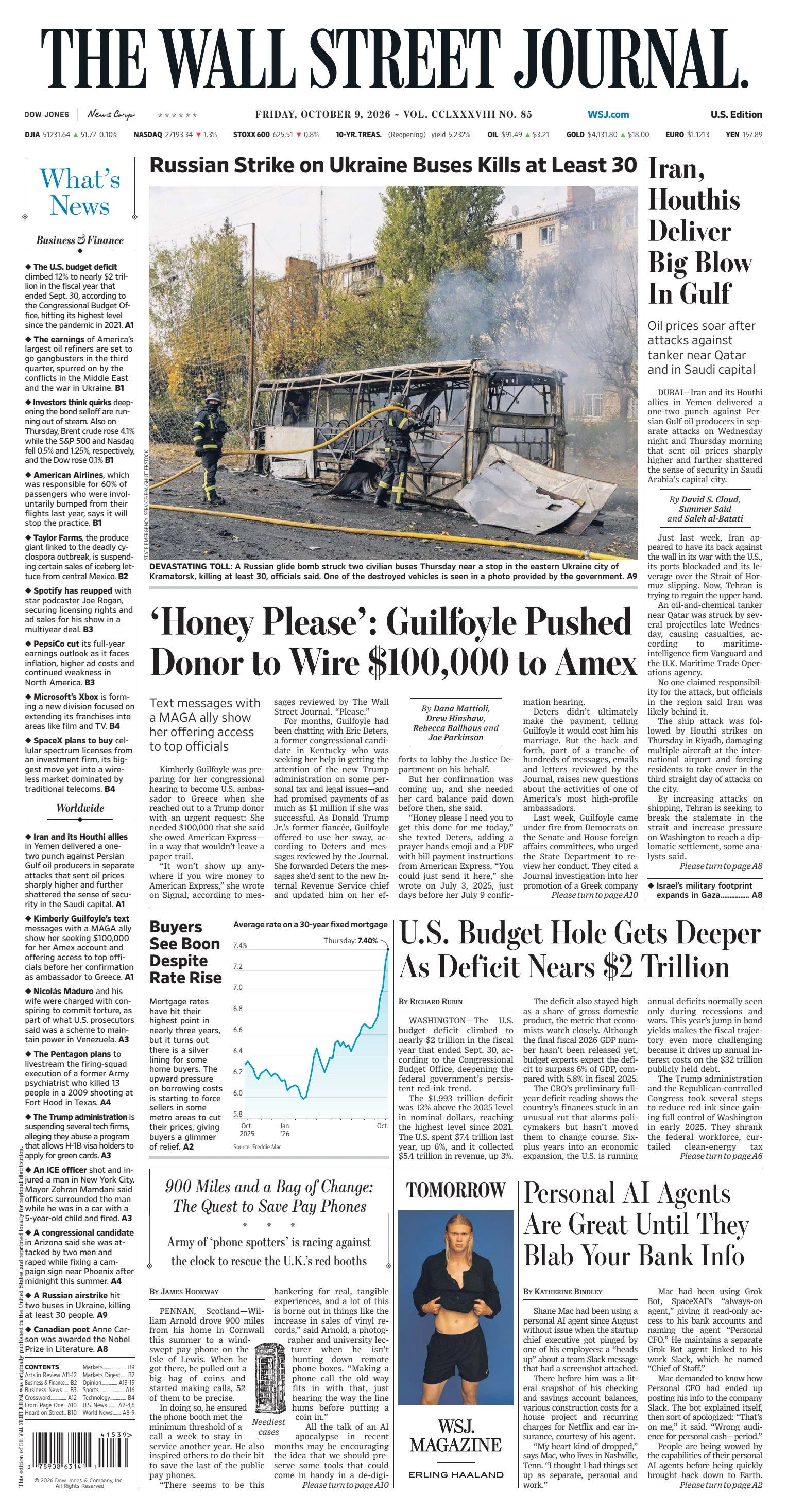
And yet, on the very day Washington moved to strangle the ICC, Ukraine’s negotiators were sitting in Miami with Steve Witkoff and Jared Kushner, the men leading the US-mediated “peace” effort. Speaking to CNN (see video below) and the BBC today, I called it what it is: buffoonery on an epic scale. Their many trips, mostly to Moscow and more recently to Kyiv, have produced nothing. We are no closer to a settlement than when they began. The reflexive move for President Zelensky would have been to pull his team out of Miami, bring it home and turn to a more neutral mediator: Türkiye, which has hosted talks with Russia before, Oman, or even Pakistan. Here on the ground, I detect zero support for leaning on the Americans.
The urgency is hard to overstate. Russia’s recent strikes on bridges, railways, airports, border crossings and Odesa’s port are not the work of an aggressor trying to make life uncomfortable. They show a state bent on taking all of Ukraine, and then some. Kyiv’s mayor, Vitali Klitschko, told AFP this week that the capital is entering survival mode. Repeated strikes on the Dnipro bridges have choked traffic between the two banks, rolling blackouts have briefly halted the metro, and parts of the city have gone without water (as did parts of Odesa today). He is again urging residents with somewhere to go to consider temporarily relocating, a suggestion that drew a backlash last winter. He refuses, though, to call for a full evacuation, warning that “the best scenario for Putin is that we all leave.” In Odesa, where I am reporting, the port that fed the world and sustains the regional economy has been immobilized. It is the equivalent of taking the launch pads out of Cape Canaveral. On the sidelines of UNGA, the clearest minds I spoke to agreed that Putin believes the West is afraid to fight him. He feels zero deterrence, and the war is spreading faster than any of us imagined.
Live from Odesa, I told Zain Asher on CNN Friday that the latest U.S.-mediated talks to end the war in Ukraine amount to "buffoonery on an epic scale." Ukraine, the United States and European officials met to discuss a settlement, but Russia was not even at the table.
News Briefs
The Omani co-pilot who attacked the captain of the Flydubai flight from Dubai to Tel Aviv had planned to crash the plane into Tel Aviv’s international airport in a suicide attack, according to the United Arab Emirates‘ top prosecutor. The statement released on Friday by Attorney General Hamad Saif al Shamsi and published by the state media did not appear to implicate Flydubai in any wrongdoing. According to the statement, UAE public prosecutors believe that the co-pilot’s plan was inspired by the September 11, 2001, attacks on the US and aimed at “causing the greatest possible loss of life.” The investigation found that the suspect had used two previous flights to Tel Aviv to familiarize himself with the flight route and airport. He had worked for several airlines in different countries, including Oman Air and Royal Air Maroc, before joining Flydubai in January 2026. The prosecutor’s findings also showed that he met the professional and security requirements for employment. These requirements included holding a pilot’s license, providing a certificate of good conduct, and completing the necessary background checks. “None of the procedures revealed any indications of his extremist views or his intention to carry out a terrorist plot,” according to the statement - DW
King Charles has paid Andrew Mountbatten-Windsor’s £1.5m repair bill that’s owed for the poor condition of Mountbatten-Windsor’s former home at Royal Lodge in Windsor. It’s understood that the money is coming from the King’s private income - and will cover what Andrew owes his former landlords, the Crown Estate, on leaving Royal Lodge. There was a total £1.8m penalty for the “dilapidations” to Royal Lodge, but that has been reduced by the £300,000 Mountbatten-Windsor would have received for an early surrender of his lease. The Crown Estate say they have not given any money to Mountbatten-Windsor at the conclusion of his lease and have now received the net £1.5m payment they were owed. Mountbatten-Windsor left his Royal Lodge home in February, in the middle of a storm of revelations about his connections to the US sex offender Jeffrey Epstein. He has consistently denied any wrongdoing in relation to Epstein - BBC
President Donald Trump said Thursday that the White House will consider anyone who does not adopt his preferred term of “super intelligence” as “the enemy,” escalating his campaign to rebrand artificial intelligence amid calls to erect more guardrails. “The White House considers anyone that uses the term, ‘Artificial Intelligence,’ as opposed to the highly accepted new and more accurate term, ‘Super Intelligence,’ THE ENEMY!” Trump said on Truth Social. The renaming of AI to “super intelligence” is part of a rebranding effort by the president to cast a more positive light on the rapidly developing technology. The technology has encountered intense scrutiny by lawmakers and experts about whether it has the appropriate guardrails to address safety and security concerns, particularly as instances of rogue agents accessing government websites have cropped up in different parts of the world. Trump has largely brushed off calls to rein in AI development, meeting with billionaire executives at the White House to vouch for the rapidly developing technology as an overall positive for the world, as well as necessary for economic growth and national security. He has argued that “super intelligence” is a better portrayal of the technology’s capabilities and has gotten some of the industry’s executives to use the term -POLITICO
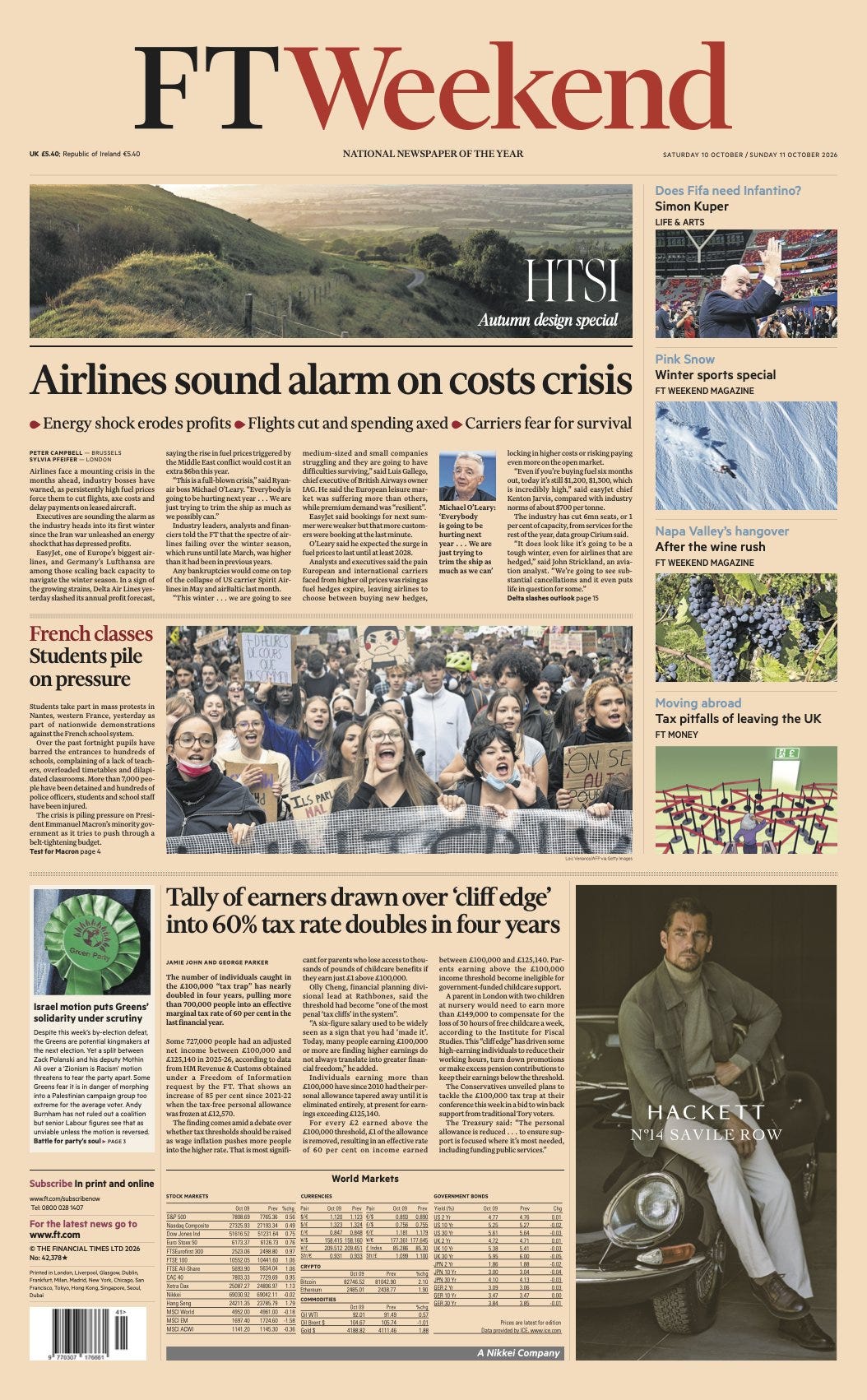
Europe’s airlines are bracing for a brutal winter. Industry bosses told the Financial Times that persistently high fuel prices, driven by the energy shock from the Iran war, will force them to cut flights, slash spending and delay payments on leased aircraft. “Everybody is going to be hurting next year,” warned Ryanair’s Michael O’Leary, who expects elevated fuel costs to last until at least 2028. The pain is spreading. easyJet and Lufthansa are among carriers scaling back winter capacity, and Delta Air Lines has slashed its annual profit forecast, saying the fuel spike will cost it an extra $6bn this year. Jet fuel is still running at $1,200 to $1,300 a tonne, against a norm of around $700, and the squeeze will tighten as fuel hedges expire. Analysts and financiers now openly raise the prospect of airline failures before winter ends in March. That would come on top of the collapses of US carrier Spirit Airlines in May and airBaltic last month. Medium-sized and smaller carriers are the most exposed, the FT reported. IAG’s Luis Gallego says Europe’s leisure market is suffering most, while premium travel is holding up. For passengers, expect fewer seats, higher fares and more last-minute uncertainty.
Accused of Spying, Treated Like Terrorists
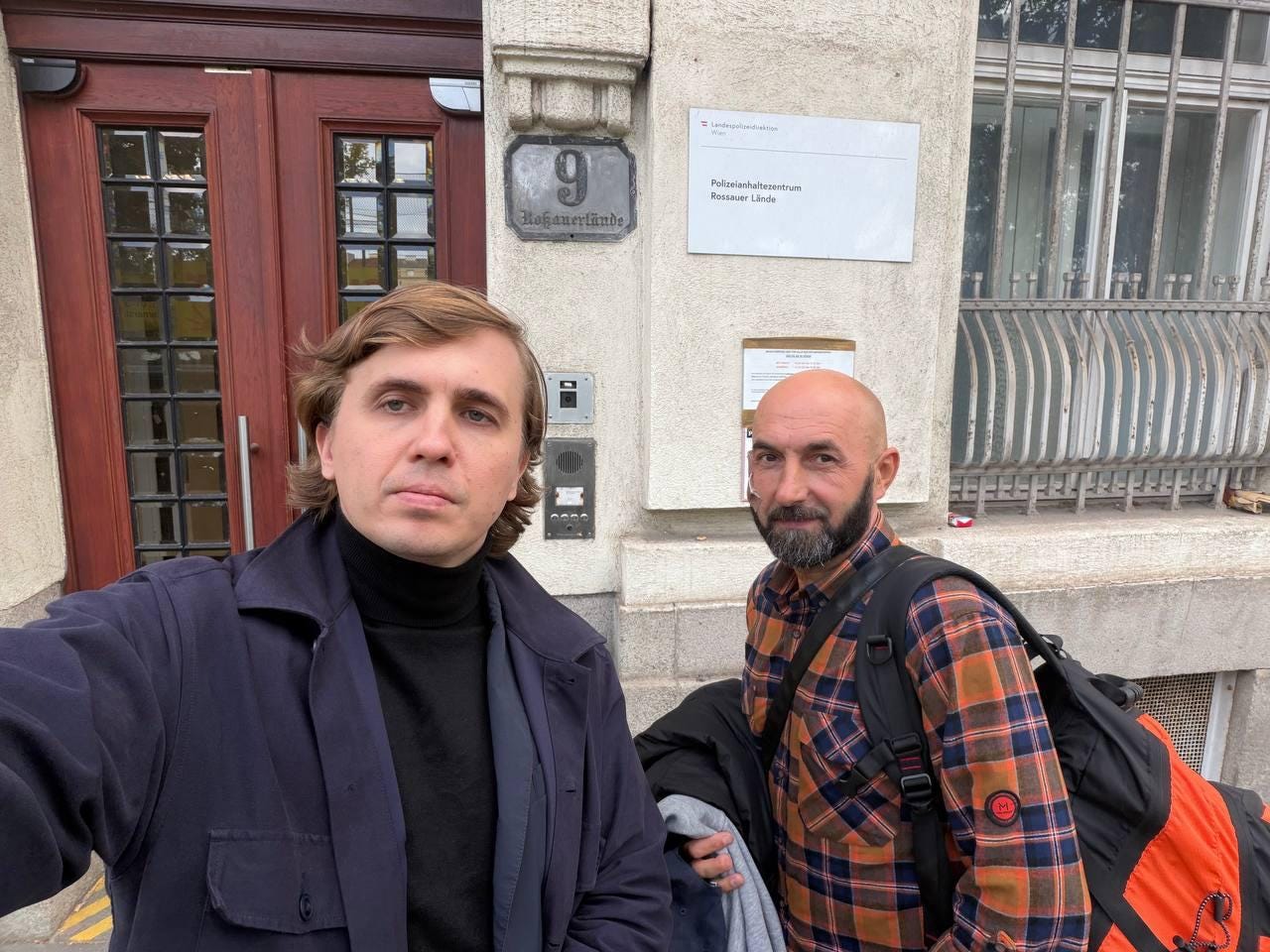
Masked, armed officers dragged a Ukrainian investigative reporter from his car in Vienna and held him for 12 hours on suspicion of spying for Ukrainian military intelligence as he tracked a fugitive former prosecutor general. His injured cameraman is still in custody, and Austria has yet to produce a shred of evidence.
Austria has some explaining to do, and so far it has offered suspicion instead of explanation.
Mykhailo Tkach, head of investigations at Ukrainska Pravda and one of Ukraine’s most respected investigative journalists, was detained in Vienna on Thursday while on assignment. He was tracking former Prosecutor General Ruslan Kravchenko, whom Ukraine’s parliament fired on September 15 amid a major corruption investigation. Kravchenko had left the country the day before, ostensibly for a conference in Paris whose organizers say they never expected him. Last month Tkach revealed that Kravchenko and his wife had registered their Vienna residence at the office address of a corporate services firm. The Ukrainian outlet Media Hub now reports that Kravchenko is under protection in Austria. World Briefing could not independently verify that claim, and it is not clear what form any such protection takes.
Tkach’s account of his arrest, given to Ukrainska Pravda after his release, is chilling. “They detained us like terrorists,” he said. Armed men in masks smashed the windows of their car and dragged him and his cameraman, Yaroslav Bondarenko, onto the road. One knelt on Tkach’s neck as he repeated that he was a journalist. Because the men did not identify themselves or explain what they were doing, Tkach says that for the first half hour he believed they were being kidnapped.
At the police station, he says, his belongings were taken and he was put in a solitary cell for two hours, where a doctor visited him. He was then ordered to strip completely, and his clothes were taken away before being returned. Officers weighed him and measured his height. When he refused to sign a document in German, saying he could not understand it, an officer grew angry and began shouting. Only when he was brought before two people he took to be investigators, he says, did a real conversation begin.
Tkach was released at 4 a.m. on Friday after roughly 12 hours in custody. His phones have not been returned. Bondarenko fared worse. He was injured during the arrest and taken to hospital, and his questioning began only overnight. At a press conference on Friday, Austria’s Interior Minister, Gerhard Karner, confirmed that Bondarenko remains in custody and said the two journalists had been detained on suspicion of espionage.
The accusations go far beyond a routine check. Tkach told Ukrainska Pravda that Austrian authorities accused him and Bondarenko on three counts: espionage on behalf of Ukraine’s military intelligence, membership in a criminal organization, and causing harm to the Republic of Austria. Vienna prosecutors told the public broadcaster ORF that the espionage suspicion has not been confirmed, and Tkach says it became clear during questioning that there is no evidence against either of them.
The prosecutors’ office also disclosed that two other Ukrainian citizens were detained earlier this week on suspicion of espionage in separate investigations. Spokesperson Nina Bussek said one has been released and the other is still being questioned, and that the suspicions against both have so far not been substantiated. That makes four Ukrainians held as suspected spies in Vienna in a matter of days, and so far not a single suspicion has stood up.
Tkach believes his detention may have been triggered by information someone fed to Austrian police, possibly in a deliberate attempt to manipulate them. He did not say who. But Austrian authorities now face an obvious question: who pointed armed officers at two reporters tracking a fugitive former prosecutor general, and why did they act on it so aggressively? On what basis were two accredited journalists treated as spies and handled like terrorists, and why is one of them, injured, still being held?
Ukrainska Pravda calls the detention unlawful. Ukraine’s embassy in Vienna says it expects a prompt official explanation of the circumstances and legal grounds for Bondarenko’s detention, and has requested consular access. Tkach credits Ukrainian diplomats with making a real difference to his case. World Briefing has put detailed questions to Austria’s Interior Ministry, its Foreign Ministry and the Austrian Embassy in Kyiv. As of Friday evening, none had responded.
The Vienna-based Organization for Security and Cooperation in Europe (OSCE), which I worked for in Ukraine, has gone quiet too. The office of its Representative on Freedom of the Media, Ambassador Jan Braathu, which also sits in Vienna, told World Briefing early on that he was aware of the case and seeking clarification. There has been nothing since: no public statement, no condemnation, no demand for Bondarenko’s release. Ukraine is an OSCE participating State. So is Austria, and both are bound by the same commitments on the safety of journalists. As a former OSCE spokesperson, I expect far more than “seeking clarification” when a journalist is injured and held on the organization’s own doorstep.
This is not the first time this team has been stopped by the authorities of an EU country while doing its job. In February 2024, Polish police detained Tkach and Bondarenko near the Belarusian border as they filmed freight moving between Poland, Russia and Belarus. They were held for at least four hours, their phones and memory cards were taken, and they were not allowed to contact anyone. Reporters Without Borders condemned that episode. Vienna has now gone much further.
For the country that hosts the OSCE - ostensibly the continent’s leading advocate for press freedom - this is a stain on its reputation. Reporters chasing a fugitive former prosecutor general were accused of spying, and one was hurt and remains locked up. The man they were chasing walks free. It also fits a pattern. Austria does not generally extradite Ukrainian citizens. Tkach’s 2022 “Battalion Vienna” investigation documented how comfortably Ukrainian businessmen and former officials, several of them wanted at home, had settled in the Austrian capital.
Then there is Dmytro Firtash. The Ukrainian oligarch was arrested in Vienna in 2014 on US bribery charges, which he denies, and has lived there ever since. Last December, Vienna’s Higher Regional Court finally ruled out his extradition, after prosecutors missed the deadline to appeal and after Firtash had claimed diplomatic immunity as a one-time representative of Belarus to international bodies in Vienna. Ukraine has sanctioned him for supplying titanium to Russia’s military industry, and Britain has sanctioned him too. Austria also turned down a Spanish money-laundering extradition request.
A country that lets a sanctioned oligarch run out the clock on extradition, while treating the reporters tracking a fugitive prosecutor like terrorists, has its priorities backwards. Bondarenko should be released without delay, and Austria owes the public the evidence, if any exists, behind the accusations. As host of the OSCE, Austria should hold itself to a higher standard. Right now, it is falling well short. World Briefing will update this story as responses come in.
And finally, on a positive note….


The journals….