

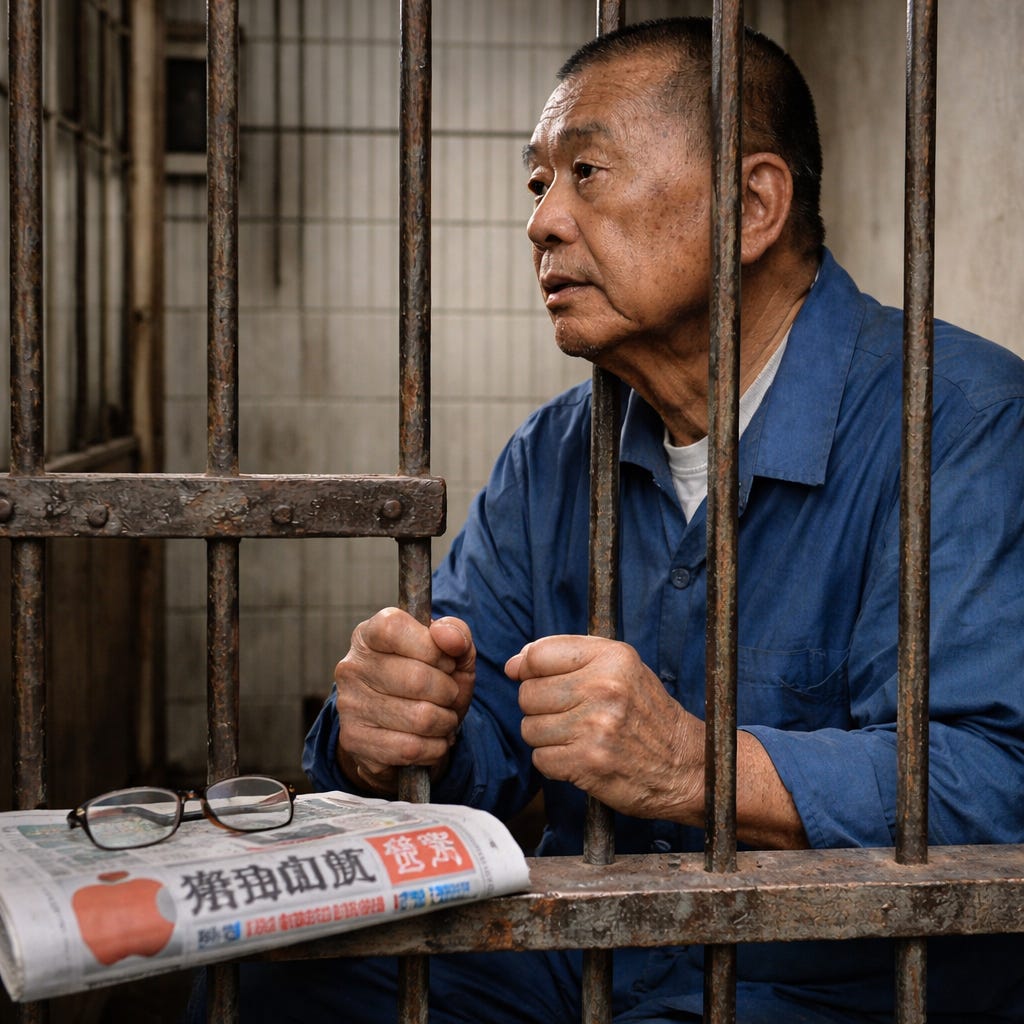
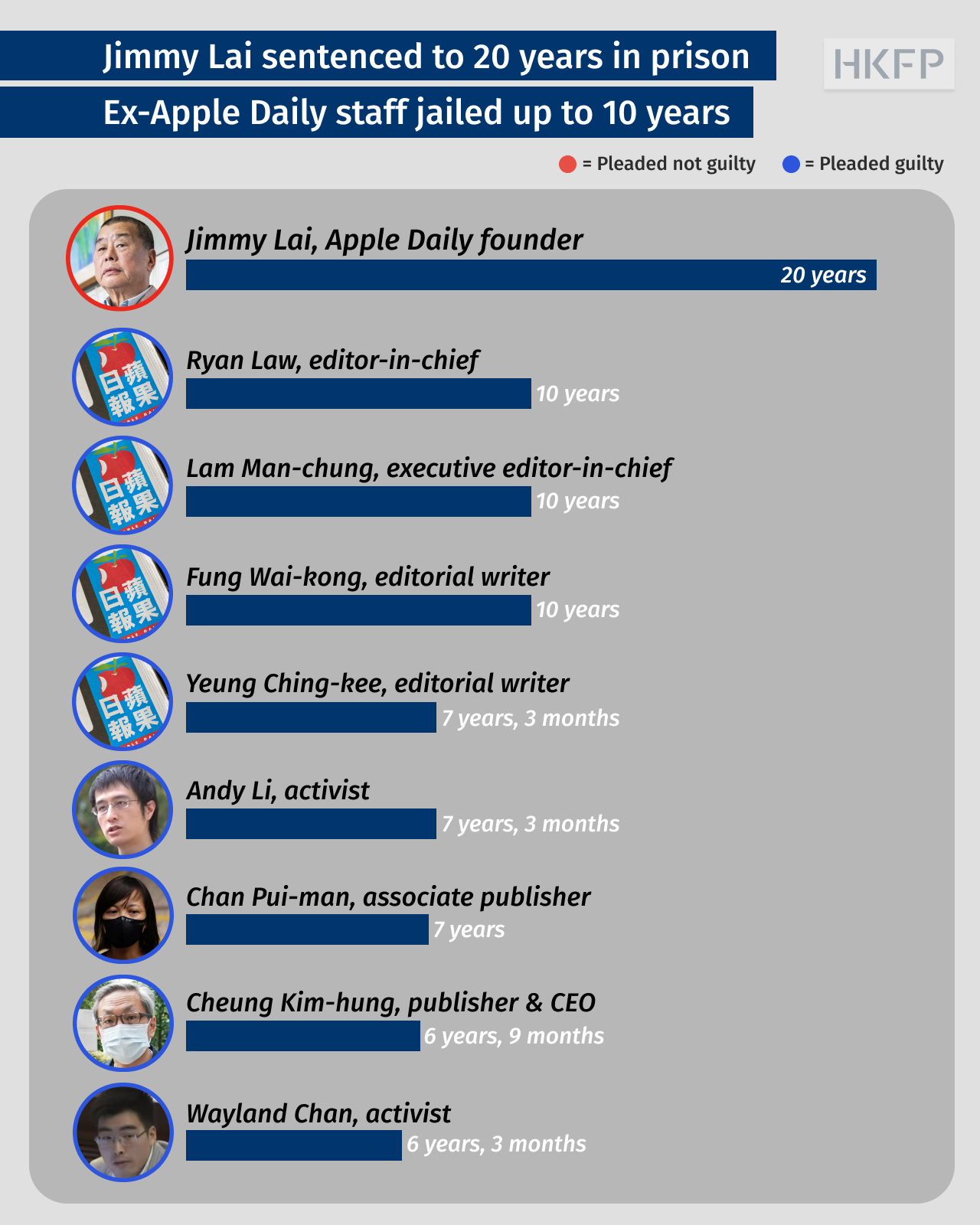
On Monday, as a court in Hong Kong sentenced Jimmy Lai - the media mogul, used his wealth and his newsroom in Hong Kong to criticize Beijing’s authoritarian excesses and give voice to those who hoped for democracy in China - to 20 years in prison. The city made clear that defiance now carries the same price as it does across the border in China. The landmark ruling completes a years-long effort by Beijing to dismantle the influence of a self-proclaimed “troublemaker” whom it blamed for masterminding Hong Kong’s pro-democracy protests nearly seven years ago. Critics say Beijing declared Mr. Lai guilty before he could ever receive a fair trial. The decision reached far beyond one man’s fate. Along with Mr. Lai, six of his former employees at the shuttered Apple Daily newspaper were sentenced to terms of up to 10 years, establishing a grim new benchmark for the city’s once freewheeling media. While the government maintains that these cases are about national security, the scale of the penalties underscores the narrowing window for independent journalism in what was once Asia’s media hub. By applying the same heavy penalties usually reserved for dissidents on the mainland to a local media tycoon and his editors, Beijing has also accelerated the erosion of a political arrangement that was supposed to preserve Hong Kong’s Western-style liberties, critics say. “The sentences handed down to Lai and his colleagues are very harsh, even by mainland standards,” said Elaine Pearson, the Asia director for Human Rights Watch. Ms. Pearson noted that only one Chinese dissident has received a longer prison term than Mr. Lai: Ilham Tohti, an economics professor who advocated for the Uyghur minority in China’s far western Xinjiang region and was sentenced to life in prison in 2014. “These national security trials are ultimately serving a political goal of extinguishing dissent and sending a message to anyone who dares to criticize the Chinese Communist Party,” she said. The sentence is effectively a life term for Mr. Lai, who is 78 years old and in deteriorating health, his family said. “This is a heartbreakingly cruel sentence,” his daughter, Claire Lai, said in a statement. “If this sentence is carried out, he will die a martyr behind bars.” - NYT
UK Foreign Secretary Yvette Cooper said in a statement: “British National Jimmy Lai was today sentenced to 20 years in prison in Hong Kong for exercising his right to freedom of expression, following a politically motivated prosecution. Beijing’s National Security Law was imposed on Hong Kong to silence China’s critics. For the 78-year-old, this is tantamount to a life sentence. I remain deeply concerned for Mr Lai’s health, and I again call on the Hong Kong authorities to end his appalling ordeal and release him on humanitarian grounds, so that he may be reunited with his family.”
The UK has opened up visas to thousands more people from Hong Kong in the wake of the 20-year prison sentence handed down to Lai. Adult children of British national (overseas) status holders who were under 18 at the time of Hong Kong’s 1997 handover to China will be eligible to apply for the route independently of their parents, a Home Office spokesperson told the Guardian on Monday. Their partners and children will also be able to move to the UK under the expanded route, the Home Office said. The Home Office estimates that 26,000 people will arrive in the UK because of Monday’s changes over the next five years.
British Conservative politician and former member of the European Parliament, Baroness Jacqueline Foster, slammed UK PM Keir Starmer in a post on Twitter for failing to negotiate Lai’s release during his recent state visit to China. “Instead he gave the Chinese permission to build it’s largest Embassy in London, with additional permission to include 42 flats - and next door to some of the most sensitive areas of the City of London….”
Lai “deserves his punishment,” Hong Kong Chief Executive John Lee has said, after the activist was handed a 20-year-jail term for his national security conviction. In a lengthy government statement published on Monday afternoon, Lee said Lai had “committed numerous heinous crimes and his evil deeds were beyond measure….The severe sentence of 20 years’ imprisonment imposed on him manifests that the rule of law is upheld and justice is done, and also brings great relief to all.” Meanwhile, Chinese foreign ministry spokesperson Lin Jian said in response to a question at a press conference on Monday that Lai had undermined the city’s prosperity and deserved to be severely punished - HKFP
“The rule of law has been completely shattered in Hong Kong… Today’s egregious decision is the final nail in the coffin for freedom of the press in Hong Kong” - Committee to Protect Journalists CEO Jodie Ginsberg
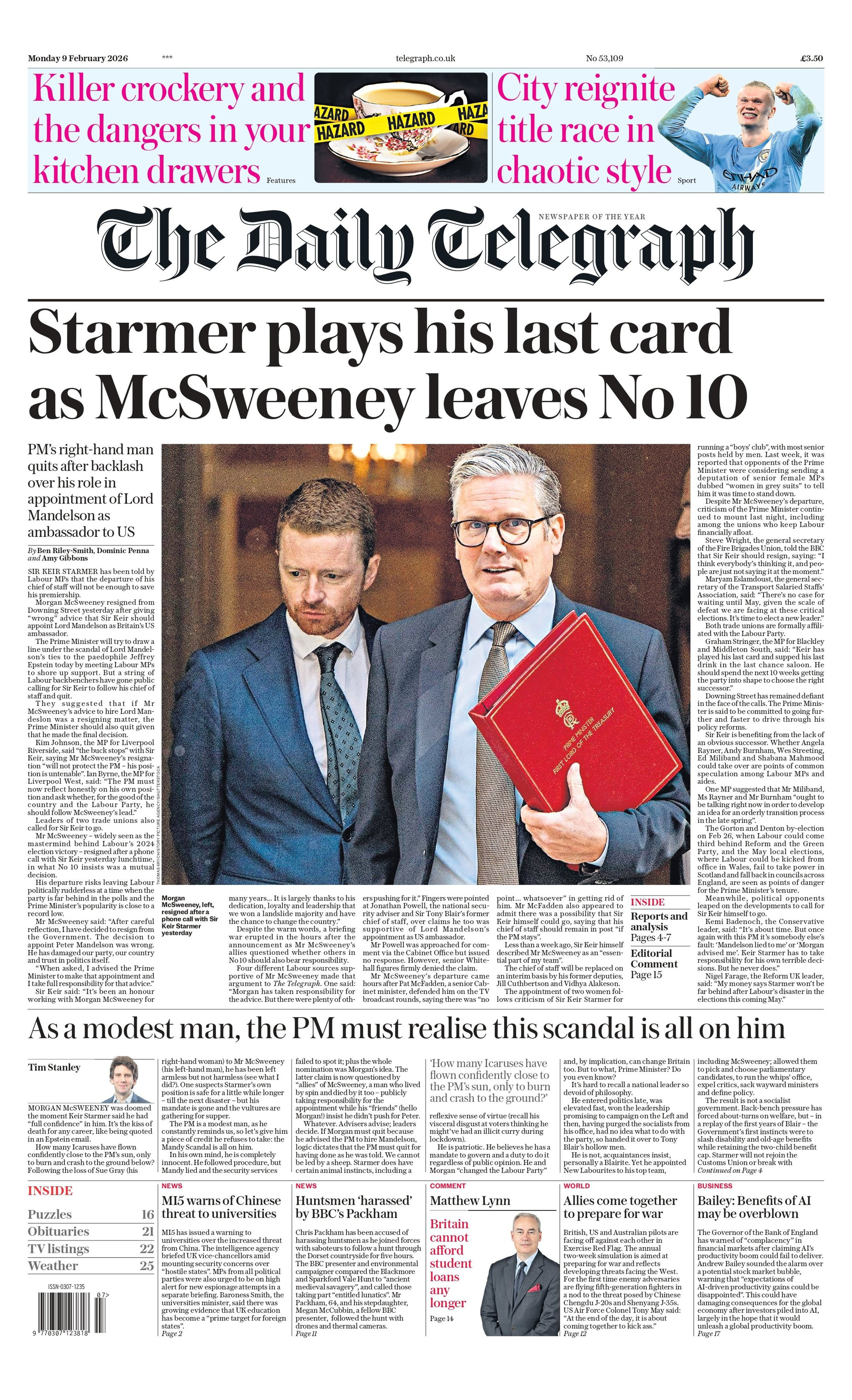
British Prime Minister Keir Starmer’s position hung by a thread on Monday as he tried to persuade his Labour Party’s lawmakers not to kick him out of his job after just a year and a half in office. Starmer lost his chief of staff on Sunday and is rapidly shedding support from Labour legislators after revelations about the relationship between former British ambassador to Washington Peter Mandelson and the late sex offender Jeffrey Epstein. Starmer is due to address Labour lawmakers behind closed doors later Monday in an attempt to rebuild some of his shattered authority. The political storm stems from Starmer’s decision in 2024 to appoint Mandelson to Britain’s most important diplomatic post, despite knowing he had ties to Epstein. Starmer fired Mandelson in September after emails were published showing that he maintained a friendship with Epstein after the late financier’s 2008 conviction for sex offenses involving a minor. Critics say Starmer should have known better than to appoint Mandelson, 72, a contentious figure whose career has been studded with scandals over money or ethics - AP
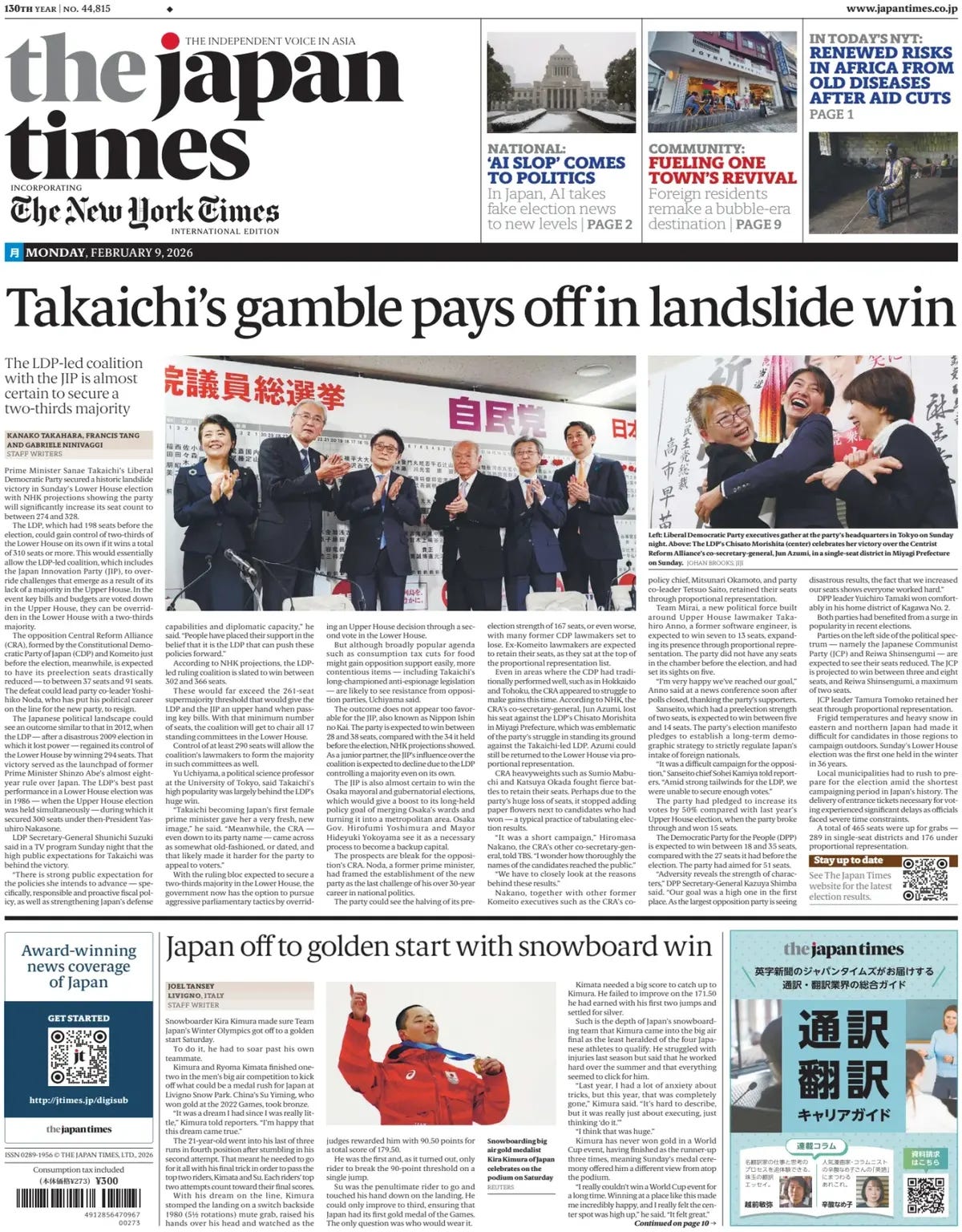
Japanese Prime Minister Sanae Takaichi’s coalition won a legislative supermajority in Sunday’s election, projections show, cementing her grip on power and providing a strong mandate for her expansionary fiscal policy. The snap election was a gamble for Takaichi, who took office in October with a goal of turning around Japan’s ruling party. Stocks are poised to surge, with investors betting higher government spending will fuel growth, but Takaichi’s policies will likely weigh on Japanese bonds and the yen, analysts said. A better domestic footing also gives Takaichi leeway to pursue a more assertive stance on Chinawhile maintaining a close partner in US President Donald Trump. Beijing’s “efforts to isolate her completely failed,” an Asia Group principal said - Semafor
Thai Prime Minister Anutin Charnvirakul said today that he was grateful for receiving more than he had asked for following the establishment Bhumjaithai Party’s landslide victory in yesterday’s general election. The party won a landslide with 194 parliamentary seats in the general election held yesterday, according to the latest unofficial tally. With 92% of votes counted nationwide by 4.08am on Feb 9, the Election Commission released preliminary results showing Bhumjaithai far ahead of its rivals, positioning the party to form the next government. Bhumjaithai secured a total of 194 seats, comprising 175 constituency seats and 19 party-list seats. The progressive People’s Party placed second with 116 seats, including 85 constituency seats and 31 party-list seats. Although the People’s Party, which won the most seats in the previous general election, finished second overall this time, it completed a clean sweep of all 33 constituency seats in the capital. The party had won 32 of Bangkok’s seats in the 2023 election. Pheu Thai finished third with 76 seats, marking the first time in years that the party has failed to reach the 100-seat mark. Its total consists of 60 constituency seats and 16 party-list seats. The party was the core of the previous coalition government led by Paetongtarn Shinawatra, daughter of former prime minister Thaksin Shinawatra. She was removed from office by the Constitutional Court following the release of a controversial recording of her conversation with Cambodian strongman Hun Sen. After winning the election and with Anutin expected to remain in office, attention has turned to Bhumjaithai’s key campaign policies, including a proposed border wall and plans to acquire fighter jets and submarines through rice-based barter deals - ThaiPBS/Khaosod English
Russia’s recruitment of Central Asian women for its nearly four-year war in Ukraine is coming to light after some high-profile cases. Russia hosts millions of migrant workers from the former Soviet republics of Central Asia. Dilbar has languished in pretrial detention for months in the Russian city of Omsk, where she said she was beaten, shocked with a taser, and threatened by prison officers. As she awaits trial on drug-smuggling charges, the 18-year-old Central Asian migrant has been given a stark choice: go to prison for up to 15 years or join Russia’s war effort in Ukraine and gain her freedom. Thousands of men from Central Asia are believed to have joined Russian forces in Ukraine. Some were lured by offers of lucrative jobs. Others, mainly convicts and detainees, have been forced to join the Russian military. A small number of Central Asian women have also enlisted, although their exact number is unknown. Dilbar, a citizen of Kyrgyzstan whose name has been changed to protect her identity, could soon be among them. Dilbar was arrested in October, a year after she moved to Russia from the Kyrgyz city of Osh. She was walking with friends in Omsk when she was arrested on drug charges, which she rejects. Human rights activists say Central Asian migrants, including women, are frequently arrested on trumped-up drug charges. Dilbar was told that she can serve as a cook in the Russian military in Ukraine and would receive 2 million rubles (around $26,000) for one year of work, a significant sum for many in Russia, according to her sister who asked not to be named for security reasons. After completing her one-year contract, prison officials promised she would be freed, said Dilbar’s sister. The sibling traveled from Kyrgyzstan to Omsk to attend her court hearings. She said she has pleaded with her sister not to take up the offer to enlist in the Russian military. “We often hear that people who go to Ukraine don’t come back alive,” Dilbar’s sister told RFE/RL’s Kyrgyz Service. She said their father, also a migrant worker in Russia, enlisted in Moscow’s war in 2023 but is missing. Russia has recruited tens of thousands of prison inmates to fight in Ukraine in exchange for having their sentences commuted. The move has been aimed at bolstering troop levels amid heavy casualties and avoiding the need for a new mobilization - RFE/RL
Israel's security cabinet approved a series of measures on Sunday, February 8, set to deepen Israeli control over the occupied West Bank, paving the way for further settlement expansion in the Palestinian territory. The territory, which Israel has occupied since 1967, would form the largest part of any future Palestinian state but is seen by many on the religious right as Israeli land. The measures, announced by Finance Minister Bezalel Smotrich and Defense Minister Israel Katz, include the removal of decades-old regulations barring Jewish citizens from purchasing land in the West Bank, according to a joint statement by the two ministers. Smotrich said the move aimed at "deepening our roots in all regions of the Land of Israel and burying the idea of a Palestinian state." The reforms also envisage transferring authority over building permits for settlements in parts of Palestinian cities, including Hebron, from the Palestinian Authority's municipal bodies to Israel. Until now, construction changes in the city's Jewish community required approval from both the local municipality and Israeli authorities, the Times of Israel reported, citing the statement. Under the new arrangements, such changes would require Israeli authorization only. The Palestinian presidency in Ramallah condemned the decision, saying it was aimed at "deepening attempts to annex the occupied West Bank." The presidency said the "decisions reflect an open Israeli attempt to legalize settlement expansion, land confiscation and the demolition of Palestinian properties, even in areas under Palestinian sovereignty." - Le Monde
France has thousands of kilometres of disused railway tracks which are too costly to renovate for heavy, modern trains. But one startup has devised an alternative solution to put them back into use. Instead of relaunching trains, the project by engineering firm SICEF (part of AKKA Technologies’ Flexmove consortium) will see hybrid vans using the lines. Dubbed Ferromobiles, these vehicles hope to boost green connections in car-dependent rural areas. According to SICEF, there are 5,700 kilometres of small railway lines in France that are not currently in use. It has left swathes of rural areas without public transport connections. The company’s solution to reactivating these lines is to launch vehicles adapted from a Peugeot e-Traveller and fitted with a technical system that allows them to switch smoothly from road to rail. The Ferromobiles will begin trials this month on the Courpière-Vertolaye line in France’s Auvergne region, according to website Railtech. If the results show potential, other regions such as Occitanie, Brittany, or Nouvelle-Aquitaine could adopt the scheme - Euronews

The journals…..
The chilling point: the punishment is the message. When journalism is treated as collusion, the public learns silence as the safest civic posture.
The two stories you’ve paired highlight very different ways governments are reshaping contested spaces. 🇮🇱
On the Israeli side, the security cabinet’s decision to lift long‑standing bans on private Jews buying West Bank land and to shift building‑permit authority from Palestinian municipalities to Israeli ministries marks a clear push toward deeper settlement entrenchment. Finance Minister Bezalel Smotrich framed it as “deepening our roots” and “burying the idea of a Palestinian state,” language that underscores how the policy is being presented as a national‑historical claim rather than a routine administrative tweak. Predictably, the Palestinian presidency condemned the move as an open attempt at annexation, warning that it could further erode the viability of a future Palestinian state. The international community has repeatedly warned that unilateral steps of this sort undermine the two‑state solution and risk inflaming tensions on the ground. ⚖️
Switching continents, the French initiative to repurpose disused rail corridors with hybrid “Ferromobiles” offers a creative, low‑carbon answer to rural mobility gaps. By adapting a Peugeot e‑Traveller to run on both road and rail, the SICEF‑AKKA consortium hopes to revive thousands of kilometers of idle track without the massive expense of reinstating full‑scale train service. Trials on the Courpière‑Vertolaye line could demonstrate a scalable model for other regions such as Occitanie, Brittany, or Nouvelle‑Aquitaine. If successful, this could provide a greener link for isolated communities while preserving historic infrastructure. 🚆🔋