But first…..From the edge of the Strait of Hormuz - where the stakes are anything but theoretical.
While much of the analysis you’ll see today is coming from air-conditioned talking chambers in London - or comfortable retirement circuits in Florida - I’m here on the ground, tracking how this crisis is actually unfolding at one of the world’s most critical chokepoints. In this video, I connect the geopolitical dots: who’s really holding leverage, how fragile the situation has become, and why the ripple effects are already being felt far beyond the Gulf.
👉 Scroll down to watch the full report
And if you value reporting that’s rooted in frontline access - not secondhand commentary - consider upgrading to World Briefing Plus. Your support keeps this kind of independent, on-the-ground journalism going.
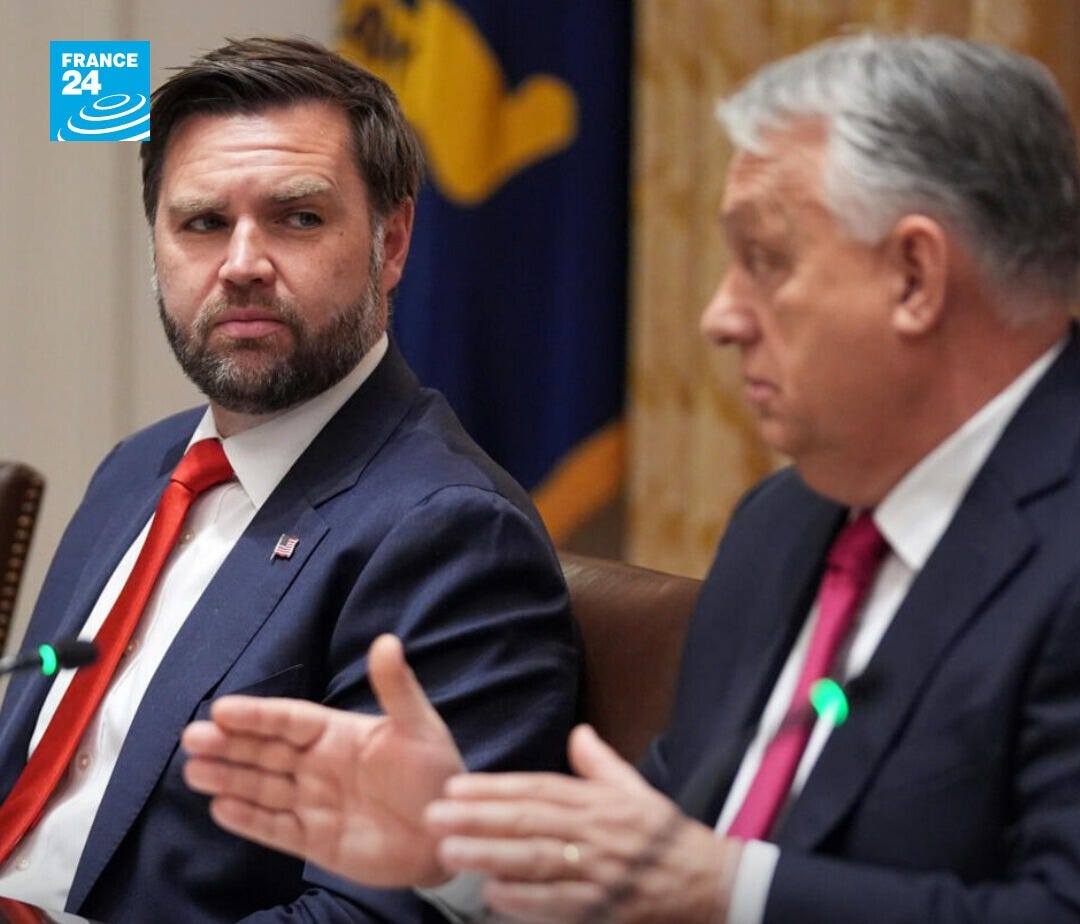
“We’re certainly aware that there are elements within the Ukrainian intelligence services that try to put their thumb on the scale on American elections, on Hungarian elections. This is just what they do…” U.S. Vice President J.D. Vance
In the middle of one of the most consequential wars of our time, the vice president of the United States - a heartbeat away from the presidency - has inserted himself directly into a European election to prop up a leader widely viewed by critics as an embattled strongman at home.
On Tuesday, J.D. Vance arrived in Budapest with a clear mission: bolster Viktor Orbán, whose grip on power faces its most serious challenge in over a decade.
The geopolitical optics are nothing short of extraordinary.
As Axios has noted, Hungary’s April 12 election reveals a rare convergence: the United States and Russia are both working to keep Orbán in power, while the EU and Ukraine would prefer to see him gone.
That alignment - unthinkable just a few years ago - is unfolding against the backdrop of expanding Russia-Iran military cooperation and a widening arc of conflict stretching from Ukraine to the Middle East.
From Budapest to the battlefield
New reporting underscores just how far that cooperation now reaches.
According to The Jerusalem Post, Russian intelligence has allegedly provided Iran with a detailed list of 55 critical Israeli energy infrastructure targets - including major power stations and urban energy hubs - enabling the potential for precision strikes designed to trigger widespread blackouts.
The assessment reportedly highlights Israel’s vulnerability as an “energy island,” where disabling even a handful of key nodes could cascade into systemic failure.
Whether fully verified or not, the report points to a deepening operational alignment between Moscow and Tehran - one already visible across multiple theatres, from Ukraine to the Gulf.
And it is in this broader context that Washington’s intervention in Hungary takes on added weight.
Orbán: ally, outlier, and pressure point
For the Trump movement, Orbán is not just an ally - he is a model.
After 16 years in power, Orbán has reshaped Hungary’s judiciary, media landscape, and electoral system in ways critics say entrench his rule. The European Parliament has labeled Hungary an “electoral autocracy.”
His challenger, Péter Magyar, has tapped into growing anger over corruption and economic stagnation - and, by some accounts, is closing the gap or even edging ahead.
For Moscow, Orbán remains its most valuable partner inside NATO and the EU - slowing sanctions, blocking Ukraine aid, and fracturing Western unity.
For Washington - at least under Trump’s strategic framing - Orbán represents proof that nationalist governance can take hold within the European project itself.
An election in the shadows
The campaign’s final stretch has begun to resemble an intelligence contest.
Hungary has accused Ukraine of sabotage and election interference. Explosives were discovered near a key gas pipeline. Investigative journalist Szabolcs Panyi - who exposed Russian intelligence activity - now faces espionage charges.
In one of the most striking episodes, Hungary’s foreign minister was caught on leaked audio assuring Sergey Lavrov he would work to ease EU sanctions tied to Russian interests.
Western officials warn that Russian-linked actors may be prepared to cast doubt on the vote if Orbán loses - raising the specter of a contested election inside the European Union.
The gamble — and the message
Into this maelstrom walks the U.S. vice president - and the message he delivered in Budapest is already raising eyebrows.
J.D. Vance accused Ukrainian intelligence services of attempting to influence both Hungarian and U.S. elections - offering no evidence - and portrayed Kyiv, not Moscow, as a source of interference.
“We’re certainly aware that there are elements within the Ukrainian intelligence services that try to put their thumb on the scale,” he said.
He also turned his fire on Brussels, accusing the EU of trying to “destroy the economy of Hungary,” drive up energy costs, and politically punish Orbán for resisting liberal norms.
Notably absent: any direct criticism of Russia.
At a moment when Moscow is deepening military cooperation with Iran - and wars are redrawing global fault lines - that omission is as telling as anything said.
The signal will not go unnoticed.
If Orbán prevails, it reinforces a model of governance that challenges the EU from within - backed, implicitly or otherwise, by two unlikely partners in Washington and Moscow.
If he falls, the result could trigger not just a domestic political shift, but a geopolitical rupture - testing how far external powers are willing to go to shape Europe’s future.
Either way, Hungary’s election is no longer just a national contest.
It is a frontline in the battle over the post-war order — and who gets to define it. - Axios, Euronews reporting summary
News Briefs
Russian intelligence has provided Iran with a detailed list of 55 critical energy infrastructure targets within Israel, according to information obtained by The Jerusalem Post from a source close to Ukrainian intelligence. The report, which highlights the deepening military and intelligence cooperation between Moscow and Tehran, suggests that the information that was shared enables Iran to launch precision missile strikes against Israel’s energy grid. According to the findings, the targeted sites are divided into three categories based on their strategic importance. Level 1: Critical production facilities. These are sites whose destruction would cripple the national energy system. The report specifically names the Orot Rabin power station as a primary target. Level 2: Major urban and industrial energy hubs. These facilities are located primarily in central Israel and serve large population centers. Level 3: Local infrastructure. These targets include regional substations that support industrial zones and smaller power plants. The Russian assessment regarding Israel’s vulnerability is that “unlike many European nations, Israel’s power grid is characterized by a high degree of isolation”. Because Israel is an “energy island” that does not import electricity from neighboring countries, Russian intelligence reportedly told Iran that damaging even a few central components could trigger a total and prolonged energy collapse, leading to mass blackouts and technical failures that could not be easily mitigated. Russian ambassador Anatoly Viktorov responded to the allegations - Jerusalem Post
A top Russian military leader has died in a plane crash in Russian-occupied Crimea. Alexander Otroshchenko, commander of the 45th Army of the Northern Fleet’s Air Force and Air Defense, was among the 30 people who died when an An-26 military transport plane crashed into a cliff on March 31. The cause of the crash remains unclear, with Russia’s Defense Ministry stating that the plane experienced a technical malfunction. The BBC Russian Service first reported that Otroshchenko, who was involved in Russia’s annexation of Crimea in 2014 and Russian operations in Syria, was believed to have been among those who had died in the crash. Several other Northern Fleet officers are also believed to be among the 23 passengers and seven crew members who died. The An-26 military transport plane was performing a scheduled flight close to where the fleet is based, and there was no indication that the aircraft had come under fire as part of the war between Russia and Ukraine. An-26s have been involved in several incidents over the years, including a training flight crash in northeastern Ukraine in 2020 that killed 26 people - The Daily Beast
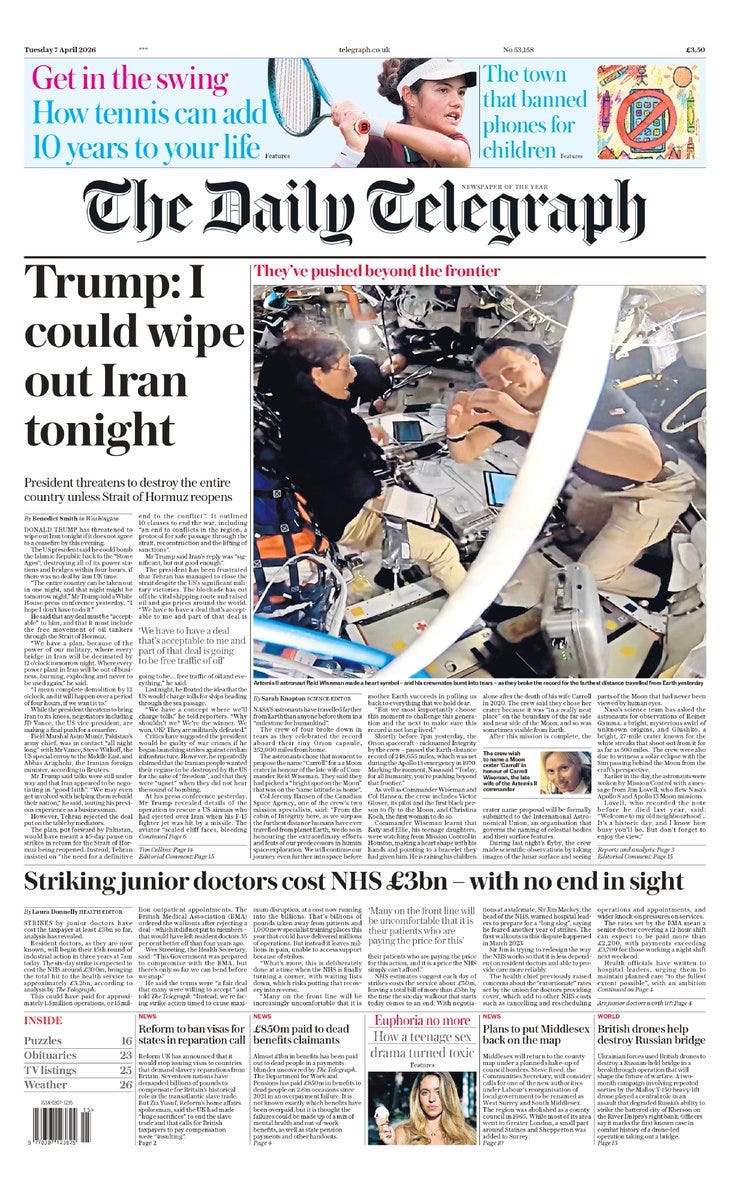
US President Donald Trump has just posted on Truth Social, warning: “A whole civilization will die tonight, never to be brought back again”. He goes on: “I don’t want that to happen, but it probably will. However, now that we have Complete and Total Regime Change, where different, smarter, and less radicalized minds prevail, maybe something revolutionarily wonderful can happen, WHO KNOWS? “We will find out tonight, one of the most important moments in the long and complex history of the World. 47 years of extortion, corruption, and death, will finally end. God Bless the Great People of Iran!” Trump has given Iran a deadline of 20:00 EDT Tuesday (00:00 GMT / 01:00 BST on Wednesday) to reopen the Strait of Hormuz.
Apple is encountering setbacks in the engineering test phase of its first ever foldable iPhone, which could lead to delays in its mass production and product shipment schedule, Nikkei Asia has learned. Issues surrounding the engineering development of foldable iPhones are more complex and are taking more time to resolve than Apple had expected, and in the worst case scenario could delay the first shipment by months, according to multiple sources briefed on the matter. A few component suppliers, though not all, have been notified that there is a possibility the component production schedule for the foldable iPhone will be pushed back, Nikkei Asia learned.
The journals….