🔥 World Briefing Hot Take
In the Middle East, where the mood has shifted from anxiety to something far more dangerous - inevitability - this week’s developments point to a stark reality: while Washington talks about deals and Tehran denies them, the machinery of war keeps expanding. From threats to “obliterate” Iran’s energy lifelines, to Ukraine’s widening strikes on Russia’s oil infrastructure, to Lebanon sliding closer to collapse, the conflicts are no longer contained - they’re beginning to merge. And yet, in a striking twist, it may not be the traditional power brokers holding the key to de-escalation. As veteran analyst Osama Al-Sharif notes, Islamabad’s intervention - backed quietly by regional heavyweights - may represent the only credible off-ramp left.
What’s becoming increasingly difficult to ignore is not just the escalation - but the erosion of credibility at the very top. Donald Trump’s rhetoric has veered from deal-making to outright threats of obliteration, while figures in his inner circle - including Defense Secretary Pete Hegseth - are advancing narratives that strain credulity and leave allies second-guessing Washington’s intentions. At a moment when discipline and clarity are paramount, the messaging instead feels fragmented, performative, and at times unmoored from reality. The result? Allies hedge, adversaries harden, and openings for credible diplomacy - like the one now emerging from Islamabad - risk being dismissed not on merit, but on mistrust.
The question now is whether those driving this war - the United States and Israel - are still interested in taking it… or whether that exit has already been missed.
News Briefs
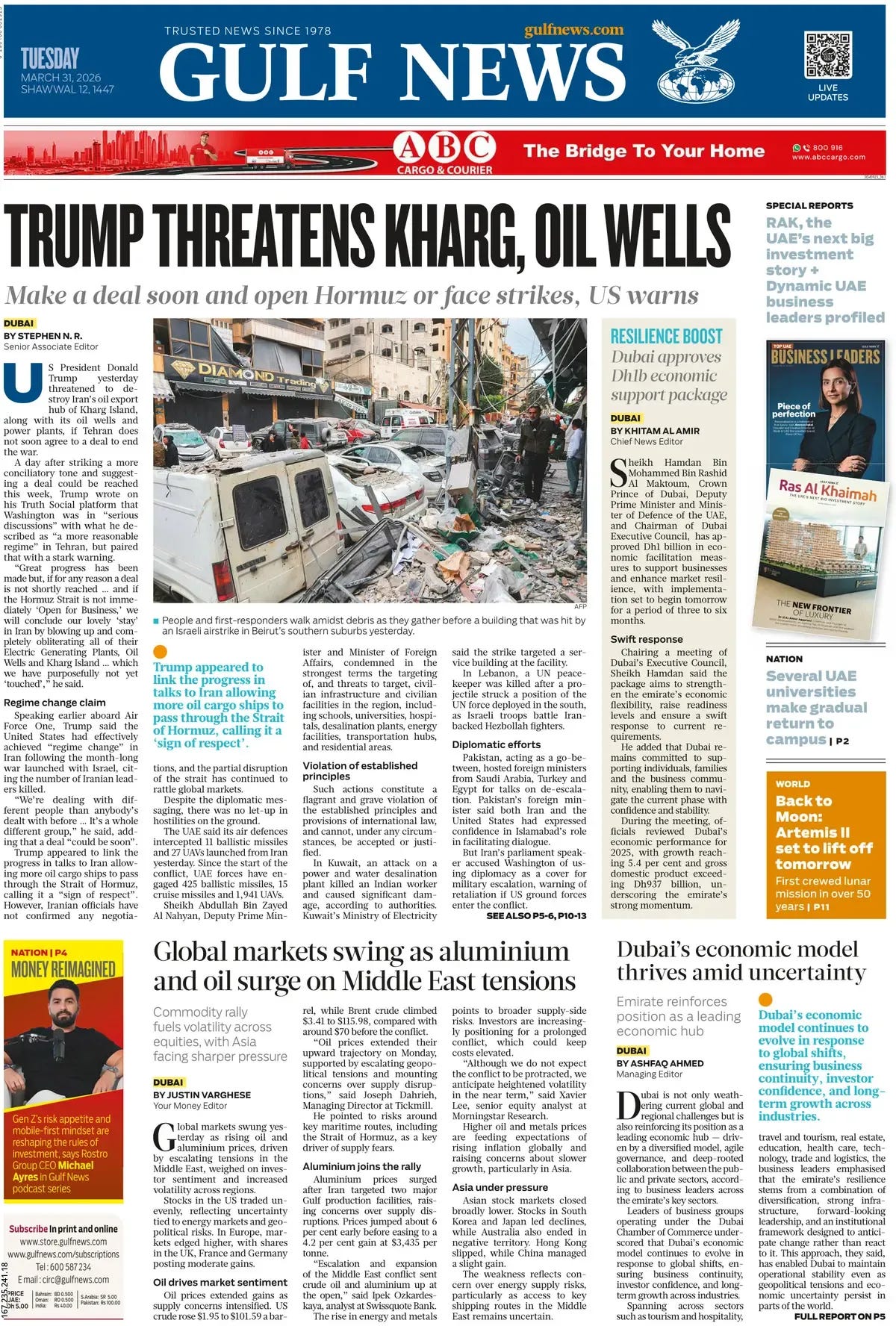
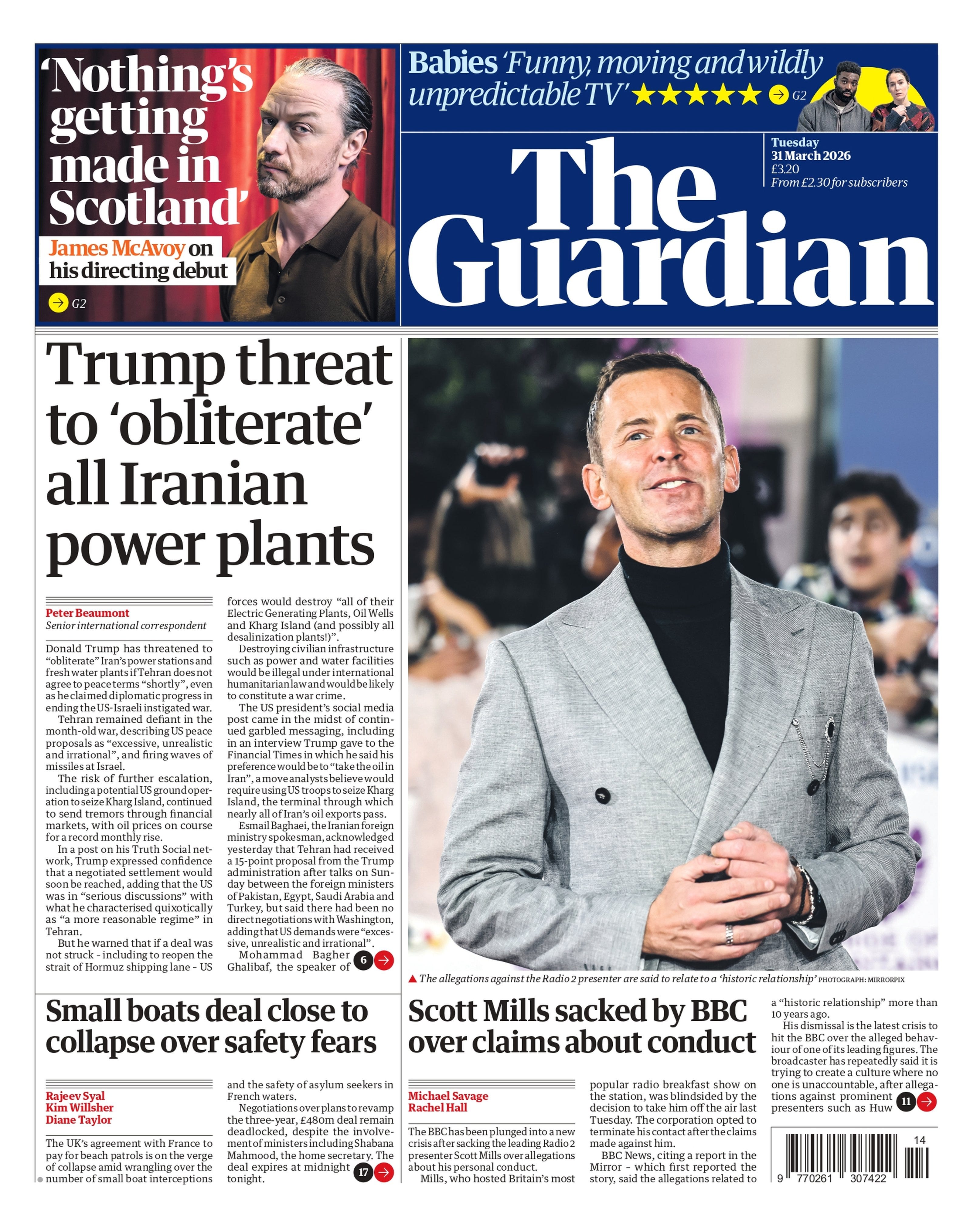
US President Donald Trump has renewed his warning to Tehran to reach a deal to end the war soon and open the Strait of Hormuz or he will order air strikes with the aim of “completely obliterating” Iran’s oil export hub of Kharg Island, oil wells, and power plants. For the second day in a row, the US leader said a deal is likely at hand, but he also said in a social media post on March 30 that “if for any reason a deal is not shortly reached” US forces will react “ by blowing up and completely obliterating all of their Electric Generating Plants, Oil Wells and Kharg Island (and possibly all desalinization plants!), which we have purposefully not yet ‘touched.’” A day earlier, Trump hailed progress in talks with Iran, saying they were being held directly and indirectly with “reasonable” leaders and asserted Tehran was partially opening the crucial Strait of Hormuz, the waterway through which some 20 percent of the world’s oil and natural gas supplies pass. But he has yet to elaborate on what he called direct talks with Iran, whose leaders deny negotiations are taking place. Tehran has said it received, reviewed, and rejected a 15-point US peace plan that was delivered through Pakistani emissaries.
The four-way foreign ministers’ meeting held in Islamabad on Sunday may be the region’s best — and last — chance to arrest the slide toward full-scale war in the Arabian Gulf and beyond. Bringing together Saudi Arabia, Turkiye, Egypt and Pakistan, the gathering represented a genuine opportunity for countries directly impacted by the US-Israeli military campaign against Iran to forge a unified front and present a credible initiative for de-escalation and an eventual peaceful resolution, Amman-based Middle East analyst Osama Al-Sharid says in an analysis shared with World Briefing. “Pakistan has earned a valuable role in this crisis that no other regional actor currently plays: a communication channel between Tehran and Washington. Its unique standing — maintaining ties with both the Iranian leadership and the White House — gives it leverage that could translate into real diplomatic movement. That potential is reinforced by the backing of the three other powers at the table: Saudi Arabia, Egypt and Turkiye. Together, they carry the political weight to make Washington listen.” Trump had given Iran until April 6 to reach a deal or else he would carry out his threat. Says A-Sharif: “What Gulf countries should make clear is their rejection of any US escalation in the form of a ground invasion or the destruction of Iranian power, oil and desalination plants. A desperate Iranian retaliation would almost certainly target Gulf power and desalination infrastructure, with catastrophic consequences. Possible US and Israeli strikes on Iran’s nuclear facilities — particularly those near the Arabian Gulf coast — could also unleash deadly radiation clouds that would affect the region for decades.”
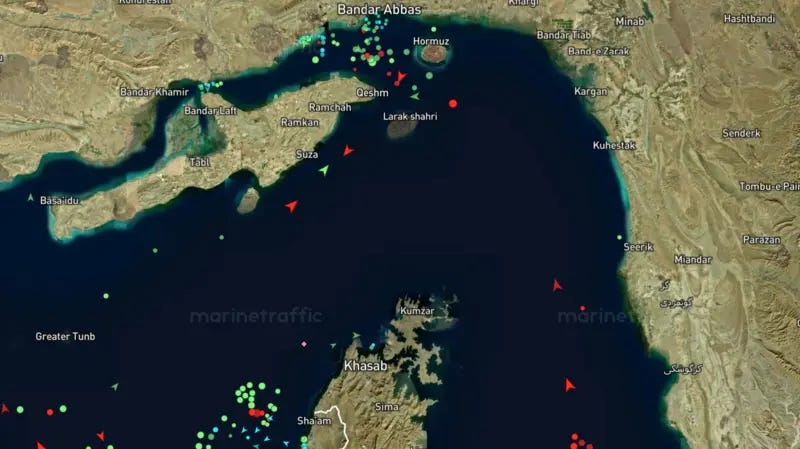
US Defence Secretary Pete Hegseth said "there are many more vessels flowing [through the Strait of Hormuz] today than there were, that the president has arranged". But BBC found today only 3 ships appear have gone through so far, and one is sanctioned by the US. According to an analysis of tracking data by maritime intelligence firm Kpler, four ships passed through the strait yesterday and six on Sunday. The highest number to get through in the past week was 13 on Saturday. Before the conflict started nearly 140 ships would make the journey every day, according to the Joint Maritime Information Center.
Donald Trump says countries “like the United Kingdom” who can’t get jet fuel because of the restrictions around the Strait of Hormuz should “build up some delayed courage, go to the Strait, and just TAKE IT”. In a post on Truth Social, he writes countries will “have to start learning how to fight for yourself, the U.S.A. won’t be there to help you anymore, just like you weren’t there for us,” addressing countries “which refused to get involved in the decapitation of Iran…Iran has been, essentially, decimated. The hard part is done,” the post adds, ending with: “Go get your own oil!” - BBC
Volodymyr Zelensky has said Ukraine’s allies have urged him to scale back attacks on Russia’s energy infrastructure amid the ongoing global fuel crisis - but that they would only end if Russia stopped targeting Ukraine’s first. The Ukrainian president told journalists in a WhatsApp voice message that, by launching attacks on Russia’s energy system, Ukraine was only responding in kind. It is unclear which countries he may have been referring to. China and India remain heavily dependent on Russian oil, and the EU on Russian gas. Zelensky’s comments come after a string of long-range Ukrainian strikes on Russia’s energy sector, including the key oil export terminal at the port of Ust-Luga outside St Petersburg. “We have received messages from some of our partners asking about how our responses against Russia’s oil sector - the energy sector - can be reduced,” Zelensky said in the voice message. “If Russia is ready not to strike Ukraine’s energy, then we’ll respond by not attacking theirs.” - BBC
The UN said Monday that three of its peacekeepers were killed in southern Lebanon within 24 hours, as Israel’s campaign against Hezbollah intensifies.
More than a million people in Lebanon have been displaced and some 1,200 killed since hostilities between Israel and the Tehran-backed Lebanese group reignited over the Iran war. An Israeli ground campaign is underway in Lebanon, and is set to widen. Israel plans to keep “effective control” of southern Lebanon even after the current hostilities end, The Jerusalem Post reported. The war has deepened sectarian divisions within Lebanon as it pushes its “fragile state and society towards breaking point,” Reuters wrote, while some analysts argue a lengthy Israeli occupation would only reenergize Hezbollah. - Semafor
Spain has banned U.S. military aircraft involved in the Middle East war from using its airspace, reaffirming Madrid’s opposition to Washington’s operations in Iran. Deputy Prime Minister Carlos Cuerpo confirmed the news on Monday, adding that the prohibition was in line with Madrid’s existing ban on the use of Spanish airbases for the U.S. and Israel’s military operations in the Middle East.
“This is part of the decision already made by the Spanish government to not participate in, or contribute to, a war which was initiated unilaterally and is against international law,” Cuerpo said in a radio interview with the Cadena SER station. Defense Minister Margarita Robles said the ban had been in place from the start of the conflict, and had been made “perfectly clear to the American military” from the outset. “We don’t authorize either the use of military bases or the use of airspace for actions related to the war in Iran.” It’s unclear how much of an impact Spain’s decision has on warplanes like the B-2 Spirit bombers making the transatlantic roundtrip from Whiteman, Missouri to Iran. Spanish authorities clarified that the planes still receive logistical support from Spain, and are allowed to enter Spanish airspace in emergency situations - Politico
The statement from Islamabad challenges Washington’s current trajectory and Israel’s maximalist war aims. It may not be welcomed by either. But it may also be the only credible off-ramp left — and the region’s most powerful states owe it to themselves, and to the broader Middle East, to take it. - Osama Al-Sahrif
Cambodian lawmakers on Monday unanimously adopted a new law targeting online scam operations with up to life in prison, following a government pledge to shut them down by the end of April. All 112 members of parliament present voted to approve the legislation, which marks Cambodia’s first legal framework specifically aimed at a lucrative, illicit industry that has transformed the country into a global hub for cybercrime. The scam operations typically involve bogus investment schemes and feigned romances that collectively extort tens of billions of dollars from victims around the world every year. Justice Minister Keut Rith noted that thousands of people, especially from other Asian nations, are lured with fraudulent job offers and forced to work in scam centers in conditions of near-slavery. Keut Rith told lawmakers that these crimes threaten public security and significantly damage Cambodia’s global reputation. The legislation awaits review by the Senate and final approval by King Norodom Sihamoni. Directing what’s described as a technology fraud site would carry five to 10 years in prison and fines reaching $250,000. For cases involving human trafficking, illegal confinement or violence, the prison term is 10 to 20 years. If a worker dies, as is often associated with failed escape attempts, offenders face 15 to 30 years or even life imprisonment. Senior Minister Chhay Sinarith , who leads the Commission for Combating Online Scams, recently announced that authorities have targeted 250 suspected locations since July, successfully shutting down 200. He said the enforcement efforts resulted in 79 legal cases against nearly 700 ringleaders and associates. Over the same period, the government has repatriated nearly 10,000 scam center workersfrom 23 countries. Experts are skeptical. Jacob Sims, a visiting fellow at Harvard University’s Asia Center, pointed out in response to Chhay Sinarith’s remarks that past crackdowns often failed because they left financial and protection networks intact, allowing criminal operations to quickly start again - Washington Post
Air Canada has begun the search for a new leader — one who can speak French — after the current CEO, English-only speaking Michael Rousseau, informed the board of directors of his retirement later this year. In a statement issued Monday morning, the airline said Rousseau, who’s been with the company for almost two decades and has served as CEO since 2021, will continue in that role until his departure at the end of the third quarter, which is on or around Sept. 30. Rousseau came under fire last week after posting an English-only video offering his condolences for the loss of two pilots who were killed in the March 22 crash at LaGuardia Airport in New York City. The only French words used in the three-minute and 45-second video post to social media on Monday were “bonjour” (hello) and “merci” (thank you). One of the pilots, Antoine Forest, was a Francophone from Coteau-du-Lac, Que. “Despite many lessons over several years, unfortunately, I am still unable to express myself adequately in French,” Michael Rousseau said in a mid-week statement amid the furor. “I sincerely apologize for this, but I am continuing my efforts to improve.” Asked about the news following a press conference on Monday, Prime Minister Mark Carney saluted the work Rousseau did but said deciding to step down is the “appropriate” move in his view. He also said it is “essential” that Rousseau’s replacement is bilingual. “I think recent events that should have gone without saying to begin with, but recent events have underscored the importance of that.” Carney was among the first to criticize the English-only video, saying it showed a “lack of compassion.” - National Post
MS NOW anchor Katy Tur asked her viewers on Monday if President Donald Trump is still mentally fit, taking a deep dive into polls showing a growing number of Americans are starting to ask the question. “Is Donald Trump well? Is his head in the presidency? Does he have the mental acuity to lead this country?” Tur began to kick off the segment, adding:
More people are starting to doubt that — beyond, of course, Democrats who have always doubted it. This is being borne out in two new polls: the first one from the Washington Post, ABC, and Ipsos, which finds the number of people who think he lacks the mental sharpness to serve effectively is now climbing to 56%; and the second, from Reuters and Ipsos, which shows six in 10 Americans now say President Trump is becoming more erratic as he ages.
That includes a growing number of Democrats, independents, and Republicans. Why is that? Well, the apparent sleeping during cabinet meetings and Oval Office visits probably isn’t helping. Neither are the stories about how he’s forcing his top aides to wear his preferred brand of shoes — buying them in incorrect sizes that he’s guessed they wear. He also doesn’t sound as energetic and clear as he did even a few years ago, comparatively speaking, of course. Case in point: the wild asides mid-thought.
He has always done that to a degree, but now he’s doing it in the middle of White House cabinet meetings, largely defined by deadly serious issues like the war in Iran or alleged political prosecutions.
…..While a lot of this has always just been part of who Donald Trump is — a man who works the room, seeks attention, seeks applause — he’s now about to be 80 years old, and he’s launched a war that he does not seem to have a plan for.
The journals…