

🔥 World Briefing Hot Take
Let’s be blunt: this isn’t peace - it’s a pause with profits attached.
From here in the region, the gap between Washington’s declaration of “a big day for world peace” and reality on the ground couldn’t be wider. Within hours of the ceasefire, Iranian drones and missiles were still targeting Gulf infrastructure. Lebanon? Not even covered. Civilians? Still dying in staggering numbers.
And yet - markets rallied, oil plunged, and governments breathed a sigh of relief.
That tells you everything.
Because buried inside this so-called “deal” is something far more consequential than any ceasefire line: control of the Strait of Hormuz.
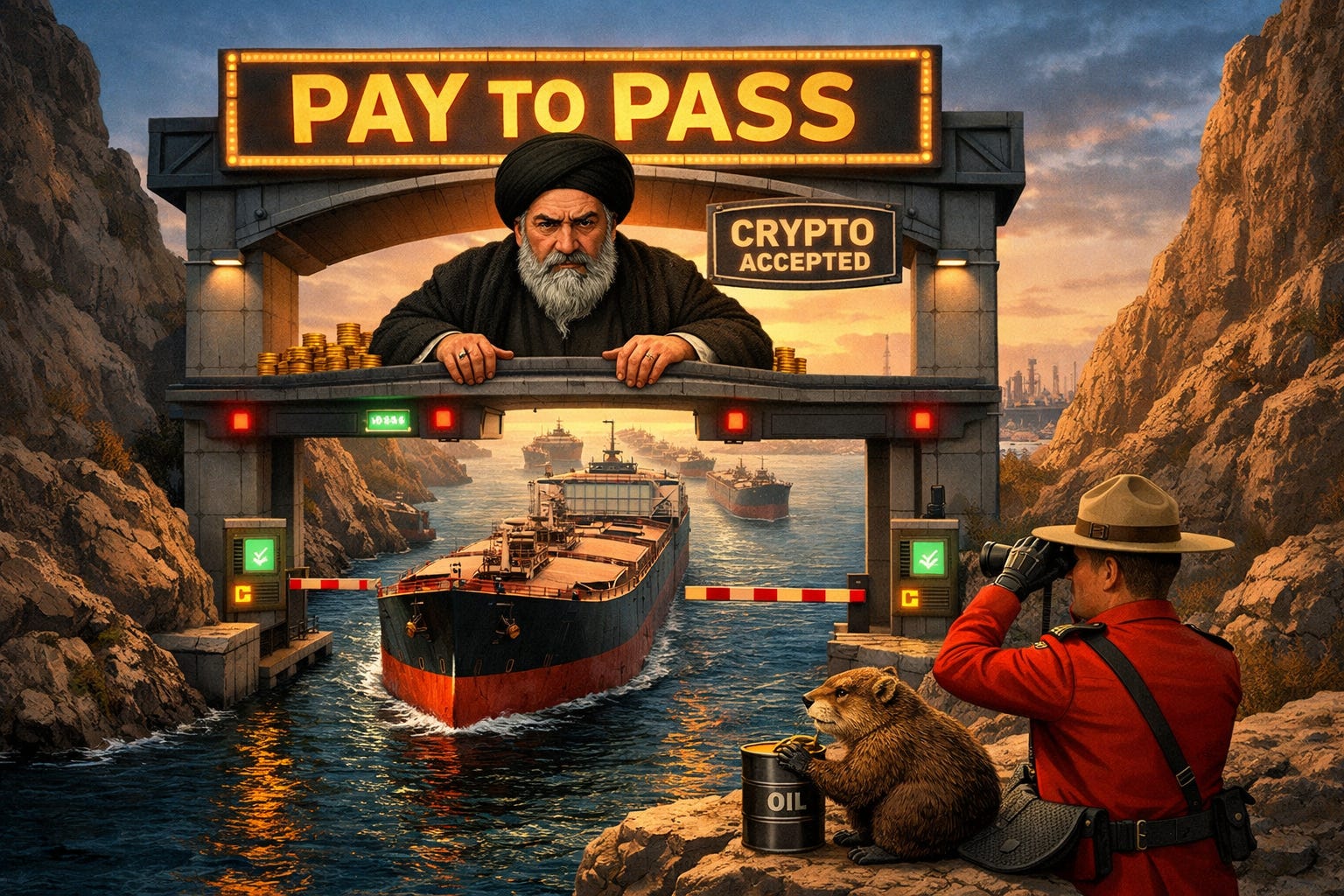
Nearly a fifth of the world’s oil flows through that narrow corridor. And now, Iran isn’t just threatening to disrupt it - it’s monetizing it. Crypto tolls for tankers? That’s not a wartime tactic. That’s a business model.
Forget the nuclear file - conspicuously absent here. For Tehran’s clerical leadership, the real prize isn’t enrichment levels. It’s leverage. Persistent, global, economically coercive leverage.
Call it “The Art of the Deal - Hormuz Edition.”
Meanwhile, the optics are almost surreal:
Pakistan (with Turkey, Egypt and other states in the region with skin in the game) emerges as the unlikely power broker
China, aiming to be the planet’s new responsible superpower, signals it’s ready to shape the endgame
Europe - under the self-declared leadership of France’s Emmanuel Macron - scrambles to reopen shipping lanes it cannot secure
And the U.S. declares victory while stepping back from escalation
But here’s the uncomfortable truth:
If missiles are still flying during a ceasefire… it’s not a ceasefire. It’s a repositioning.
And as I report from Turkey in today’s video, the two sides remain miles apart on fundamentals. This isn’t a bridge to peace - it’s a holding pattern before the next surge of instability.
The world wanted a breakthrough.
What it got instead is a fragile truce…
and a newly empowered gatekeeper sitting astride the global energy system.
From brinkmanship to bargaining: Trump unveils a conditional two-week ceasefire with Iran - if Hormuz reopens. A tactical pause, not a strategic shift. My take from the ground - and why Turkey is quietly emerging as one of the biggest winners.
🔥 Frontline analysis like this doesn’t come from air-conditioned studios or armchair pundits - it comes from being here on the frontlines. If you value that perspective, consider upgrading to World Briefing Plus to support independent, on-the-ground reporting.
News briefs
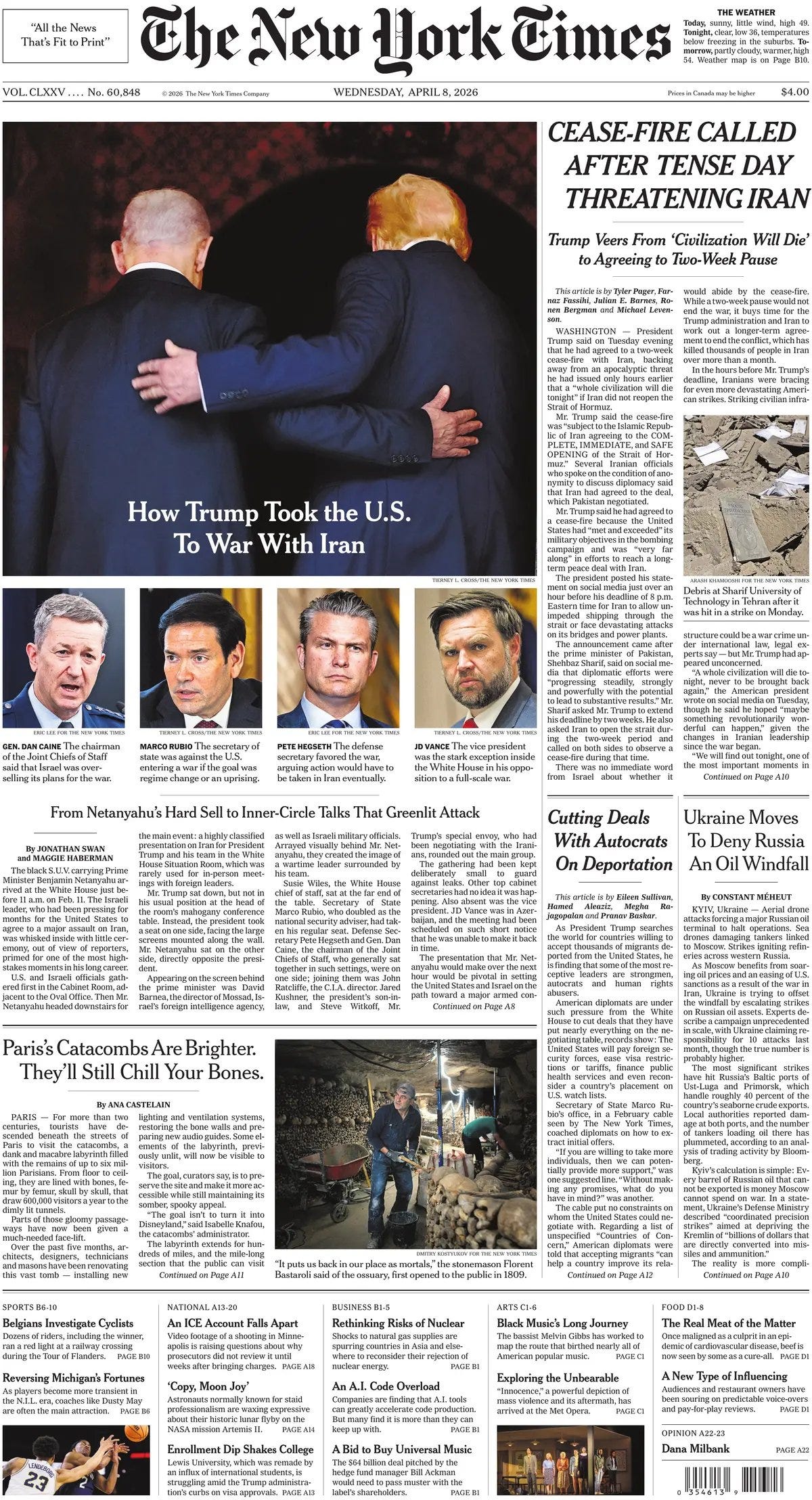
U.S. President Donald Trump and the Iranian government -- along with Pakistan, which acted as a mediator -- announced on Wednesday that the warring parties had agreed to a two-week ceasefire, giving market players a sense of exhilaration. (The Israeli military said on Wednesday, however, that it was continuing “fighting and ground operations” in its war against the Lebanese militia Hezbollah, despite a statement from mediator Pakistan that Lebanon was included in the ceasefire). The news came immediately before trading opened in Tokyo and Seoul, and with the region heavily reliant on the Middle East for energy, stock markets throughout Asia jumped. At the same time, oil prices tumbled. West Texas Intermediate crude futures declined 15%. Brent prices also fell by 15%. Pakistan was able to leverage its good relations with both sides to begin mediating in March. It ended up playing a major role. A Pakistani official told Nikkei Asia that the government “prevailed and succeeded in averting a doomsday scenario” in which Trump would have launched attacks of annihilation against Iran. In Beijing, a foreign ministry spokeswoman said China aims to help “bring a full end to the conflict.” She said the country “maintained communication with all parties” and would continue working to ease tensions. The ceasefire came as Asian governments from Japan to Southeast Asia and India moved to spend billions of dollars in subsidies. Price support payments, tax cuts and cash handouts are all in the works to mitigate the effects of energy shortages. Governments and businesses around Asia welcomed the ceasefire but cautioned it was far from a settlement, expressing concerns about when prewar shipping conditions would return to the Strait of Hormuz. It remains unclear whether tankers and cargo ships will be able to pass freely through the crucial waterway, or whether negotiations scheduled for Friday in Pakistan will lead to a permanent ceasefire - Nikkei Asia
White House Press Secretary Karoline Leavitt says Vice President JD Vance will lead a U.S. delegation to peace talks in Pakistan on Saturday, according to BBC reporting. Vance - who has signalled unease with the Iran strikes - was notably in Hungary at the height of the conflict, fuelling speculation about internal divisions within the administration over the war.
Persian Gulf countries reported dozens of Iranian missile and drone attacks on Wednesday, after a cease-fire was declared between the United States and Iran. Kuwait’s army said in a statement on Wednesday that, since 8 a.m. local time, the country had faced 28 Iranian drone attacks, some of which had targeted “vital oil and power facilities” and caused extensive damage. In the United Arab Emirates, the defense ministry reported 17 ballistic missiles and 35 drone attacks launched by Iran since the beginning of the cease-fire. And the Saudi defense ministry said on Wednesday afternoon that it had intercepted nine drones in recent hours, without naming an attacker. It was unclear why the attacks were continuing, despite the truce and the beginning of what President Trump called “a big day for World Peace.” - NYT
Iran will demand that shipping companies pay tolls in cryptocurrency for laden oil tankers passing through the Strait of Hormuz, as it seeks to retain control over passage through the key waterway during the two-week ceasefire - FT
European leaders have welcomed the US-Iran ceasefire deal, while calling for the reopening of the strait of Hormuz and a permanent end to hostilities, including in Lebanon. France’s president, Emmanuel Macron, welcomed the ceasefire, but called for Lebanon, a former French protectorate, to be included in the deal. He said about 15 countries were mobilised “under French leadership” to facilitate the resumption of traffic through the strait of Hormuz, where around one-fifth of the world’s oil flows. UK Prime Minister Keir Starmer, who is travelling to the Gulf on Wednesday, wrote on X: “Together with our partners we must do all we can to support and sustain this ceasefire, turn it into a lasting agreement and reopen the strait of Hormuz.” - The Guardian
The Human Rights Activists News Agency said at least 1,665 civilians, including 244 children, had been killed in Iran as of Monday. Lebanon’s health ministry on Monday said that more than 1,500 people had been killed in the latest fighting between Israel and Hezbollah. In attacks blamed on Iran, at least 32 people have been killed in Gulf nations. In Israel, at least 20 people had been killed as of Monday. The American death toll stands at 13 service members, with hundreds of others wounded - NYT
European governments have been calling on Mark Rutte to tone down his support for Trump’s decision to attack Iran, saying “this isn’t our war”. Rutte’s approach to Trump has been to speak directly to him and mirror his talking points in public, which has given him privileged access to the president. There is concern that Rutte’s approach may undermine Europe’s position toward the US, with some officials feeling he is too aligned with Washington and occasionally takes Trump’s side against Europe. Despite Rutte’s unique ability to connect with Trump, the US president has cut aid to Ukraine, boosted Russia’s finances and sent the global economy reeling with his war in Iran. There is also concern that Rutte’s Iran war bullishness may have caused Trump to expect NATO would back him, one of the people familiar with the matter who spoke anonymously to describe private conversations said. On Wednesday, Rutte will be at the White House on yet another NATO rescue mission, arriving just moments after Trump announced a tentative, two-week ceasefire with Iran to allow for negotiations - Bloomberg
JD Vance’s visit to Hungary to show support for its far-right leader has been marred by reports that the European country’s government offered support to Iran in the wake of an Israeli attack. A leading member from the pro-Trump Hungarian Prime Minister Viktor Orbán’s government called a top Iranian official in September 2024 following the large scale explosive pager attack that Israel was accused of carrying out in Lebanon against Hezbollah, a group designated a terrorist organization by the U.S. “Our secret service has already contacted your services and we will share all the information we have gathered during the investigation,” Hungarian Foreign Minister Péter Szijjártó told his Iranian counterpart Abbas Araghchi on September 30, according to a transcript obtained by The Washington Post. “Every possible document will be shared with your services.” Details of the call, in which Hungary offered aid to a country the U.S. has been at war with for more than a month, will likely cause further headaches for Vance and the rest of the Trump administration. On the morning of Vance’s Hungary trip, Bloomberg reported that Orbán had called Russian President Vladimir Putin in October 2025 to offer help to Moscow “in any way” to win the war in Ukraine, adding: “In any matter where I can be of assistance, I am at your service.” Vance has also experienced other awkward moments during his European trip. During a “Hungarian-American Friendship Day” rally in Budapest to support Orbán, Vance attempted to call Trump during his speech, but the president did not pick up and the call went to voicemail. Vance eventually managed to get through to Trump after several excruciating seconds of silence on stage - The Daily Beast
The World Health Organization is “devastated to confirm” that a person who was “contracted to provide services” to the UN agency in Gaza was killed “during a security incident”, its chief says. “Following the incident, WHO suspended today’s medical evacuation of patients from Gaza via Rafah to Egypt,” WHO chief Tedros Adhanom Ghebreyesus said in a statement shared on social media, adding that “medical evacuations will remain suspended until further notice”. More than 1,700 healthcare workers, including doctors, nurses and paramedics, have been killed in Gaza since October 2023, according to Gaza’s Ministry of Health - Al Jazeera
Chinese leader Xi Jinping’s purging of a third Politburo member points to the failure of his long-running anti-corruption program, as well as that of the Communist Party’s promotions system, analysts said. Authorities said this week that Ma Xingrui was being probed for graft confirming experts’ suspicion that he was in trouble; he had not been seen in public for months. The ensnaring of top officials indicates that “Xi’s 13 year (!) anti-corruption campaign has not worked” and “the Party’s personnel system is not functioning properly,” analysts at the China-focused research firm Trivium said. Still, as a biographer of Xi wrote in The Wall Street Journal, the campaign may be meeting an unstated goal of keeping officials loyal and on their toes - Semafor
Taiwan opposition leader Cheng Li-wun headed to China on Tuesday at the invitation of President Xi Jinping, in what she call it a “journey for peace” as Beijing calls for the self-ruled island to come under its control. The visit is the first by a Taiwanese opposition leader in a decade and comes ahead of a meeting in Beijing between Xi and U.S. President Donald Trump scheduled to take place in May. Before leaving Taipei, the chairwoman of the Kuomintang told reporters that Taiwan must spare no effort to prevent war and seize any opportunity to promote peace. China claims the self-ruled island as its own territory and has not ruled out the use of force to take it. “The purpose of this visit to mainland China is precisely to show the world that it is not just Taiwan that unilaterally hopes for peace,” Cheng said. “I believe that through this journey for peace, everyone is even more eager to see the sincerity and determination of the CPC Central Committee to use peaceful dialogue and exchange to resolve all possible differences between the two sides,” she added, referring to the initials of the Communist Party of China. A few dozen supporters and detractors of Cheng showed up at Taipei’s airport, chanting and holding signs - Politico
Democracy is strengthening worldwide, according to a leading index, but the improvement is far from universal. Nearly 75% of countries held firm or saw measures of democracy improve, according to the research firm EIU. The most marked growth has been in Latin America and the Caribbean, while current trends bode well for Asia and sub-Saharan Africa. The finding is contested: Sweden’s V-Dem Institute last month said in its annual measure that democratic gains worldwide over the past 50 years had been almost entirely eradicated. And key countries are backsliding. EIU noted democratic declines in the US were “not abating,” while “freedom itself is at stake.” in an election in Hungary this weekend, the Financial Times’ chief economics commentator argued - Semafor
Pilots must be given a “final and non-negotiable” say allowing them to refuse to fly over or within conflict zones without influence from commercial pressures, global union group International Federation of Air Line Pilots’ Associations (IFALPA) said. The position paper from IFALPA comes as the six-week-long Iran war is reshaping airspace across the Middle East and increasing disruptions to flights due to drone and missile attacks and interceptions, heightening safety risks for airline crew members and their passengers. Montreal-based IFALPA said airlines should recognize how conflict zone operations can create mental and emotional strain in the cockpit. “The Commander’s decision regarding the conduct or rerouting of a flight, including refusal to overfly a conflict zone, must be final and non-negotiable,” the paper said. “Additionally, this decision must not be influenced by financial or other incentives, career repercussions or other penalties, or commercial pressures.” While many carriers have canceled services to affected destinations, Dubai-based Emirates is now operating at about 69% of its normal capacity and Qatar Airways at 26%, according to Flightradar24 data. That equates to hundreds of flights per day in airspace that has been targeted by Iranian missiles and drones. The United Arab Emirates has instituted “safe corridors” with specific flight paths, but planes still regularly enter holding patterns during attacks and in some cases have been turned back or diverted to other destinations when airspace was closed temporarily. The IFALPA paper said airlines needed to provide pilots operating in conflict zones with mitigation measures like post-flight recuperation time and confidential support - Reuters
The Associated Press is offering buyouts to an unspecified number of its U.S.-based journalists as part of an acceleration away from the focus on newspaper journalism that sustained the company since the mid-1800s. The news organization is becoming more focused on visual journalism and developing new revenue sources, particularly through companies investing in artificial intelligence, to cope with the economic collapse of many legacy news outlets. Once the lion’s share of AP’s revenue, big newspaper companies now account for 10% of its income. “We’re not a newspaper company and we haven’t been for quite some time,” Julie Pace, executive editor and senior vice president of the AP, said in an interview. Despite changes – the company has doubled the number of video journalists it employs in the United States since 2022 – remnants of a staffing structure built largely to provide stories to newspapers and broadcasters in individual states have remained. That has its roots well back in American history; the AP was started in the mid-19th century by New York newspapers looking to share the costs of reporting outside their immediate territory. The number of AP journalists who will lose jobs is murky, in part intentionally. The AP does not say how many journalists it employs, though it has a large international presence as well as its U.S. staff. Pace said the AP’s goal is to reduce its global staff by less than 5%. The Marketing and Media Alliance estimated the AP had 3,700 staffers, but it was not clear when that estimate was made. Since buyouts are being offered now to only U.S. journalists, it stands to reason that the cut among that workforce will be more than 5%. Whether there are layoffs depends on how many people take the offer, Pace said - PBS
The journals…

Hi Michael, excellent insight to the situation, thanks. I really enjoy the cartoons you post with many of your commentary. Political cartoon satire has a long history, I remember well the drawings of Al Capp. Take care,