World Briefing Hot Take
It was supposed to be Russia’s annual showcase of economic resilience - a signal to the world that despite three years of war and Western sanctions, Moscow remains open for business. Instead, the St. Petersburg International Economic Forum opened Wednesday morning under a thick plume of black smoke, after Ukrainian drones struck a nearby oil terminal and naval hub. The symbolism was hard to miss, even for the 20,000 guests from 130 countries who had gathered for what the Kremlin bills as the “Russian Davos.”
But the smoke over St. Petersburg - a city dear to Vladimir Putin, who once served as its deputy mayor, as I pointed out on BBC World Television today - was just one chapter in a punishing 24-hour news cycle for the Kremlin.
In Washington, a small but significant band of Republican lawmakers broke ranks to advance both an Iran war powers resolution and legislation that could unlock fresh U.S. military aid for Ukraine - a rare bipartisan rebuke of the Trump administration’s hands-off posture. And in Brussels, the EU moved to sanction four Chinese companies accused of fueling Russia’s war machine, doubling down on its strategy of going after Moscow’s enablers even as Beijing warned of consequences.
The centerpiece of the U.S. Ukraine Support Act is a sweeping sanctions package aimed squarely at Russia’s oil and gas sector - the Kremlin’s primary wartime revenue engine. The bill would tighten restrictions on financial institutions doing business with sanctioned Russian entities, crack down on sanctions evasion, and - critically - target the Chinese firms, Central Asian banks, and other third-party actors that have helped Moscow keep the money flowing despite existing Western restrictions. It would also eliminate a sanctions waiver Trump quietly approved earlier this year. On the aid side, the legislation would authorize roughly $1.8 billion in direct spending and more than $8 billion in loans for Ukraine’s war effort.
The bill still faces a difficult path. Senate divisions over the sanctions package and near-certain White House opposition - Trump has repeatedly signaled he doesn’t want Congress tying his hands in negotiations with Moscow - could yet kill it. But the 218-to-204 vote to advance it, secured through a rare procedural maneuver called a discharge petition that bypassed Republican leadership entirely, sends an unmistakable message: bipartisan patience with the Kremlin is wearing thin, and so is deference to Trump on Ukraine.
And it raises an uncomfortable question closer to home: if Washington and Brussels are tightening the screws, where is Canada? As I have noted repeatedly on international television, Canada remains the only G7 nation not to have expelled a single Russian diplomat - a staggering omission for a country that prides itself on standing with Ukraine. With the U.S. and EU raising the pressure bar this week, Ottawa’s inaction looks less like restraint and more like negligence. Expelling diplomats is the lowest of low-hanging fruit in the sanctions toolkit. The only question is what Canada is waiting for.
Bottom Line: Moscow walked into its own showcase event this week and found smoke in the sky, defectors in Washington, and its Chinese lifeline under fresh scrutiny in Brussels. For a Kremlin that has bet heavily on Western disunity, that’s a bad day at the office.
News briefs
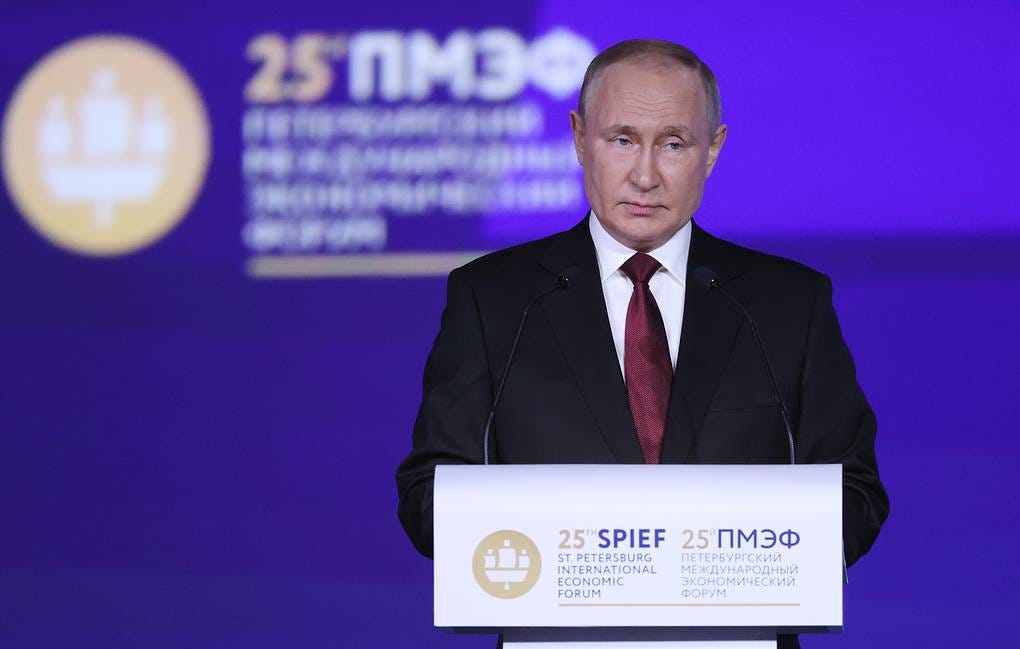
The annual St. Petersburg International Economic Forum (SPIEF) opened on Wednesday under a cloud of black smoke after Ukrainian drones struck a nearby oil terminal and naval hub earlier in the morning. Some 20,000 guests from 130 countries are expected to attend SPIEF, a flagship business and investment event known as the “Russian Davos,” which runs through Saturday at the Expoforum Convention and Exhibition Center. This year’s theme, “Pragmatic Dialogue: the Path to a Stable Future,” leans heavily on Russia’s relations with the Global South and expanding technologies like artificial intelligence. As with previous years since the 2022 invasion of Ukraine, Western companies and business leaders will be largely absent from SPIEF. President Vladimir Putin will deliver his annual keynote speech during the plenary session on Friday. He will be joined by the presidents of Uzbekistan and Tanzania, as well as Chinese Vice President Han Zheng and Saudi Energy Minister Abdulaziz bin Salman Al Saud. The Saudi delegation is featured as the “guest of honor.” Around 200 officials and corporate executives are representing the kingdom at SPIEF. UN Secretary General Antonio Guterres will speak at a panel on the environment on Friday. While Russia’s war against Ukraine is not mentioned in the SPIEF 2026 program, attendees needed only to look up at the sky above St. Petersburg on Wednesday morning, filled with black smoke from Ukrainian drone strikes, to be reminded that the conflict continues to rage. “The Petersburg forum is opening with a nice plume of black smoke in the background after Ukrainian strikes,” wrote Serhii Sternenko, an adviser to the Ukrainian defense minister. An employee at one of Russia’s largest banks described the atmosphere at this year’s SPIEF as “the most stifling” he had experienced in six years of attending the event. “Participants and colleagues spent the whole morning discussing the smoke from the fire that blanketed the sky right above the exhibition center,” he told The Moscow Times, speaking on condition of anonymity for safety reasons. “Some people are joking, but mostly everyone is pretty gloomy because St. Petersburg has never been hit this hard before.” The employee said SPIEF organizers were trying to downplay the impact of the attacks, and that his company’s management had instructed staff to avoid words or phrases that might remind visitors of drone strikes. “Words like ‘explosive forum’ or ‘bomb,’ which in slang means ‘cool’ and ‘awesome,’ are off limits,” he said. “More generally, we’re supposed to project optimism, [because] the forum is the vanity fair of Russian economy. But pretending that everything is great gets harder and harder every year. Nothing is great at all!” Ukraine said its drones struck a warship at the Kronstadt base of the Russian Navy’s Baltic Fleet, as well as an oil terminal not far from where SPIEF is being held - Moscow Times
Several Republican lawmakers joined House Democrats on Wednesday afternoon to pass a resolution to force the Trump administration to end its war against Iran and to advance legislation to support Ukraine in its fight against Russia. Four Republicans crossed party lines to support the Iran war powers resolution, including Reps. Thomas Massie (Ky.), Brian Fitzpatrick (Pa.), Tom Barrett (Mich.) and Warren Davidson (Ohio). Additionally, six GOP lawmakers voted to push through legislation that could authorize more U.S. aid to Ukraine. This clears the way for a vote on the Ukraine Support Act, authored by Rep. Gregory Meeks (D-N.Y.), the ranking member of the House Foreign Affairs Committee. The bill was forced to the floor by an obscure procedural gambit, known as a discharge petition, which requires 218 signatures to compel votes on legislation opposed by the Republican leaders who control the chamber. Last month, Rep. Kevin Kiley, a California Republican-turned-Independent, provided the 218th endorsement, forcing a vote later this week on an issue that has divided the House Republican conference. Republican Reps. Michael McCaul (Texas), Don Bacon (Neb.), Fitzpatrick, Mike Lawler (N.Y.), Max Miller (Ohio) and Joe Wilson (S.C.) all voted in favor of this discharge petition. Bacon called the vote the House’s “Churchill or Chamberlain moment when it comes to helping a democracy and standing up to an invading thug,” in a social media post on Tuesday, in a reference to the two British political leaders Winston Churchill and Neville Chamberlain. Chamberlain pursued a peacekeeping approach with Nazi Germany leader Adolf Hitler, while Churchill was an outspoken opponent to this regime. “Tonight we chose Churchill,” Bacon wrote in the post. “We are not done yet, though. We have two more votes before this fully passes the House. Moral clarity and freedom must win.” - The Hill
The EU is pushing to sanction four Chinese companies it accuses of supporting Russia’s war against Ukraine, according to documents seen by POLITICO. The four firms, likely to be included in the latest package of sanctions due to be approved at a gathering of EU foreign ministers next week, assist Russia’s shadow fleet, providing chemicals for Russia’s military and delivering components Moscow uses to build attack drones, officials said. The move is likely to feed into rising tensions between Brussels and Beijing as European Commission President Ursula von der Leyen seeks the backing of EU capitals for a major crackdown on subsidized Chinese imports. Last week, China said it would take “resolute countermeasures and effective steps to safeguard its own interests” if the EU imposed additional trade restrictions. The EU has targeted Chinese firms in previous rounds of sanctions, but the latest proposals show the bloc doubling down on its strategy of going after Russia’s enablers despite China warning of “consequences” over measures included in the EU’s 20th round of Russia sanctions. In addition to the four Chinese firms, the document proposes sanctions against five firms located in the United Arab Emirates, three in Turkey and one in Azerbaijan, all of which are described as facilitating Russian shipping and energy sales. It also proposes sanctioning subsidiaries of Russian company Lukoil, as well as dozens of individuals and firms described as supporting Moscow’s war machine. The list is part of a “rolling” sanctions approach whereby entities are added or removed based on how Russia is changing its tactics to avoid sanctions.
Putin’s Attacks On Ukraine Are Payback For Fuel Shortages | Michael Bociurkiw
VIDEO: “This is the first time in Russian history that Putin has banned the export of jet fuel.” Putin’s strikes on Ukraine are “pay back” after the Ukrainians have reduced Russia’s refining capacity by a third, says senior fellow at the Atlantic Council’s Eurasia Center Michael Bociurkiw. He was speaking to Neil Breakwell on Times Radio.
Iranian drones heavily damaged a passenger terminal at Kuwait’s main airport Wednesday, killing one person, wounding dozens and briefly closing the airfield — the latest in back-and-forth attacks by Iran and the U.S. that test a fragile ceasefire. The strike reinforced the risks to residents and travelers in Gulf countries that had considered themselves relative havens before the U.S.-Israeli war with Iran. Iran denied causing the damage. Talks have dragged on for weeks as mediators seek a more enduring truce in the war, now in its fourth month. They are increasingly strained by Israel’s broadening war with Iran-backed Hezbollah militants in Lebanon. A regional official said Iran wanted a separate ceasefire in Lebanon enforced before returning to talks. President Donald Trump said negotiations continue to extend the Iran ceasefire, even as the U.S. launched strikes against military sites on an Iranian island - AP
Help Us Keep Connecting The Dots
For more than three decades, I’ve reported from conflict zones, humanitarian crises, and geopolitical flashpoints — and World Briefing is how I continue that mission independently. No editors second-guessing the story. No algorithms deciding what matters. Just rigorous, on-the-ground analysis delivered straight to your inbox.
If you find this reporting valuable, please consider upgrading to a paid subscription — or support World Briefing at your own level via PayPal.
At a time when foreign coverage is shrinking and misinformation is filling the void, your support helps keep independent global journalism alive and in the field.
Thank you for reading, sharing, and being part of this community.
Recent reports highlight a surge in militarized playgrounds appearing throughout Russia as the war in Ukraine continues to influence domestic life. These recreational areas feature factory-made equipment modeled after tanks, rocket launchers, and fighter jets, often adorned with patriotic slogans. While war-themed play structures existed sparingly in the past, their municipal funding and widespread installation have increased significantly following the full-scale invasion. Experts suggest these designs are less about child development and more about local officials demonstrating political loyalty to the central government. Consequently, the previous public debate regarding the appropriateness of such themes has largely vanished due to a crackdown on anti-war dissent. Ultimately, these spaces serve as a visual tool for integrating military imagery into the everyday environments of Russian children.
Some politicians and business leaders are claiming that China is driving the American backlash to data centers. A Republican lawmaker on Wednesday called for legal action against US nonprofits that he alleged are backed by China to sow opposition to the AI buildout. Canadian millionaire Kevin O’Leary recently claimed “nefarious accounts” linked to Beijing were behind the pushback to a data center project he’s backing. But the idea that foreign influence is seeding a populist campaign against AI facilities is far-fetched, experts told Semafor last month, noting that Chinese media is instead likely exploiting existing US divisions over the tech. The accusations reflect China’s growing role in US tech discourse, as the superpowers’ AI race heats up - Semafor
Germany failed for the first on Wednesday time to secure a seat on the UN Security Council, with Portugal and Austria receiving more votes for the two Western European spots starting in 2027. The UN Security Council has 15 members: five permanent - the United States, Russia, China, France and the United Kingdom - and 10 elected for staggered two-year terms, with seats allocated for different world regions. In secret ballots cast by the General Assembly for the European seats, Portugal and Austria received 134 and 131 votes respectively. Germany, which has already served six terms, received 104. A member of the G7, Germany is Europe's largest economy and seen as the continent's political and security anchor. Zimbabwe, the sole candidate for an African seat, was elected with 182 votes, while Trinidad and Tobago, also facing no competition, secured the Latin American and Caribbean group seat with 181 votes. A second round was under way on Wednesday to decide between the Philippines and Kyrgyzstan for the seat allocated to Asia. The five elected countries will replace Pakistan, Somalia, Greece, Denmark, and Panama starting 1 January 2027. They will join the five other members elected for the 2026–2027 term: the Democratic Republic of the Congo (DRC), Liberia, Latvia, Colombia and Bahrain - Euronews
President Trump on Wednesday attacked CNN’s Kaitlan Collins, accusing her of having “hatred in her eyes,” while he took questions from reporters in the Oval Office. The president was answering a question about the recently defunct “anti-weaponization” fund, which he called “a beautiful thing.” He then attacked CNN, calling the network “crooked as hell” and “a very corrupt organization” before he turned his attention to Collins. “But with a corrupt reporter standing right there, never smiles,” he said. “You never see a young, beautiful woman who never smiles. I never see a smile on her face. I see her standing there with hatred in her eyes.” Trump claimed she has “hatred because we have borders, because we have a strong military, because we cut our taxes, because we do things that everybody wanted, and then we win our election in a massive landslide.” He again attacked CNN minutes later after the topic returned to the “anti-weaponization” fund and accused the outlet and The New York Times of abusing “our people so badly.” Collins tried to cut in but Trump tersely told her to “be quiet.” “You used to be a conservative,” he continued. “She was a conservative from Alabama. Can you believe it? The president turned his attention back to CNN and said that “it has new ownership, so maybe it’ll straighten it out. I doubt it. But it’s so hard to straighten garbage out.” He was likely referring to Paramount, led by Trump ally David Ellison, acquiring Warner Bros., CNN’s parent company. “Kaitlan Collins is an exceptional journalist, reporting every day from the White House and the field with real depth and tenacity,” a CNN spokesperson said in a statement to The Hill - The Hill
The journals…..